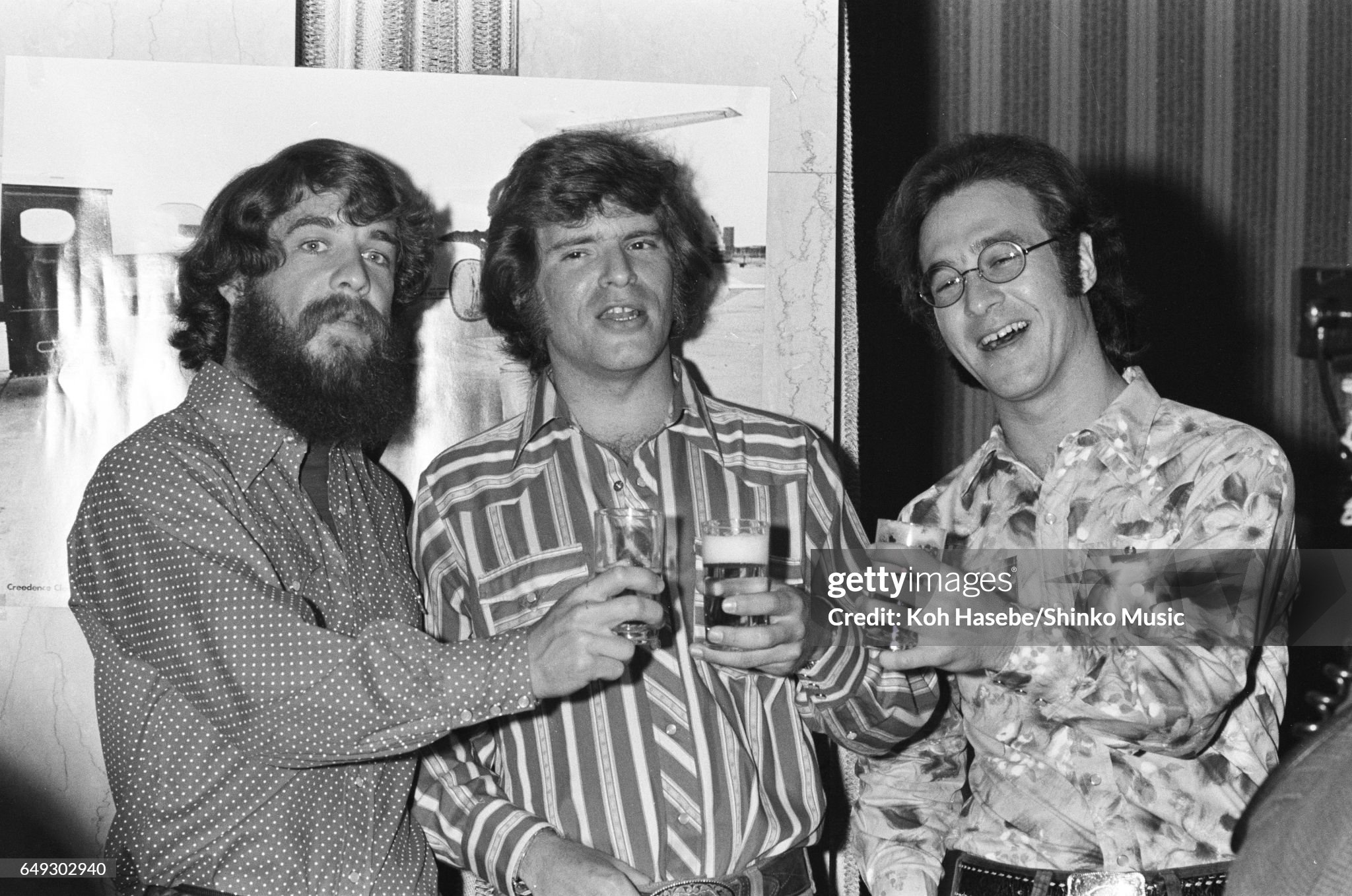
On an album crowded with motion and swagger, “Graveyard Train” slows everything down and turns Creedence Clearwater Revival toward something heavier, older, and far more ominous.
When Creedence Clearwater Revival released Bayou Country in 1969, the record quickly became associated with the songs that moved fast and hit hard: “Proud Mary”, “Born on the Bayou”, the sense that this California band had somehow tapped into an older American current and made it feel urgent again. But sitting deeper in that album is “Graveyard Train”, a track that stretches past eight minutes and refuses the clean economy of a hit single. Written by John Fogerty, it is one of the most absorbing slow burns in the group’s catalog, a blues dirge carried not by ornament but by insistence, mood, and the long shadow of Fogerty’s harmonica.
That is what makes the song so striking in the context of Bayou Country. The album is often remembered as the moment when Creedence sharpened its identity, but “Graveyard Train” reveals how much of that identity depended on atmosphere as much as attack. This is not simply a long track placed on side two to fill space. It feels like a deliberate descent. The band takes a familiar American image—the train, the night, the distant pull of something relentless—and turns it into a piece of music that seems to move by its own grim mechanics.
John Fogerty’s harmonica is the key to that effect. In many rock records, harmonica arrives as a burst of color, a nod to roots music, a rough edge laid over the arrangement. Here it does more than decorate the song. It becomes part of the machinery. The lines rise and cut through the track like a warning carried over steel and smoke, less a solo than a signal. The instrument gives “Graveyard Train” its haunted center, but not in a theatrical way. What Fogerty does is simpler, and more unsettling: he lets the harmonica keep returning like a sound from somewhere beyond the frame, something inevitable and already in motion.
The rest of the band understands exactly what kind of pressure the song needs. Stu Cook and Doug Clifford keep the rhythm grounded and patient, never rushing the mood, while the guitars work in rough, repeating figures that make the track feel both rooted and uneasy. That patience matters. A lesser band might have treated the song’s running time as an excuse to sprawl. Creedence does the opposite. They tighten the groove until repetition itself becomes expressive. The song does not wander; it advances. Slowly, steadily, almost without mercy.
That slow advance is part of why the song lingers. “Graveyard Train” is not built around the kind of chorus that leaps out on first listen. It gets under the skin through accumulation. Each pass through the groove adds weight. Each return of the harmonica thickens the air. By the time the track has fully settled in, it feels less like a performance than an environment. You are no longer hearing a band demonstrate its command of blues-based rock. You are hearing a band create a landscape and stay inside it long enough for the details to turn strange.
As an album deep cut, the song also says something important about Creedence Clearwater Revival at this stage of their career. In 1969, the group was moving fast, and the public story would soon become one of extraordinary run, radio staples, and a catalog packed with instantly recognizable songs. Yet records like Bayou Country mattered because they held more than the obvious singles. They showed that the band’s power did not depend only on speed, hooks, or concise songwriting. “Graveyard Train” proves they could sustain tension over a long form without losing shape, and that they understood how deeply American folk images could be transformed by texture, restraint, and repetition.
It also reveals how unusual Creedence really was. They were not southern blues traditionalists, and they were not psychedelic wanderers, even in an era full of extended tracks. What they did on “Graveyard Train” was something more focused. They borrowed from the language of blues, railroad mythology, and back-porch unease, then filtered it through the band’s own stripped-down discipline. The result is a song that feels old without sounding archival, cinematic without becoming inflated, and dark without losing its physical drive.
That may be why the song continues to draw listeners back, especially those who already know the famous Creedence singles by heart. A track like “Proud Mary” announces itself immediately. “Graveyard Train” takes its time and asks for a different kind of attention. It reminds us that some of the most revealing moments in a great band’s catalog are not the ones that raced onto the radio, but the ones buried a little deeper in the album sequence, waiting for the right mood and the right listener.
On Bayou Country, that deep place belongs to “Graveyard Train”. It is a long, heavy, stubborn piece of music, and all the better for refusing to charm. With John Fogerty’s harmonica acting like a distant beacon through the murk, the song becomes more than an extended blues exercise. It becomes a study in pressure, motion, and the eerie discipline of a band that knew exactly how to make repetition feel alive. Long after the album’s brightest moments have flashed by, this is the sound that keeps rolling somewhere in the background, steady as a wheel on the track.
