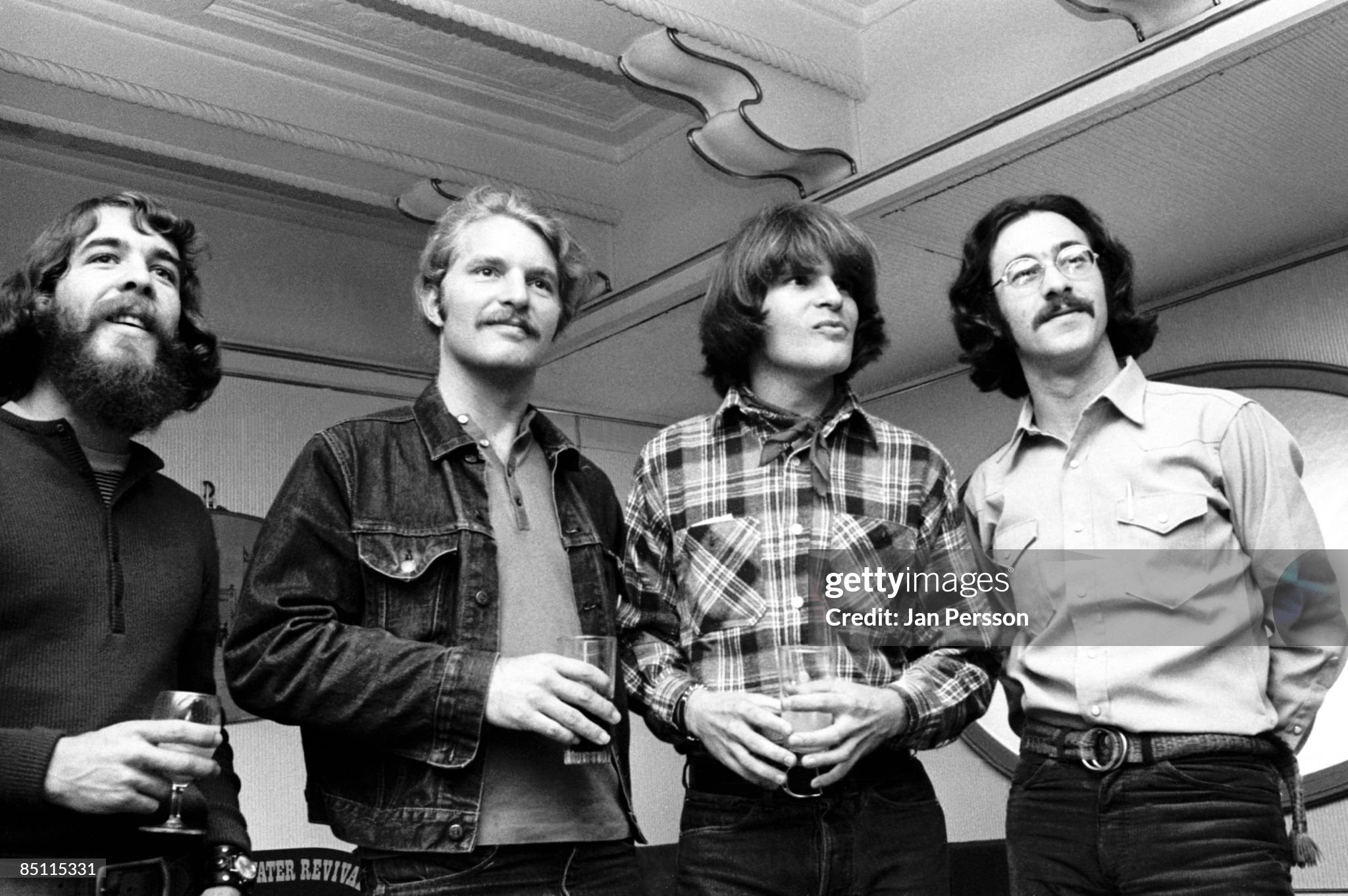
Before Creedence Clearwater Revival found the sound that would soon define them, “Walk on the Water” stood at the edge of two identities, carrying the last echo of The Golliwogs into a new era.
When Creedence Clearwater Revival released their self-titled debut album in 1968, “Walk on the Water” was already carrying history inside it. The song was not simply another album track from a young American band still feeling its way forward. It was a re-recording of “Walking on the Water,” a 1966 release from the group’s earlier incarnation, The Golliwogs. That alone makes it one of the most revealing recordings in the band’s catalog. Long before the swampy attack of “Proud Mary” or the rough authority of Bayou Country, this song captured a group in transition, with one foot in the garage-band shadows of the mid-1960s and the other stepping toward the leaner, harder identity that would soon make them unmistakable.
The story matters because Creedence Clearwater Revival did not arrive from nowhere. Before they became one of the most distinctive bands of their time, John Fogerty, Tom Fogerty, Stu Cook, and Doug Clifford had already spent years learning how to survive the changing currents of American rock. Under the name The Golliwogs, they made records during a period when labels often pushed young bands toward British-influenced sounds, fashion, and even names that concealed where they really came from. By the time the group reemerged as Creedence Clearwater Revival, something had sharpened. The songs were becoming more direct. The identity was becoming less borrowed. “Walk on the Water” sits right in that moment of clearing vision.
You can hear the difference in the way the 1968 version carries itself. It is still rooted in the jangling, slightly psychedelic atmosphere of the late 1960s, but it also points toward the economy that would become one of the band’s great strengths. The arrangement feels tighter, less decorative, more committed to groove and attack. The guitars no longer seem to be searching for a style so much as narrowing one down. Even before Creedence reached full command of their swamp-rock language, the record suggests a band learning that power often comes from stripping away rather than piling on.
John Fogerty’s vocal is especially revealing here. He does not yet sound exactly like the hard, weathered presence that would drive the group’s most famous singles, but the shape of that voice is already emerging. There is a tension in his delivery, a refusal to smooth every edge, that gives the song its importance. He sounds like someone moving away from imitation and toward ownership. That may be the deepest reason the track endures. It is less about perfection than about recognition. You can hear a musician discovering which parts of himself belong on the record and which can finally be left behind.
Lyrically, “Walk on the Water” has the dreamlike, slightly elusive quality common to its era, but that only adds to its strange place in the band’s history. The title suggests confidence, impossibility, performance, and illusion all at once. In retrospect, that feels fitting. The band itself was crossing water of a kind, trying to move from the uncertain terrain of regional singles and label pressures into a sound that could hold its own weight. The song does not yet deliver the clean narrative force of later Creedence writing, but it offers something equally valuable: the atmosphere of becoming.
There is also something moving about the fact that the band chose to bring this earlier song with them onto the debut album. Young groups often try to erase their formative years once a stronger identity appears. Creedence Clearwater Revival did something more interesting. By re-recording “Walking on the Water” as “Walk on the Water,” they left a trace of the road behind them. The debut album becomes more than a first statement. It becomes a document of continuity, proof that the celebrated band did not replace The Golliwogs so much as grow out of them.
That is why the track feels richer than its place in the catalog might suggest. It is not usually the first song named when people talk about Creedence Clearwater Revival, and that is understandable. Their later run would be so concentrated, so forceful, that many early recordings now seem like preludes. But some preludes matter because they tell the truth about how a sound is formed. “Walk on the Water” is one of those. It lets us hear the band before the mythology settled in, before the image hardened, while the past was still audible in the present tense.
On the 1968 debut, the song stands like a narrow bridge between names, styles, and ambitions. Behind it is the long apprenticeship of The Golliwogs, with all the compromises and experiments that young bands absorb. Ahead of it is the remarkable concentration of Creedence at full strength, when the songs would sound as if they had always existed and the band had merely uncovered them. In between sits this recording: restless, transitional, and quietly revealing. Not yet the full storm, but the pressure in the air just before it breaks.
That is part of the pleasure of returning to early roots material. It reminds us that even the most self-assured bands once had to become themselves in public. “Walk on the Water” preserves that process with unusual clarity. It is a song about crossing over in more ways than one, and nearly six decades later, it still carries the excitement of a group hearing its real voice coming into focus.
