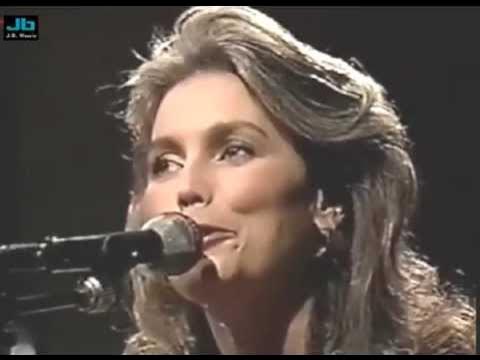
Where Will I Be opens Wrecking Ball like a question hanging in dusk, and in that suspended first moment Emmylou Harris steps into one of the boldest reinventions of her career.
When Emmylou Harris released Wrecking Ball in 1995, the change was immediate. The album’s opening track, Where Will I Be, did not greet listeners with the clean lines of traditional country production or the bright certainty of a familiar Nashville arrangement. Instead, it arrived in layers of echo, low-moving rhythm, and atmosphere, with Harris’s voice floating inside the sound rather than standing sharply above it. Produced by Daniel Lanois, the recording announced that this was not simply another strong Emmylou Harris album. It was a new frame around a voice people thought they already knew.
That mattered because Harris had already built one of the most admired catalogs in American music. By the mid-1990s, she was long established as an artist whose work connected country, folk, bluegrass, and rock with rare grace. Her earlier records had shown precision, poise, and deep feeling, whether she was singing heartbreak, tradition, or harmony. But Wrecking Ball did something more radical than update her sound. It placed her in a wider, stranger landscape. On Where Will I Be, the old strengths remain fully intact: the clarity of her phrasing, the steadiness of her emotional tone, the sense that she never reaches for effect. What changed was the space around her. Lanois gave the song a horizon.
By the time he worked with Harris, Daniel Lanois was already known for records that felt less built than conjured. His production often favored mood over neat separation, texture over polish, and a kind of sonic weather that could make a song feel half remembered and fully present at the same time. That approach was perfect for Where Will I Be. The track moves like a slow current. The rhythm does not push; it breathes. The guitars shimmer and recede. The atmosphere feels almost physical, as if the song has air, distance, and shadow inside it. Harris’s voice becomes the one sure light in that terrain, not because it is oversized, but because it is calm.
What makes the performance so striking is its restraint. Harris never oversings the uncertainty in the lyric. She lets the question of the title remain open, unresolved, and suspended. That choice is essential to why the recording still feels so modern. Where Will I Be is not trying to deliver a grand climax. It lives in motion, in doubt, in the feeling of standing between one self and another. As an opening track, it tells the listener almost everything about Wrecking Ball. This is an album that trusts atmosphere, ambiguity, and emotional patience. It is willing to let silence and echo carry as much meaning as a direct statement.
The album around it deepened that impression. Wrecking Ball drew from a remarkable range of writers, including Neil Young, Steve Earle, Julie Miller, Lucinda Williams, Bob Dylan, Gillian Welch, and Jimi Hendrix. Yet despite the variety of material, the record holds together as a single nocturnal atmosphere. Where Will I Be is the doorway into that world. Before the title track arrives, before Harris sings “All My Tears” or “Sweet Old World,” this first song establishes the emotional weather of the whole album. It says that tradition is still here, but it is now filtered through distance, memory, and reverberation.
That is why the song became such an important marker in Harris’s story. Reinvention in popular music is often discussed as if it must be loud, dramatic, or oppositional. Emmylou Harris chose something subtler. She did not reject her roots. She allowed them to be heard differently. Where Will I Be is full of the qualities that had always made her compelling, but Lanois placed those qualities inside a more cinematic setting, one that connected her not only to country tradition but to the alternative and roots-minded currents that were reshaping American music in the 1990s. For many listeners, Wrecking Ball became the record that revealed how expansive her art could be without losing its center.
Nearly three decades later, the opening of Where Will I Be still feels like a threshold. You hear an artist entering a new room without announcing it, and that quiet confidence is part of the song’s power. Nothing is forced. Nothing feels like a bid for relevance. The transformation happens through sound, patience, and trust. Emmylou Harris sings as if she has seen farther than the arrangement can show, while Daniel Lanois surrounds her with a landscape large enough to hold uncertainty, memory, and grace all at once. That is why the track remains more than an album opener. It is the moment Wrecking Ball reveals its secret: reinvention does not always arrive like impact. Sometimes it arrives like mist, and changes the whole view before you realize it has happened.
