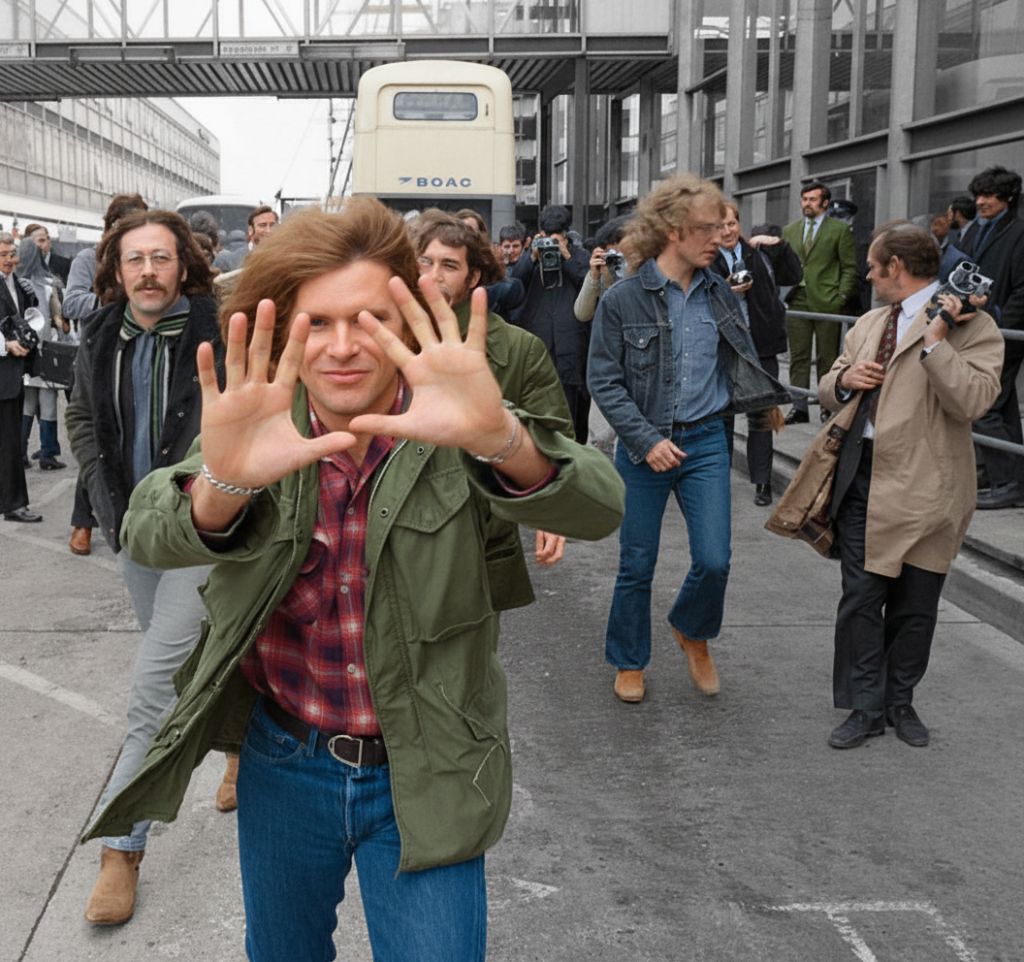

On Cosmo’s Factory, John Fogerty and Creedence Clearwater Revival did not simply cover I Heard It Through the Grapevine; they stretched it into an 11-minute swamp-rock trance and gave a familiar classic an entirely new pulse.
When Creedence Clearwater Revival unveiled their version of I Heard It Through the Grapevine on Cosmo’s Factory in 1970, they were operating from a place of unusual confidence. The album itself rose to No. 1 on the Billboard 200 and stayed there for nine weeks, confirming just how completely CCR had come to dominate American rock in that season. Yet this was not one of the album’s tidy hit singles. It was a long, smoldering, just-over-11-minute performance that belonged to the growing freedom of the album era. That mattered. And so did what happened next: in 1976, after the band had already broken apart, an edited version was finally issued as a single and climbed to No. 43 on the Billboard Hot 100. Not many tracks built that way survive the trimming. This one did, because the heart of the performance was too strong to disappear.
To understand why CCR’s reading still feels so distinctive, it helps to remember what song they were touching. I Heard It Through the Grapevine was written by Norman Whitfield and Barrett Strong, and by the time CCR recorded it, the composition was already deep in popular memory. Gladys Knight & the Pips had taken it to No. 2 on the Billboard Hot 100 and No. 1 on the R&B chart in 1967. Then Marvin Gaye transformed it again in 1968, turning the song into one of Motown’s great slow-burning masterpieces; his version spent seven weeks at No. 1 on the Hot 100. In other words, John Fogerty was not covering some overlooked B-side. He was stepping into a room that already held giants.
That is what makes the reinvention so impressive. Many bands, faced with a song that iconic, would have settled for respectful imitation. CCR did the opposite. They kept the lyric’s unease, but they changed the air around it completely. The polished tension of Motown became something rougher, more open-ended, more road-worn. Stu Cook‘s bass locks into a relentless pattern, Doug Clifford‘s drums keep the groove steady without ever sounding stiff, and the guitars circle and repeat until the song feels less like a neat pop narrative and more like a thought you cannot shake loose. What once sounded urban, elegant, and controlled now moved like heat above blacktop.
John Fogerty‘s vocal is the key to that transformation. He does not try to out-soul Marvin Gaye, and he wisely does not try to imitate Motown phrasing. Instead, he sings with grit, urgency, and a kind of weathered insistence. In his hands, the song’s pain is not silky or private. It is restless. It keeps moving. The suspicion inside the lyric becomes something nearly physical, as if the singer is walking with it, driving with it, carrying it mile after mile. That is why the long running time never feels wasteful. The band is not merely extending the track; they are letting the anxiety of the song breathe, stretch, repeat, and deepen.
There is also something revealing about where this performance sits inside Cosmo’s Factory. This was an album loaded with concision and power, packed with songs such as Travelin’ Band, Who’ll Stop the Rain, Up Around the Bend, Run Through the Jungle, Lookin’ Out My Back Door, and Long as I Can See the Light. In that company, an 11-minute cover could easily have felt self-indulgent. Instead, it showed another side of CCR’s gift. They could be brutally efficient, yes, but they could also build atmosphere without losing shape. Even at its most extended, this performance never drifts. It stays locked to the groove, patient and sure of itself, proving that discipline and looseness do not have to be enemies.
The song’s meaning changes as the arrangement changes. In the Motown world, the grapevine is a network of whispers, gossip, and emotional shock arriving secondhand. In the CCR version, the same idea feels broader and lonelier. The song becomes less about one rumor and more about the way doubt keeps turning over in the mind. That is why this cover reinvention continues to matter. It did not improve the original by trying to erase it. It honored the original by discovering another truth inside it. The lyric remained wounded, but the landscape became American rock: humid, dark, repetitive, and impossible to dismiss.
When the shortened 1976 single finally appeared, it served as a reminder of just how durable the performance had been. Radio could slice it down, but it could not remove the personality that made it memorable in the first place. The album version remains the real statement, of course. That is where the full spell lives. Still, the single’s chart run showed that people were hearing more than a cover. They were hearing a band take a familiar song and move it into another tradition altogether.
That may be the lasting beauty of Creedence Clearwater Revival‘s I Heard It Through the Grapevine. It stands as one of those rare recordings that reminds us how a great cover works. It does not bow too low. It does not copy the furniture in the room. It walks in, opens the windows, changes the weather, and somehow leaves the song even larger than it was before. On Cosmo’s Factory, John Fogerty and CCR did exactly that, and more than five decades later, the groove still rolls forward with the same stubborn, hypnotic force.
