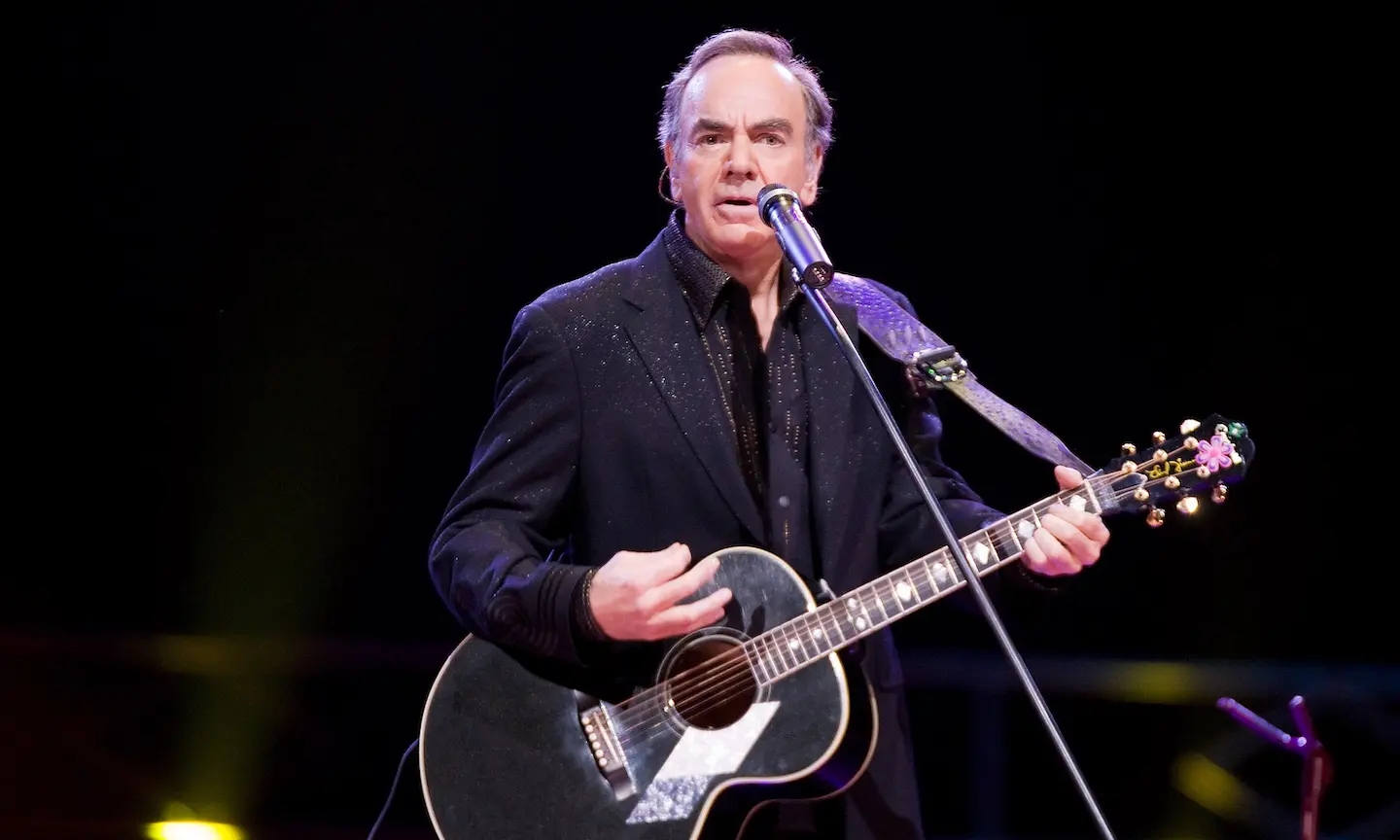
On Neil Diamond’s 1993 salute to the Brill Building, “You’ve Lost That Lovin’ Feelin’” stopped being a single cry of longing and became a duet between two artists who knew how much feeling can live inside restraint.
When Neil Diamond recorded “You’ve Lost That Lovin’ Feelin’” with Dolly Parton for his 1993 album Up on the Roof: Songs from the Brill Building, he was not simply revisiting a familiar old pop standard. He was stepping back into the songwriting world that had shaped him. Before Diamond became an arena headliner and one of the most recognizable voices in popular music, he had his own history in the Brill Building orbit, where New York songwriters and publishers turned out some of the most durable songs of the postwar era. That makes the album feel less like a covers project and more like a homecoming. In that setting, choosing this song and inviting Parton into it gave the performance an added layer of meaning.
The song itself already carried enormous history. Written by Barry Mann, Cynthia Weil, and Phil Spector, “You’ve Lost That Lovin’ Feelin’” first reached the world through The Righteous Brothers in 1964, with Spector’s production turning romantic uncertainty into something almost orchestral in scale. It is one of those records so embedded in memory that many singers approach it carefully, if they approach it at all. The original feels like a plea rising out of panic, a man trying to hold on to a bond he can already feel slipping away. Diamond’s version honors that history, but the presence of Parton changes the song’s emotional geometry from the start.
That is the quiet brilliance of the collaboration. A lyric that often lands as a one-sided appeal becomes, in duet form, something more complicated and more adult. Instead of a solitary voice staring into the end of a relationship, the recording sounds like two people standing inside the same silence, hearing it differently. Neil Diamond brings his familiar dark warmth, that grain in the voice that can suggest confidence and vulnerability at the same time. Dolly Parton, with her bright phrasing and unmistakable lift, does not soften the song so much as sharpen its human contours. She is not there as decoration, and not merely as a star guest. She becomes the other half of the scene.
That matters because Parton and Diamond came from different musical roads, yet both built careers on direct communication. Diamond’s pop writing often married grandeur to intimacy; Parton’s best recordings could make plainspoken lines feel piercingly personal. Put them together on a song this famous, and the tension becomes less about vocal power than about perspective. Their voices do not blend by erasing their differences. They blend by keeping those differences audible. His tone is grounded, conversational, slightly weathered. Hers rises with clarity and emotional poise. The contrast gives the performance an unforced dramatic shape, and it lets the listener hear the song less as theater and more as relationship.
Up on the Roof: Songs from the Brill Building was built on that kind of understanding. The album was Diamond’s tribute to the writers, rooms, and melodic instincts that helped define a generation of American pop. Songs from that era were constructed with craft, yes, but the best of them also carried adult confusion in deceptively simple language. “You’ve Lost That Lovin’ Feelin’” is a perfect example: the lyric never overexplains itself, yet the ache is immediate. By 1993, both Diamond and Parton had long since become institutions in their own right, and that maturity serves the recording well. They do not sing as if discovering distance for the first time. They sing as if they know how quietly it can arrive.
The arrangement, too, helps place the performance in its own era. Rather than trying to recreate the 1964 record note for note, the track sits in the polished, spacious sound of early-1990s adult pop. The sweep is still there, but it is less about imitating Phil Spector’s wall and more about making room for two established voices. That choice was wise. A strict reconstruction would have turned the song into a museum piece. This version keeps it alive by letting personality do the work. The listener hears not just the composition, but the meeting of two artists with very different histories and a shared respect for strong songs.
There is also something quietly beautiful in the fact that Dolly Parton appears on an album so tied to New York songwriting culture. She brings another American tradition into the frame: country storytelling, mountain directness, the discipline of singing a line so clearly that the emotion does not need ornament. Against Diamond’s urbane melancholy, that presence opens the song outward. It reminds us that great pop writing travels well. A Brill Building classic can hold country feeling; a country voice can deepen metropolitan pop. In that sense, the duet is not a novelty pairing at all. It is a meeting place.
That is why this recording still lingers. Not because it tries to outdo the original, and not because celebrity duets are automatically memorable, but because it hears an old song from a wiser angle. On Up on the Roof, Neil Diamond was paying tribute to a world that helped make him. By bringing in Dolly Parton for “You’ve Lost That Lovin’ Feelin’”, he turned one of pop’s great laments into something more conversational, more tender, and in some ways more revealing. The song still carries loss, but it also carries recognition. And sometimes that is the deeper feeling: not the first moment love fades, but the calm, unmistakable sound of two voices knowing it.
