
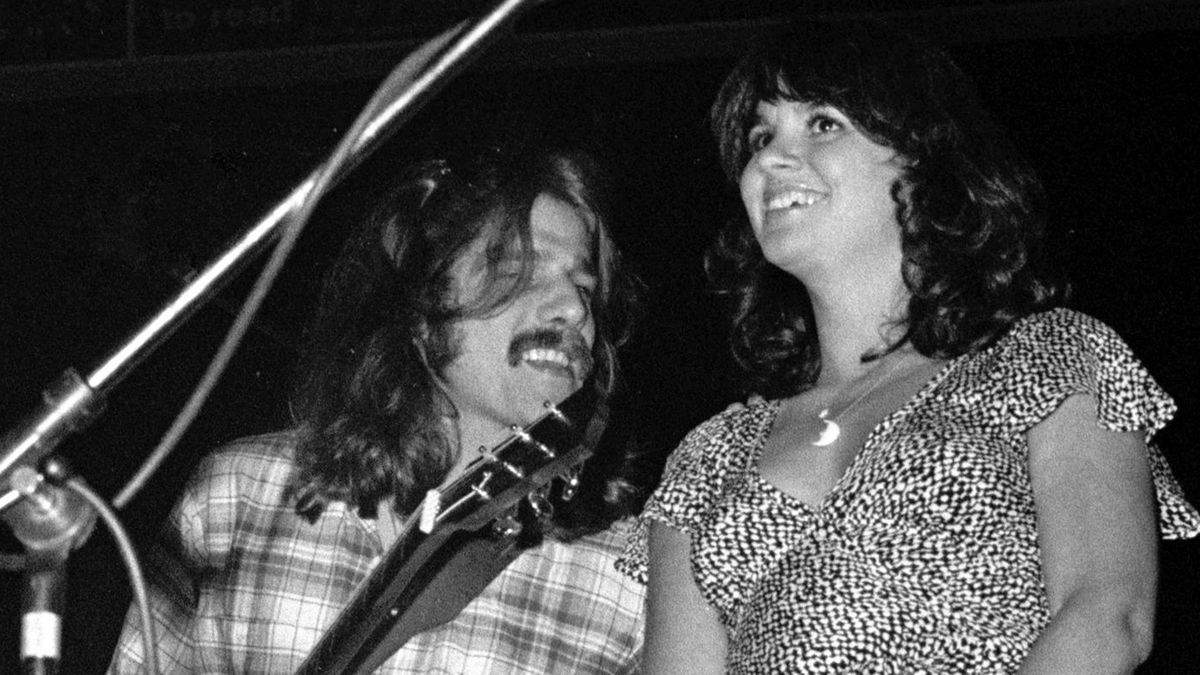
The title sounds plain, almost stubbornly plain, but “I Can’t Let Go” is not simple at all. In Linda Ronstadt’s hands, it becomes the sound of love after pride has failed—when the heart is no longer trying to win, only trying to survive what it cannot release.
When Linda Ronstadt recorded “I Can’t Let Go” for Mad Love in 1980, she was standing at a turning point. This was not another easy extension of the warm California country-rock image that had already made her one of the biggest singers in America. Mad Love was her sharper, riskier record—released in February 1980, produced by Peter Asher, and built in part around a leaner, more new-wave-tinged sound. The gamble worked: the album climbed to No. 3 on the Billboard 200, and “I Can’t Let Go,” released as the third single, reached No. 31 on the Billboard Hot 100 in the summer of 1980.
That chart story matters, but the deeper story lies in the song itself. “I Can’t Let Go” was not a Ronstadt original. It was written by Chip Taylor and Al Gorgoni, first recorded by Evie Sands in 1965, then turned into a major 1966 hit for The Hollies, whose version reached No. 2 in the UK. Ronstadt came to it later, long after the song already had a life of its own, and that is one of the reasons her recording feels so charged. She was not introducing a new heartbreak to the world. She was stepping into an old one and making it sound immediate again.
The title says everything in the fewest possible words.
I can’t let go.
No poetry to hide behind. No dramatic metaphor. No elegant distance.
That plainness is the song’s hook, but it is also its wound. The phrase sounds simple because the feeling underneath it is so stripped down. There is no strategy left in it, no pride left, no illusion that the speaker has mastered the pain. The story inside the song is not really about romance in bloom or even romance breaking apart in one grand scene. It is about emotional captivity. Love has already become something the singer cannot control, cannot tidy up, cannot dismiss with dignity. That is why it hits like love with no exit. The song does not describe a clean goodbye. It describes the terrible stage after goodbye should already have happened, but the heart refuses to obey.
That emotional pressure fit Mad Love perfectly. The album itself was widely understood as a bold stylistic shift for Ronstadt—an attempt to move toward a tougher, newer, more stripped-down sound at the start of a new decade. It contained songs by Elvis Costello, material from The Cretones, and a harder-edged production style than many listeners associated with her in the mid-1970s. Inside that restless setting, “I Can’t Let Go” feels especially revealing. It is not merely a remake of an old beat-era song. It becomes one of the clearest expressions of what Mad Love was trying to do: take emotional vulnerability and sharpen it until it cuts.
And that is why the song still lands so hard.
Because Ronstadt does not sing it as a plea. She sings it as a fact already discovered too late. The hurt is not theatrical. It is already lodged inside the voice. The phrase “I can’t let go” might sound repetitive on paper, but in performance it becomes a trap the singer keeps circling without finding a door. That is the song’s real story. Not just attachment, but entrapment. Not just longing, but the humiliation of knowing that the will has lost its argument with the heart.
There is also something important in the contrast between the song’s brevity and its force. It is not a sprawling confession. It does not need a long narrative. Like many great pop songs, it works by pressure rather than explanation. The feeling arrives quickly, and once it arrives, it stays. That makes the title even more effective. A phrase so plain should have been easy to shake off. Instead, it becomes unforgettable because it names one of love’s hardest truths with almost brutal clarity.
So the song’s emotional center is not mystery. It is recognition. Love is over, or should be. The mind knows it. The body knows it. The life around the singer may already be moving on. But the feeling will not release its grip. That is why “I Can’t Let Go” still feels larger than its title. The words are simple. The condition is not.
In Linda Ronstadt’s version, the song becomes more than a revival of a strong 1960s composition. It becomes a portrait of attachment at its most exposed: no graceful exit, no comforting self-deception, no clean emotional landing. Just the raw, undeniable truth that some loves end in form long before they end in feeling. And that is why the record still hits so sharply. The title sounds simple. The emotion is not.
