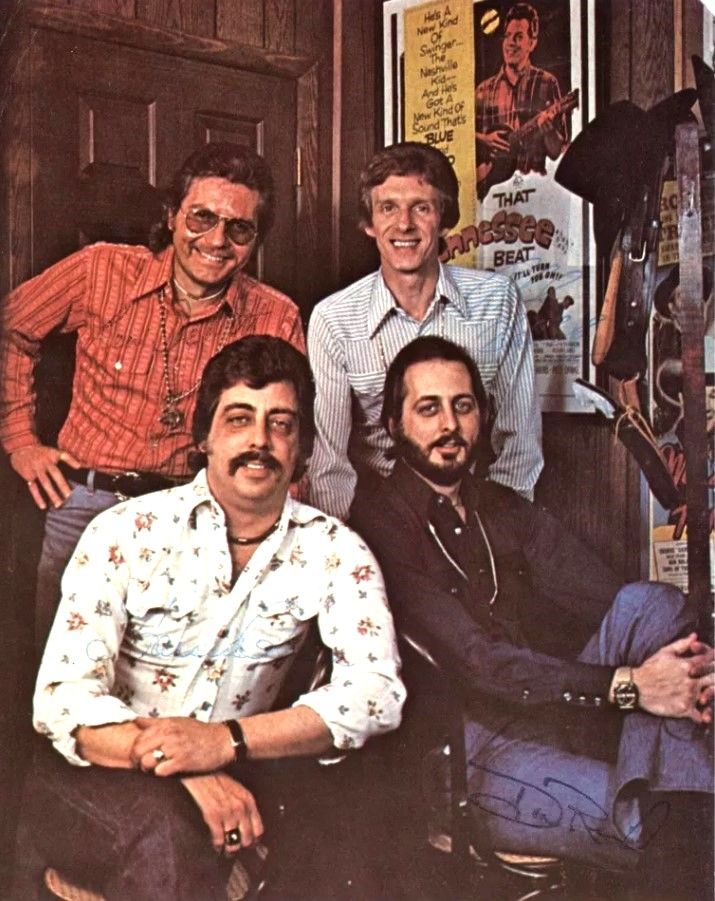
With “Elizabeth,” The Statler Brothers made renewal sound like blend: one new song, four familiar voices, and a name carried gently in harmony.
Released in 1983 by The Statler Brothers, “Elizabeth” became a No. 1 country hit and one of the clearest early showcases for Jimmy Fortune, the group member who wrote it. Appearing in the era of the album Today, the song arrived at a moment when the quartet’s identity was both established and newly delicate. The Statlers were already admired for the precision of their vocal blend, but this record carried a particular kind of importance: it showed that their four-part sound could absorb change without losing its center.
That mattered because The Statler Brothers were never simply a country act with harmonies added for color. Harmony was their architecture. Their roots in gospel quartet singing gave their records a sense of order, balance, and mutual dependence. The bass did not merely deepen the sound; it grounded it. The inner voices did not merely fill space; they shaped the emotional temperature. The tenor did not simply rise above the others; it completed the chord’s emotional reach. In a group like this, a new voice is not a minor adjustment. It changes the way every line breathes.
Jimmy Fortune had joined the group after the departure of original tenor Lew DeWitt, whose health problems had made touring and recording difficult. Fortune’s arrival could have been heard only as a replacement story, but “Elizabeth” gave the transition a creative dimension. He was not just fitting into an existing structure; he was contributing a song that felt naturally suited to it. The record did not ask listeners to forget the past. Instead, it offered something more durable: continuity shaped by a new hand.
Musically, “Elizabeth” is striking for its restraint. It does not try to overwhelm the listener with scale or drama. The melody moves with a calm directness, and the arrangement leaves room for the voices to carry the emotional weight. The song’s central name becomes almost architectural, a word the harmonies can gather around. Each time it returns, the quartet’s blend gives it a slightly larger presence, not because the record becomes louder or more ornate, but because the voices make the name feel held from several directions at once.
That is the quiet art of a harmony group at its best. A solo singer can make a lyric feel like confession. A quartet can make the same lyric feel like memory, witness, and reflection. On “Elizabeth”, the lead line remains clear, but the surrounding parts soften its edges. The harmonies do not compete with the melody; they frame it. The effect is intimate without becoming fragile. The record sounds polished, but not cold. Its craft is evident in the way the voices meet cleanly and then disappear into one another, leaving the impression of a single feeling carried by four distinct men.
The Statlers’ gift was always partly conversational. Even on polished studio recordings, they often sounded as if they understood the social life of a song: how it might live in a car, a kitchen, a church basement, a small-town theater, or a radio playing low in the next room. “Elizabeth” belongs to that world. It is romantic in subject, but its deeper appeal lies in proportion. Nothing is forced. The emotion is allowed to stay human-sized. That kind of discipline can be easy to miss because it does not announce itself as difficulty, yet it is one of the reasons the record endures in memory.
As a country single in the early 1980s, “Elizabeth” also fit a broader moment when traditional vocal values and smooth contemporary production could meet without canceling each other out. The record has the clean surface associated with that era, but beneath it is an older quartet grammar: blend, timing, vowel shape, breath, and trust. The modern polish helps the song travel; the harmony discipline gives it roots. In that balance, The Statler Brothers found a way to sound current without abandoning the communal vocal identity that had defined them.
The achievement of “Elizabeth” is not only that it became a hit. Hits can mark a season and then recede. This song marked a passage. It showed a beloved group working through change not by spectacle, but by craft. It allowed Jimmy Fortune to step forward as a writer and voice while still serving the ensemble. It reminded listeners that harmony is not sameness; it is the careful joining of differences until they create something steadier than any one line alone.
Heard now, “Elizabeth” carries the grace of artists who understood that renewal does not always have to sound like reinvention. Sometimes it sounds like a chord settling into place, a familiar blend opening just enough to let a new voice become part of the family, and a simple name sung with the patience to make it last.
