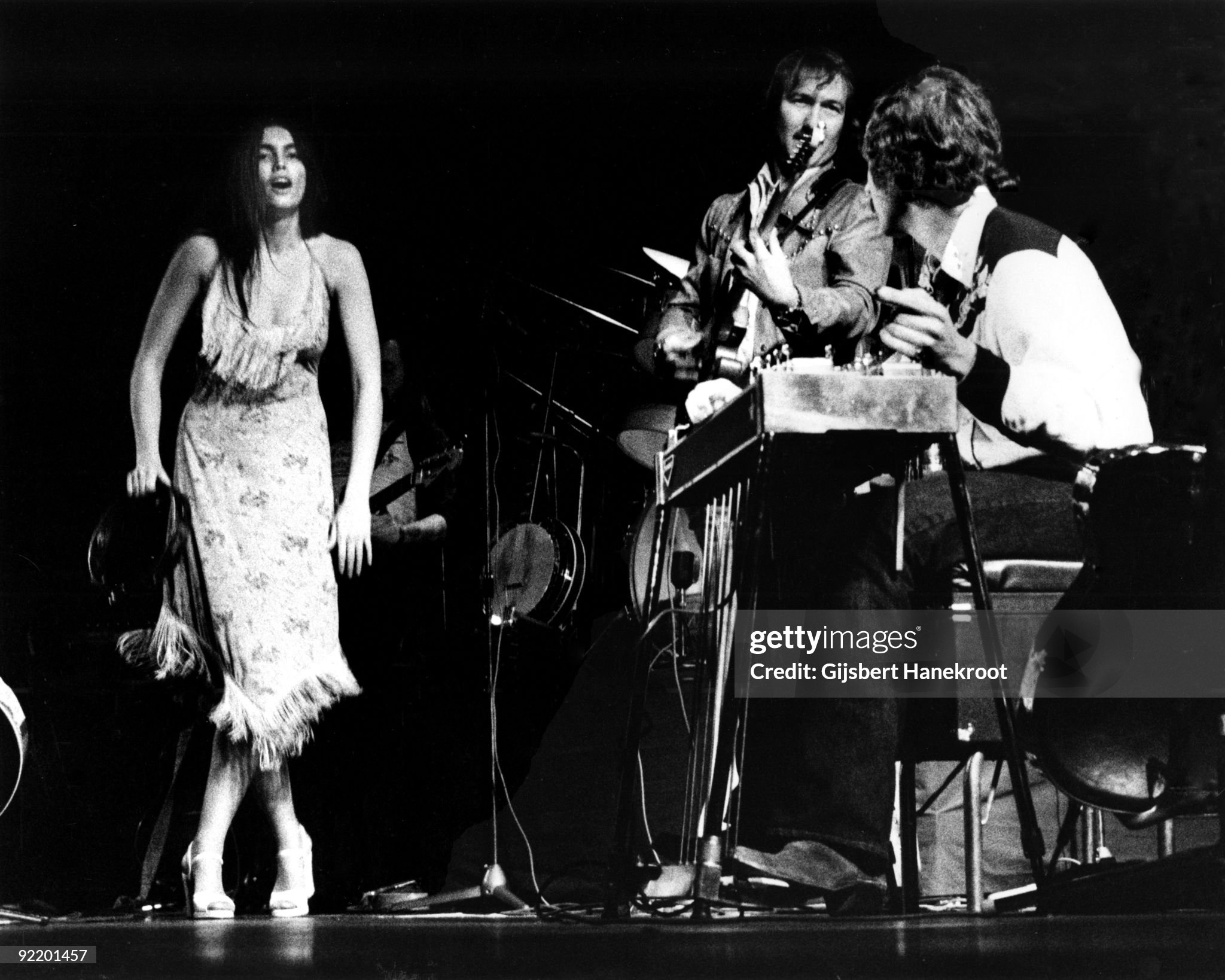
Blackhawk is where Emmylou Harris stopped looking backward and stepped into the mist—finding, on Wrecking Ball, a sound that felt both wounded and fearless.
When people talk about Emmylou Harris and her extraordinary 1995 album Wrecking Ball, they often begin with the title track or with the shock of hearing such a beloved country voice placed inside a world of echo, shadow, and electric atmosphere. But if you want to hear the moment that transformation becomes undeniable, the song to return to is “Blackhawk.” It was not a big radio single, and it did not become a conventional chart story on its own. The larger album, however, made a real commercial and artistic mark, reaching the Billboard 200 and the Top Country Albums chart in 1995 before going on to win the Grammy Award for Best Contemporary Folk Album. More importantly, it altered the way many listeners understood Harris herself.
“Blackhawk” sits near the heart of that change. Co-written by Emmylou Harris and producer Daniel Lanois, the song is not built like a tidy Nashville single. It does not rush toward an obvious hook or settle into the polished comfort of mainstream country production. Instead, it drifts, circles, and gathers force in the half-light. That was exactly the point. By the time Wrecking Ball arrived in late 1995, Harris had already spent decades proving herself as one of the most elegant and emotionally precise voices in American music. What Lanois recognized was that she did not need reinvention through trend-chasing. She needed space—mysterious, cinematic space.
And that is what he gave her. Daniel Lanois, already known for his work with U2, Peter Gabriel, and Bob Dylan, brought a producer’s imagination that treated sound almost like weather. On “Blackhawk”, the instrumentation feels less arranged than summoned. Guitars seem to hover at the edge of the room. The rhythm does not push so much as pulse from somewhere below the floorboards. Reverb is not decoration here; it is part of the song’s emotional meaning. Harris’s voice, always luminous, is allowed to glow through the haze rather than dominate it in the old-fashioned star manner. She is still unmistakably herself—but now she sounds as though she is singing from inside memory, dream, distance, and dust all at once.
That production choice reshaped her sound in a way that now seems historic. Before Wrecking Ball, many listeners associated Emmylou Harris most strongly with crystalline country records, harmony singing, and her deep connection to the traditions of folk, bluegrass, and classic American songwriting. Those qualities never disappeared. What changed was the frame. Lanois placed her inside a darker, more atmospheric landscape, and in doing so he revealed how modern, how restless, and how emotionally open she could sound. “Blackhawk” may be one of the clearest examples of that artistic gamble paying off.
The song’s meaning is part of its power. Rather than operating as a simple story-song, “Blackhawk” feels like an invocation of movement, danger, longing, and release. The title itself suggests flight, vision, and a kind of hard-earned freedom that is never entirely safe. There is a haunted American quality to it—wide spaces, old burdens, the pull of escape, and the knowledge that escape always carries its own loneliness. Harris had sung heartache before, of course, but here the ache is more atmospheric than literal. It is not just about one broken moment. It feels like a life passing through weather.
That is why the recording context matters so much. Wrecking Ball was not merely a collection of songs; it was a radical act of listening. Lanois heard in Harris a voice that could carry silence as beautifully as melody. On “Blackhawk,” he resisted the temptation to crowd her with conventional polish. Instead, he let texture, tone, and room sound become part of the storytelling. The result was transformative not only for this song, but for Harris’s entire late-career legacy. After Wrecking Ball, she was no longer seen only as a guardian of tradition. She became, very clearly, an artist still moving forward.
There is also something deeply moving about the fact that Emmylou Harris was not passively remade by a famous producer. Because “Blackhawk” was a collaboration, the track shows her participating in the reinvention, not merely receiving it. That distinction matters. The album worked because Harris was ready for the emotional and sonic risk it demanded. Lanois opened the door, but she walked through it.
Nearly three decades later, “Blackhawk” still sounds uncannily alive. It belongs to 1995, certainly, but it also sits outside easy time. That is often the mark of a great record: it does not age into nostalgia alone. It keeps speaking. In this case, it speaks of artistic courage, of mature reinvention, and of what happens when a legendary singer allows the familiar light around her to dim just enough for a deeper mystery to emerge. On Wrecking Ball, many songs are beautiful. But on “Blackhawk,” you can hear the shape of a new Emmylou Harris taking flight.
