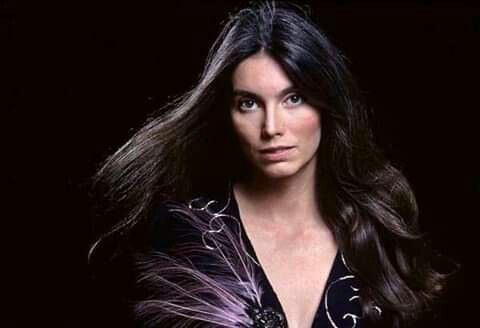
On Cowgirl’s Prayer, Emmylou Harris sang “Crescent City” as if she were already stepping away from one world and listening for the next. It is a small, restrained recording that now feels like the sound of an artist standing at a threshold.
When Emmylou Harris recorded “Crescent City” for her 1993 album Cowgirl’s Prayer, she was not introducing a new phase with fanfare. The song arrived quietly, tucked inside a record that still lived within the broad language of country music, yet carried a different kind of inwardness. Written by Lucinda Williams and first heard on Williams’s 1988 self-titled album, “Crescent City” already had a drifting, weathered quality to it, part memory, part landscape, part emotional residue. In Harris’s hands, it became something even more hushed: less a declaration than a visitation.
That matters because Cowgirl’s Prayer now sits in a very particular place in her story. It is often heard as the last Emmylou Harris album of her mainstream Nashville-era trajectory before the startling shift of Wrecking Ball in 1995, when Daniel Lanois‘s atmospheric production helped recast her sound for a new chapter. Looking back from that later reinvention, “Crescent City” feels almost prophetic. Not because it sounds like Wrecking Ball in any literal sense, but because it reveals Harris leaning toward mood, shadow, and emotional space rather than the more settled expectations of radio-era country polish.
The beauty of her version lies in how little it insists. Harris had long been one of the great interpreters in American music, a singer able to honor a songwriter without flattening the mystery out of the song. With “Crescent City”, she does not try to outwrite Lucinda Williams or out-perform the song’s own sense of distance. She enters it carefully. Her voice, always marked by clarity and ache, moves through the melody with unusual patience, as though each line has to cross a small stretch of private weather before it can be spoken aloud.
That restraint is what makes the performance linger. The song itself is full of place, longing, and motion, but it never behaves like a travelogue. The city in the title is real enough to suggest roads, river air, station platforms, and disappearing lights, yet it is also a state of feeling: the far-off place where memory and desire keep meeting without ever settling the matter. Harris understands that instinctively. She sings as if the geography matters because of what it holds, not because of what it proves. The result is subtle, but not slight. It leaves a trace rather than a climax.
There is also something revealing in her choice to record a Lucinda Williams song at that moment. By the early 1990s, mainstream country was changing fast, and Harris, though deeply respected, was no longer simply occupying the center of the commercial conversation. Williams, meanwhile, represented a different current in American songwriting: literary, regional, emotionally unvarnished, resistant to neat categories. For Harris to take on “Crescent City” was not an act of trend-chasing. It felt more like recognition, one artist hearing in another a language she could inhabit. In hindsight, that matters. It hints at the bridge between the classic interpretive grace Harris had always carried and the more adventurous, mood-driven work that would soon redefine her late career.
What makes Cowgirl’s Prayer so moving in retrospect is that it does not present itself as a farewell to anything. There is no dramatic break, no public burning of the old map. Instead, songs like “Crescent City” reveal an artist quietly narrowing her focus, trusting atmosphere, trusting understatement, trusting the emotional intelligence of a song that does not need to raise its voice. Harris had spent years singing with luminous precision; here, she seems equally interested in what can be left suspended.
And perhaps that is why the track feels larger now than it may have seemed on first release. Some recordings gain strength not by dominating their moment, but by becoming more legible as time passes. “Crescent City” is one of those. Heard today, it sounds like a hinge in the Emmylou Harris catalog: a performance still rooted in the craft and discipline that defined her country years, but already leaning toward a more spacious, searching emotional world. It is not the reinvention itself. It is the intake of breath before it.
There is a special kind of dignity in that. Harris does not make the song announce transition; she lets it carry transition within its tone. You hear a singer who has nothing to prove about command, taste, or history, and who is beginning to follow subtler instincts into stranger weather. That is often how the most meaningful artistic turns actually happen: not with a loud break from the past, but with a song that suddenly reveals the past has already started to loosen its grip.
So “Crescent City” endures as more than a fine cover on a 1993 album. It is a delicate document of timing, instinct, and artistic self-knowledge. In its quiet way, it captures Emmylou Harris at the edge of reinvention, not yet arrived, but already listening for the sound that would carry her forward.
