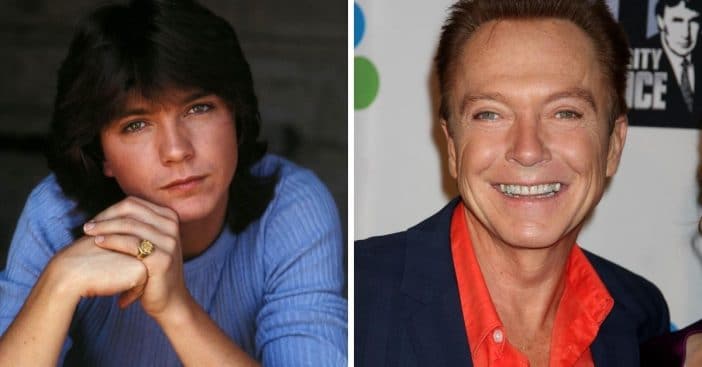
David Cassidy choosing “For What It’s Worth” for Dreams Are Nuthin’ More Than Wishes was more than a cover. It was one of the clearest early signs that he was reaching beyond teen-idol expectations and toward a broader, more contemporary musical identity.
There are album tracks that feel like decoration, and then there are album tracks that quietly announce a change in direction. David Cassidy’s version of “For What It’s Worth”, included on his 1973 album Dreams Are Nuthin’ More Than Wishes, belongs firmly in the second category. It was not a major hit single in its own right, so it does not carry the chart history that followed some of his best-known releases. But that almost makes its importance clearer. This was not about chasing an obvious chart moment. It was about taste, intent, and identity.
By 1973, David Cassidy was still famous on an enormous scale, but fame and artistic freedom are not always the same thing. The public knew him as the bright face of The Partridge Family, as a pop phenomenon, as a star around whom an entire machinery of fan culture had been built. Yet beneath that image, he was increasingly trying to widen the frame. That is why “For What It’s Worth” stands out so strongly on Dreams Are Nuthin’ More Than Wishes. It showed him reaching toward material with a different emotional weather: more skeptical, more alert, more connected to the wider currents of late-1960s and early-1970s rock culture.
The song itself already carried weight before David Cassidy touched it. Written by Stephen Stills and first recorded by Buffalo Springfield, “For What It’s Worth” was released in late 1966 and rose to No. 7 on the Billboard Hot 100 in 1967. Over time it became one of the defining songs of its era, even for listeners who only knew its opening warning bell of a guitar line and that unforgettable first lyric: “There’s something happening here.” Though often loosely treated as a general protest anthem, the song came from a specific atmosphere of public unrest and generational tension in Los Angeles. In other words, it was never lightweight material. It carried seriousness with it wherever it went.
That is precisely what made David Cassidy’s choice so revealing. He was not simply covering an old favorite. He was stepping into a song already linked to social unease, cultural change, and adult ambiguity. For an artist whom many people still insisted on seeing through the narrow lens of teen stardom, that mattered. Even if his version was shaped by the smoother production values of early-1970s pop, the selection itself told a story. He wanted to be heard inside a different conversation.
And that may be the most important way to understand this recording. The significance of “For What It’s Worth” on Dreams Are Nuthin’ More Than Wishes lies not only in how he sang it, but in what it sat beside in his catalog. Cassidy had the looks, the visibility, and the commercial momentum to remain safely within a more predictable lane. Instead, choices like this suggested he was listening more widely and imagining a future less confined by the image that had made him famous. He was reaching for songs with lineage, songs with cultural memory, songs that had already lived complicated lives.
His reading of “For What It’s Worth” does not try to outdo Buffalo Springfield on raw tension, nor should it be judged by that standard alone. The original had a spareness and a sense of watchful uncertainty that belonged to its moment. David Cassidy’s interpretation, by contrast, feels like the work of an artist trying to bridge worlds: commercial pop on one side, a deeper contemporary repertoire on the other. There is polish in it, certainly, but there is also intention. He sounds less interested in merely decorating the melody than in proving he could inhabit more serious material without losing his own vocal identity.
That is why this track now feels so poignant. Looking back, one hears not just a cover, but an argument. An argument that David Cassidy had more on his mind than the marketplace often allowed him to show. An argument that his musical instincts were wider than the labels attached to him. An argument that he understood, perhaps better than he was often credited for, that survival in pop music sometimes begins with repertoire.
The album title Dreams Are Nuthin’ More Than Wishes has a gentle, almost playful ring to it, but “For What It’s Worth” introduces a more thoughtful shade into that world. It hints at an artist standing between youth and adulthood, between packaging and self-definition, between what the audience expected and what he may have hoped to become. That tension gives the recording its afterlife. Not because it was louder than his hits, but because it revealed more.
For listeners returning to David Cassidy now, this performance can feel unexpectedly moving. It reminds us how often pop history freezes artists in one image and ignores the quieter signs of growth. “For What It’s Worth” was one of those signs. It suggested that Cassidy was not just chasing the next scream or the next magazine cover. He was looking toward a more contemporary songbook, one with sharper edges, heavier shadows, and a little more truth in it. In that sense, the song remains an important marker in his story: not the final reinvention, perhaps, but a real and unmistakable turning point.
