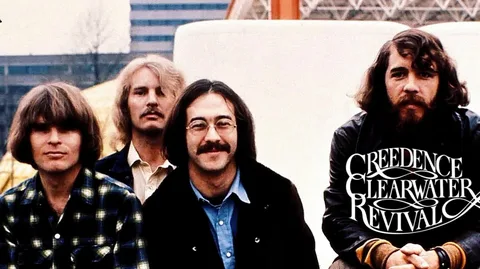
A road song, a warning, and a studio leap all at once, Ramble Tamble opens Cosmo’s Factory by showing how far Creedence Clearwater Revival could stretch without losing their grip.
When Creedence Clearwater Revival released Cosmo’s Factory in 1970, they were already one of the most efficient hit-making bands in America. Their reputation rested on compression: sharp riffs, direct hooks, no wasted motion, songs that seemed to arrive with the force of something already familiar. That is what makes the album’s opening move so striking. Instead of beginning with one of the concise, radio-ready performances that would help define the record, the band opens with Ramble Tamble, a track that runs a little over seven minutes and refuses to behave like an easy introduction. Written entirely by John Fogerty and produced by him as well, it feels like the sound of a famously disciplined band deciding to test just how much pressure their music could hold.
That decision matters. Cosmo’s Factory is often remembered as the album where CCR seemed almost impossibly complete, full of songs that moved across the radio and into everyday life with unusual ease. But Ramble Tamble tells a deeper truth about the group. It says that underneath the clean surfaces and compact singles was a band with a serious appetite for structure, texture, and tension. The track begins with a wiry, almost restless charge, drawing from rockabilly energy and hard-edged roots rock, but it never settles for simply driving forward. It keeps tightening. It keeps suggesting that motion itself may not be freedom, that speed can become strain, and that the American road can sound a little more crowded, nervous, and unstable than the mythology promised.
The brilliance of the song is in how carefully that unease is built. John Fogerty does not treat length as indulgence. He treats it as architecture. The early passages have the clipped momentum people associate with Creedence at their best: sharp guitar attack, a rhythm section that sounds both loose and exact, and a vocal performance that pushes urgency without ever tipping into chaos. Then the song opens out into its famous middle section, and the whole piece seems to leave the ground. The tempo shifts, the groove elongates, the atmosphere turns stranger. What had seemed like a straight-ahead rocker begins to feel like a machine accelerating, swerving, and glancing into the edge of something psychedelic.
That psychedelic element is important, but it is not the loose, ornamental kind that many bands were chasing around the turn of the decade. Ramble Tamble is too muscular, too precise, and too suspicious of self-display for that. Its long instrumental passage does not float; it presses. The effect is less about dreaminess than motion under stress. You can hear the band holding the line while the song stretches and mutates around them. Doug Clifford and Stu Cook give the performance its hard spine, while Tom Fogerty helps keep the texture grounded enough that the arrangement never loses shape. Over all of it is John Fogerty’s sense of control, not just as songwriter and singer, but as the person determining when the song should tighten, when it should expand, and when it should return with force.
That return is one of the most satisfying moments anywhere in the CCR catalog. After the track spends so long pulling against its own center, the groove snaps back into place with a feeling that is almost physical. It is a reminder that Creedence Clearwater Revival understood release because they understood restraint. The band never needed to sound grand in order to sound powerful. On Ramble Tamble, the size comes from contrast: the plainspoken attack of the opening, the disorienting middle, the fierce recovery at the end. It is a studio epic made by musicians who still trusted the economy of rock and roll.
That is why the song remains such a revealing way into Cosmo’s Factory. The album title itself came from the nickname the band gave their rehearsal space, a place associated with work, repetition, and craft rather than mystique. Ramble Tamble carries that ethic into something more adventurous. It does not sound like a band abandoning discipline for exploration. It sounds like a band using discipline to make exploration possible. There is a difference, and it helps explain why the song still feels so alive. Even at its most open-ended, it never drifts into vagueness. Every section feels earned. Every transition feels placed.
There is also something revealing in the way John Fogerty frames the whole piece. His songwriting here keeps one foot in concrete American imagery and another in modern unease. The road is still there, the movement is still there, the engine is still running, but the feeling is no longer simple release. The song hears congestion inside motion, tension inside speed. In that sense, Ramble Tamble belongs perfectly to 1970, when the old promises of freedom and expansion could still be sung, but not quite innocently. It catches that shift without becoming heavy-handed about it. The ideas stay inside the music.
For many listeners, Creedence Clearwater Revival will always be the band of immediate impact, the group that could say more in three minutes than others could manage in twice that time. Ramble Tamble does not contradict that reputation. It deepens it. The song proves that concision was a choice, not a limit. When CCR wanted to open the frame, they could do it with uncommon authority. And because the track stands at the front door of Cosmo’s Factory, it changes the way the whole album is heard. Before the familiar songs begin to arrive, this opener tells you that the room is bigger than expected, the band is more ambitious than memory sometimes allows, and the road ahead may be rougher, stranger, and more exhilarating than it first appears.
That is the lasting thrill of Ramble Tamble. It is not just long for a Creedence song. It is purposeful in a way that makes its size matter. The performance has the snap of old American forms, the pressure of a changing era, and the cool confidence of a band that knew exactly how far it could push before the whole engine roared back into line. Few album openers announce that kind of command so vividly. Fewer still do it while sounding this lean, this wired, and this alive.
