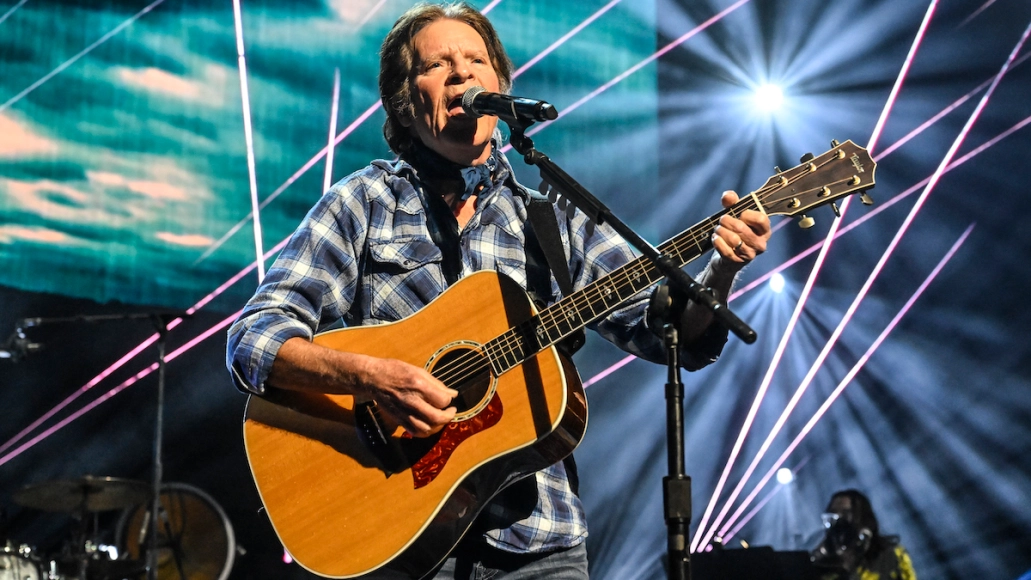
On Revival, the idea of “Swamp River Days” feels like a return to first memories—where John Fogerty looks back on the California landscapes, sounds, and restless young dreams that helped shape his American myth.
There is an important truth to say at the beginning: strictly speaking, “Swamp River Days” is not an official song title on John Fogerty’s 2007 album Revival. But as a phrase, it captures something very real about that record. It names the atmosphere many listeners hear running through the album—the river mist, the long-road memory, the feeling of looking backward without becoming trapped there. And that is why the phrase works so well when people talk about Revival as a late-career homecoming.
Released in 2007, Revival arrived as one of Fogerty’s strongest and most spirited solo statements in years. The album reached No. 14 on the Billboard 200, a reminder that his voice, his guitar attack, and his instinct for American scenes still carried uncommon force. But charts only tell part of the story. What mattered more was the feeling: this was not an artist borrowing his own past for comfort. This was a songwriter returning to the source of his imagination.
That source, of course, has always held a beautiful contradiction. For decades, listeners associated John Fogerty with swamps, bayous, riverboats, and humid Southern mystery. Yet he built much of that world from Northern California, not Louisiana. He grew up in El Cerrito, California, and the American South of his songs was filtered through records, radio, old films, blues, country, rockabilly, and his own remarkable gift for atmosphere. That is one reason the notion of “Swamp River Days” is so moving in the context of Revival: it brings the myth and the memory together. The swamp is there, yes—but behind it stands a California boy who never stopped dreaming in American images.
Listen closely to Revival, and you can hear that backward glance everywhere. “Summer of Love” carries the heat of youthful memory, but it does not sound naive. It sounds like someone remembering how bright the world once looked from a car window, from a sidewalk, from a neighborhood where possibility still felt close enough to touch. “River Is Waiting” adds another shade, using the river as both place and symbol—a destination, a calling, a line between where a man has been and where he still hopes to go. Even “Creedence Song”, sharper and more confrontational in tone, is bound up with origin, identity, and the long shadow of what came before.
That is what makes Revival such an interesting album in the story of John Fogerty. He was not simply revisiting the sound that made him famous with Creedence Clearwater Revival. He was examining the road that led to it. Before the myth, before the swamp-rock legend, before the world turned CCR into a permanent part of American music, there was a young Californian absorbing everything around him—country records, rhythm and blues, early rock and roll, the pulse of highways, rivers, weather, and working-life imagery. On Revival, that earlier self seems to flicker in the background. Not as a ghost, but as a companion.
There is also a maturity in the album that gives this nostalgia real weight. Fogerty does not romanticize the past in a soft, easy way. His nostalgia is weathered. It carries grit. It understands that memory is never only warm; it is also full of what was lost, what changed, what had to be endured. That is why the album feels emotionally deeper than a simple return-to-form narrative. Revival does revive an old spirit, certainly, but it also tests that spirit against time. Can the old fire still burn? Can the old images still mean something? In Fogerty’s hands, the answer is yes—because they are tied not just to success, but to roots.
Those roots matter. When people hear the phrase “Swamp River Days” attached to Revival, they are responding to the way Fogerty’s music has always blurred geography and memory into one believable American landscape. The river may sound Southern, but the longing underneath it is intensely personal and unmistakably his. It comes from a life shaped in California, from the early band years with Tom Fogerty, Stu Cook, and Doug Clifford, from garage beginnings and roadside imagination, from the years before legend hardened into history.
In that sense, the nostalgia of Revival is not merely about youth. It is about authorship. It is about reclaiming the emotional terrain that always belonged to John Fogerty, even when the public story around him became complicated. If one chooses to call that current “Swamp River Days”, the phrase makes emotional sense: it describes the moment where memory, place, and music all meet in the same slow-moving water.
And perhaps that is why Revival still lands with such warmth. It reminds us that the most enduring artists do not simply repeat themselves. They return to the soil. They look again at the roads, rivers, summers, and sounds that first made them who they were. In John Fogerty’s case, that return was never just to a style. It was to the California ground beneath the myth—and to the young dreamer who could already hear America humming in the distance.
