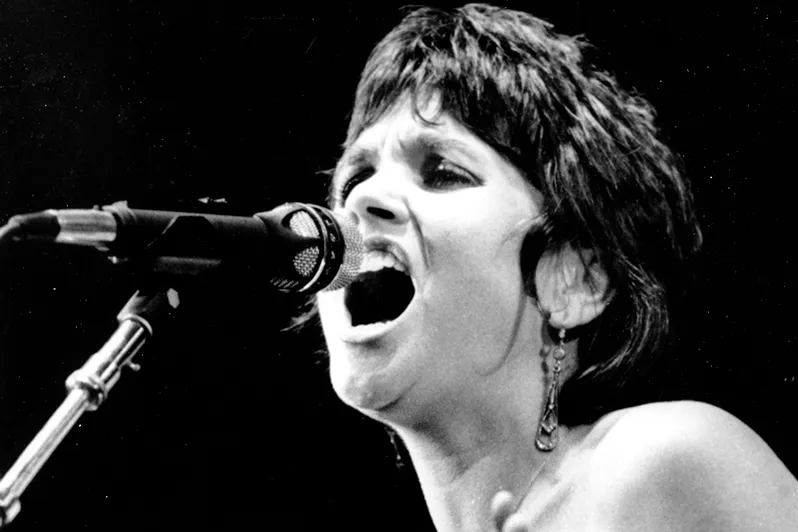
“Lovesick Blues” in Linda Ronstadt’s early voice is a joyful ache—yodeling heartbreak with a grin, as if laughter is the only way to keep longing from winning.
Before the world crowned Linda Ronstadt as the definitive interpreter of so many American songs, she was still learning how to place her own emotions inside other people’s classics—testing where her power could go, and how tender she could sound without breaking. Her cover of “Lovesick Blues” is one of the clearest snapshots of that moment. It opens her Nashville-made album Silk Purse (released April 13, 1970, produced by Elliot F. Mazer), a record that became her first to enter the Billboard 200, peaking at No. 103.
The “ranking at launch” story for “Lovesick Blues” is unusual and very period-correct: Ronstadt’s performance wasn’t pushed as the A-side that introduced her to radio. Instead, it was paired as the B-side to her single “Will You Love Me Tomorrow”, released by Capitol on March 2, 1970—a physical 45 where the listener literally had to turn the record over to find this wilder, more mischievous heartbreak. That old B-side ritual matters emotionally, because songs discovered that way often feel chosen rather than assigned—found like a secret, kept like a talisman.
To understand what Ronstadt is doing here, you have to remember what kind of song “Lovesick Blues” is. It began life far earlier than the honky-tonk era most people associate with it: the Library of Congress notes it was published in 1922, drifting through Tin Pan Alley and early recordings long before it became a country standard. Its writers are commonly credited as Cliff Friend and Irving Mills—the same names you’ll see attached to Ronstadt’s track on reliable discographies and reissue listings. Then, of course, came the version that burned it into American consciousness: Hank Williams turning it into a defining, yodeling heartbreak statement. Ronstadt’s choice to cut it in 1970 wasn’t nostalgia—it was ambition. She was walking straight up to a towering monument and saying, in effect, I can live in this song too.
And she does—by refusing to sing it politely.
On Silk Purse, her “Lovesick Blues” is brief (just over two minutes on many tracklists), punchy, and front-loaded like an opener that wants to wake you up. It’s also telling that critics later singled it out as one of the moments where she truly clicked—a sign that even then, Ronstadt had the rare ability to make a classic feel immediate, not antique. You can hear her leaning into the song’s theatrical DNA—those swooping phrases, the emotional exaggeration that’s somehow more honest because it’s exaggerated. Heartbreak, after all, often feels absurd when you’re inside it: too big for the room, too loud for the hour. The song gives her permission to be dramatic, and she uses that permission like a spark.
The meaning of “Lovesick Blues” is deceptively simple—someone left behind, pleading, unraveling—yet the deeper truth is how it captures love as a physical condition. “Lovesick” isn’t metaphor; it’s illness. It’s the stomach-drop of absence, the restless pacing, the mind returning—against your will—to the same name. But what makes the song endure is that it doesn’t only suffer. It performs suffering, turning pain into sound you can share. That’s why Ronstadt’s version can feel almost oddly liberating: she lets the heartbreak yodel, lets it throw its arms up, lets it make a scene—because sometimes a scene is what keeps a person from collapsing.
There’s also a poignant historical footnote that deepens the nostalgia: Silk Purse was the Nashville experiment Ronstadt herself later spoke of harshly, saying she “hated that album” and felt she “couldn’t sing” yet. Listening now, you may disagree with her self-judgment—because “Lovesick Blues” doesn’t sound like a singer who can’t sing. It sounds like a singer who is still discovering how fearless she can be. The voice is already there: bright, elastic, capable of both grit and lift. What’s not fully formed yet is the certainty that would come later—the sense of a queen on her throne. Here, she’s still climbing toward it, laughing a little as she climbs.
So “Lovesick Blues” becomes more than a cover. It becomes an early portrait of Linda Ronstadt’s lifelong gift: taking inherited American songs and making them feel like lived experience. In her hands, heartbreak doesn’t only ache—it moves. It swings. It raises its chin. And somehow, by the end of that quick two minutes, the “blues” don’t feel like defeat. They feel like proof you were alive enough to love.
