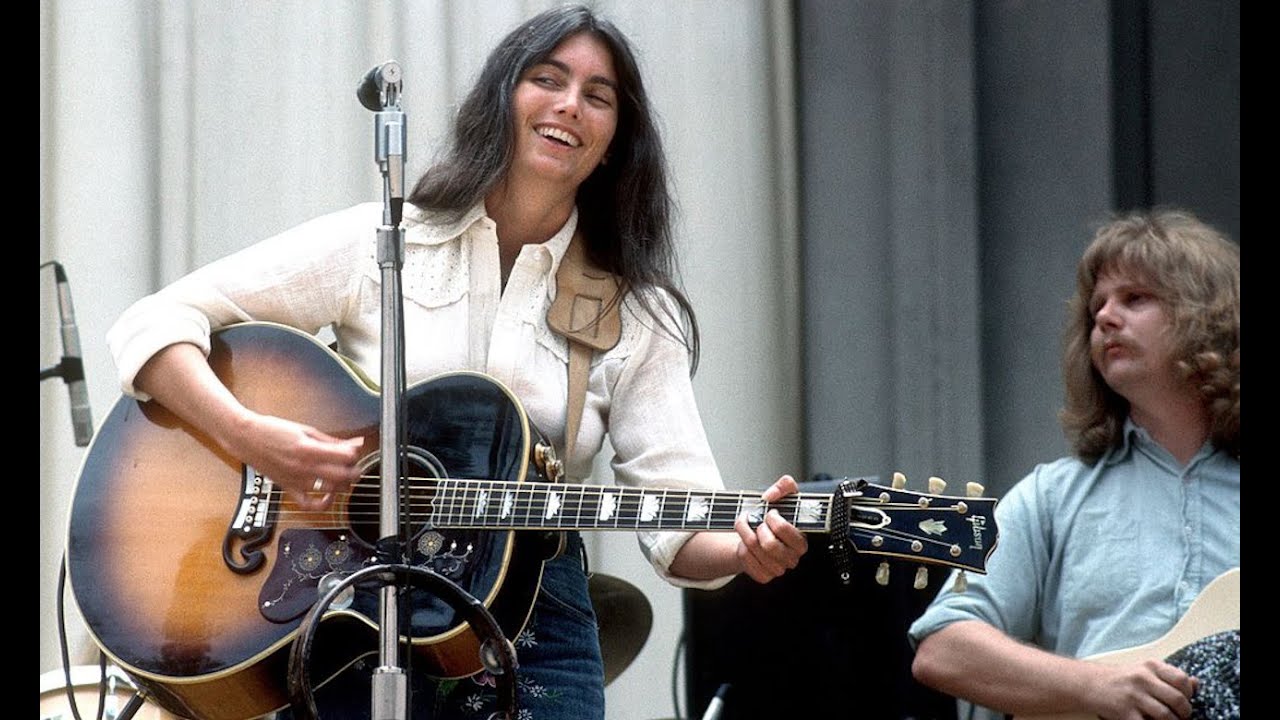
On Hello Stranger, Emmylou Harris did more than revisit an old song on Blue Kentucky Girl; she stepped into the hush of the Carter Family tradition and made 1979 sound older, wiser, and beautifully unhurried.
Some recordings announce themselves with force. Hello Stranger does the opposite. It arrives softly, almost as if it had been waiting in the room long before the needle touched the record. That is part of what makes Emmylou Harris’s 1979 version on Blue Kentucky Girl so enduring. Released as a single, it reached No. 9 on Billboard’s Hot Country Singles chart, while Blue Kentucky Girl climbed to No. 6 on Billboard’s country albums chart. Those numbers matter because they show this was not merely a private act of musical devotion; it was a successful return to older country values at a moment when mainstream records often leaned toward polish and speed. Yet the real triumph of the track lies somewhere beyond chart positions. It lies in the stillness.
By the time Blue Kentucky Girl appeared, Harris had already built one of the most respected catalogs in modern country music. She could move between country rock, folk, bluegrass feeling, and heartbreak balladry with unusual grace. But this album, produced by Brian Ahern, felt like a conscious turn back toward the deeper well. Not backward in a nostalgic, museum-piece sense, but inward, toward the old emotional architecture of country music: plain words, timeless melodies, and arrangements that trust silence. In that setting, Hello Stranger became one of the clearest statements of purpose on the whole record.
The song itself carries the weight of lineage. Credited to A.P. Carter and long associated with the foundational repertoire of the Carter Family, Hello Stranger comes from the earliest bedrock of commercial country music. That heritage matters enormously here. The Carter Family were never just important because they came first. They were important because they understood that a song could be intimate without being small, sorrowful without collapsing into drama, and simple without losing mystery. Their music often seemed to hold its breath. Harris understood that instinct perfectly. She did not treat Hello Stranger as a period piece to be admired from a distance. She sang it as living music.
That is why her version feels so rooted and yet so fresh. She does not crowd the song with interpretation. She does not press every phrase for effect. Instead, she allows the melody to carry its own old wisdom. Her voice on this recording is clear, tender, and restrained, but never fragile. There is confidence in the calm. The phrasing suggests someone who knows that true feeling rarely needs to shout. In many hands, a song from the early country canon can be turned into a reverent exercise. Harris avoids that trap by making the performance feel inhabited rather than reconstructed.
The arrangement is crucial to that effect. Blue Kentucky Girl as an album has beauty throughout, but on Hello Stranger the musicians and production seem to understand that atmosphere is everything. The acoustic textures, the measured pace, the unobtrusive support around Harris’s voice, all of it creates a kind of emotional weather. Nothing is rushed. Nothing is overexplained. The result is what can only be called an old-soul stillness, the sensation that the song is standing in place while time moves around it. That quality connects Harris directly to the Carter Family spirit. Not by imitation, but by temperament.
There is also something quietly profound in the way Harris approached roots music at this stage of her career. She was not an archivist pretending to be untouched by modern recording. She was a contemporary artist, fully aware of the distance between 1920s mountain repertoire and 1979 Nashville studio craft. But instead of treating that distance as a problem, she bridged it with taste and humility. Hello Stranger sounds like a conversation across generations. You can hear the old songbook in it, but you can also hear Harris’s own lifelong gift: the ability to make traditional material feel personal without ever making it self-important.
That may be the deepest reason this recording stays with people. The emotional center of Hello Stranger is not spectacle. It is recognition. The title itself carries warmth and separation at once, a greeting touched by memory, affection, and the ache of time. Harris leans into that emotional doubleness. She sings as if she understands that some reunions are sweet because they are shadowed by distance, and that some of the most moving songs in country music are built not on grand confessions but on what is left gently unsaid.
In the broader story of Emmylou Harris, this performance remains one of her most revealing recordings because it shows what kind of artist she truly is. She did not simply admire the roots of country music; she knew how to enter them with respect. On Blue Kentucky Girl, and especially on Hello Stranger, she proved that returning to tradition did not mean sacrificing elegance or individuality. It meant trusting the song, trusting the lineage, and trusting the quiet. The Carter Family gave American country music some of its earliest emotional grammar. Harris, in turn, gave that grammar a late-20th-century voice of extraordinary grace.
So when people speak of this recording as a return to roots, that is true, but it is not quite enough. What happened on Hello Stranger was more delicate than a genre correction. It was an act of listening across time. Harris heard the old pulse inside the song and refused to disturb it. That is why the performance still feels suspended between eras. It belongs to 1979, certainly. But it also seems to come from much farther away, from a place where country music still knew how to stand very still and break your heart without raising its voice.
