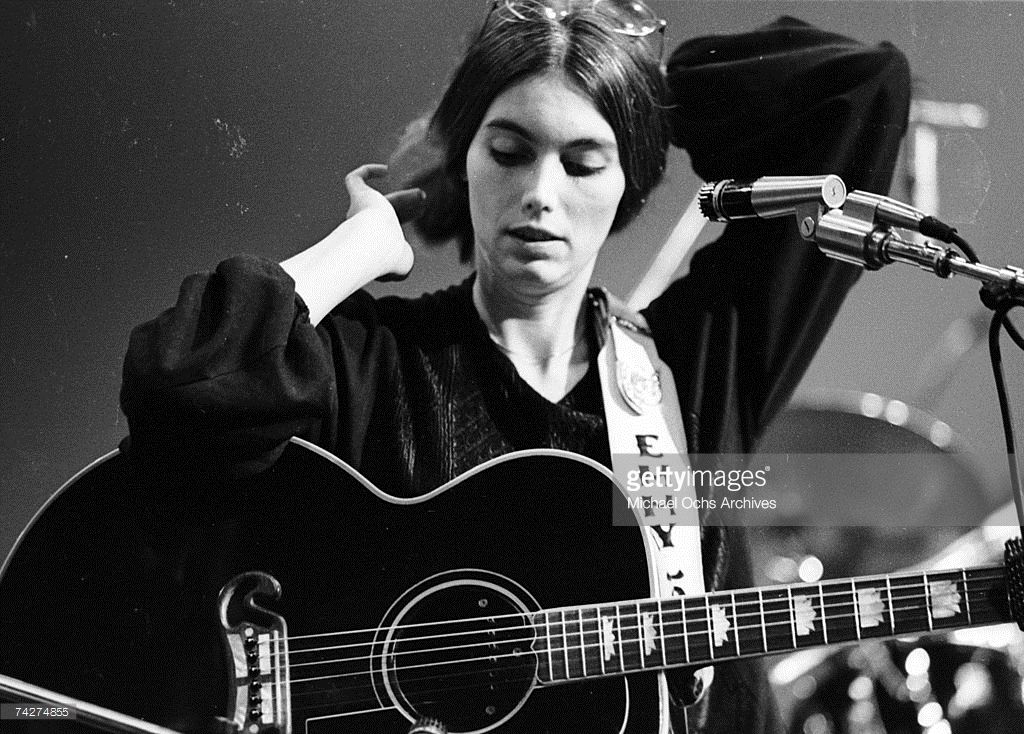
“Save the Last Dance for Me” in Emmylou Harris’s hands becomes something softer and sadder than a pop standard—a smile through heartbreak, a graceful act of longing in which love remains tender even while jealousy quietly burns underneath.
One of the most important facts to place right at the beginning is that Emmylou Harris’s version of “Save the Last Dance for Me” was released in 1979 on her album Blue Kentucky Girl, not on Luxury Liner. The song was written by the legendary team Doc Pomus and Mort Shuman, and Harris turned this old pop classic into one of her biggest country hits. Her recording reached No. 4 on Billboard’s Hot Country Songs chart, and it also charted in Canada, confirming that this was far more than a lovely album cut. The album that carried it, Blue Kentucky Girl, became another major success in her remarkable late-1970s run, continuing the period in which she was one of the finest and most consistent voices in country music.
That chart success matters because “Save the Last Dance for Me” is not the kind of song that wins by force. It wins by poise. The original Drifters version from 1960 is one of the great records of its era, and the song itself already carried one of the most bittersweet premises in popular music: the singer watches the one he loves dance, laugh, and enjoy the evening with others, all the while asking only one thing—that when the night is over, she save the last dance for him. It is an astonishing lyric because it sounds generous on the surface, yet underneath it lives vulnerability, insecurity, patience, and quiet possessiveness all at once. Harris understood that mixture beautifully.
And that is why her version lingers. Emmylou Harris never sang songs as if they were decorative old hits borrowed for convenience. She sang them as living emotional documents. In her voice, “Save the Last Dance for Me” loses none of its sweetness, but the ache becomes more visible. The song no longer feels merely charming. It feels exposed. What had once been an elegantly crafted pop plea becomes, in her hands, a country meditation on loyalty and restraint. She does not demand love. She waits for it. That waiting is where the heartbreak lies.
The deeper meaning of the song is not simply romantic devotion. It is the emotional discipline of loving while pretending not to suffer. The singer lets the beloved shine in the world, lets her dance, lets her charm others, lets the night belong partly to everyone else. But hidden inside that courtesy is a private wound: the need to know that after all the public smiling and mingling, something intimate still remains. The last dance becomes a symbol of truth. It is the moment that reveals where the heart really belongs. That is what gives the song its staying power. It is about love, yes, but even more about the fragile reassurance love sometimes needs.
This emotional shading suited Emmylou Harris perfectly in 1979. By then, she had already become one of the great interpreters of songs about devotion, distance, and wounded grace. She could sing a lyric without overselling it, and that restraint is exactly what “Save the Last Dance for Me” requires. A more aggressive singer might push the jealousy too far. A lighter singer might make it merely pretty. Harris finds the narrow, beautiful middle: she lets the tenderness remain tender, and the sadness remain quiet. That is much harder than it sounds.
Placed within Blue Kentucky Girl, the song also reveals something important about Harris’s art. She had an extraordinary gift for taking material from outside strict country boundaries and making it feel as if it had always belonged there. The old Doc Pomus–Mort Shuman classic is not originally a country song in the narrow sense, but Harris hears the country heart inside it immediately. She hears the longing, the patience, the emotional humility. And once she sings it, the song seems to settle naturally into the country tradition of love carried with dignity rather than display.
There is also something deeply appealing in the contrast between the song’s graceful surface and its bruised interior. That contrast is one of the oldest and finest tricks in popular music: to let a melody smile while the lyric quietly hurts. “Save the Last Dance for Me” does that brilliantly, and Harris, with her clear, sorrow-lit voice, makes the contrast even more affecting. She sounds as if she already knows that love is rarely secure, that the heart often must make do with gestures, promises, and small final reassurances.
So “Save the Last Dance for Me” deserves to be heard as one of Emmylou Harris’s essential late-1970s triumphs: a 1979 single from Blue Kentucky Girl, written by Doc Pomus and Mort Shuman, and a Top 5 country hit. But beyond the facts lies the reason it still glows. It understands that love is not always loud, and not always proud. Sometimes it stands quietly at the edge of the dance floor, smiling for the world, and asks only to be remembered when the music is almost over.
