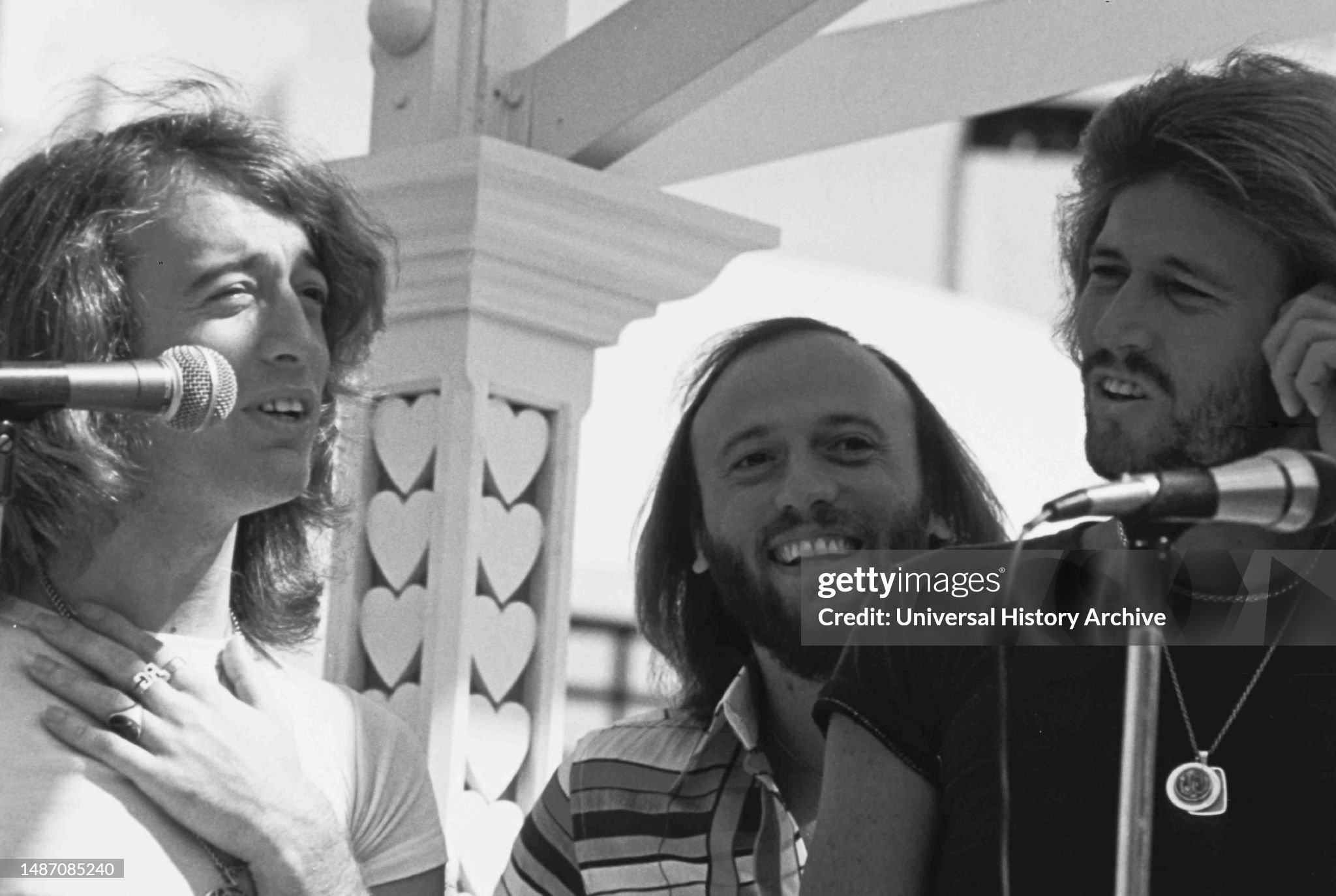
On the 1991 title track High Civilization, the Bee Gees sounded less like visitors to a new decade than master craftsmen trying to rewire their own reflection.
Released as the title track of the Bee Gees 1991 album High Civilization, the song stands as one of the group’s most ambitious and unusual studio statements. Barry, Robin, and Maurice Gibb had already lived several musical lives by then: beat-group hopefuls, orchestral balladeers, disco-era architects, adult-contemporary survivors, and late-1980s comeback figures. But this track did not simply polish an old formula for a new market. It pushed their sound into heavy electronic architecture, using dense programming, hard-edged rhythm, and a techno-rock atmosphere that made the familiar Gibb harmonies feel as if they were being transmitted through metal, glass, and voltage.
Part of what makes High Civilization so striking is the studio context around it. The album credits included Femi Jiya, an engineer associated with Prince and the kind of late-1980s production world where funk, rock, synth technology, drum programming, and studio experimentation could collide in bold, high-pressure ways. That connection matters not because the Bee Gees were trying to become Prince, but because it points to the scale of their ambition. They were not treating technology as decoration. They were trying to build a new surface for their voices to strike against.
For listeners who mostly associate the Bee Gees with the silken ache of How Deep Is Your Love, the pulse of Stayin’ Alive, or the elegant melancholy of their earlier ballads, High Civilization can feel almost startling. It does not welcome the listener with softness. It arrives with machinery. The beat feels heavy and squared-off, the keyboards carry a metallic intensity, and the arrangement has more tension than ease. It belongs to the early 1990s moment when pop music was absorbing club culture, electronic sequencing, industrial textures, and rock muscle all at once. Instead of standing outside that shift, the Gibb brothers stepped directly into it.
Yet the most fascinating thing about the track is not the machinery itself. It is the way the human voice survives inside it. The Bee Gees’ greatest instrument had always been the blend: Barry’s recognizable upper register, Robin’s tremulous emotional edge, Maurice’s anchoring presence, and the uncanny way their family harmonies could seem both precise and instinctive. On High Civilization, those voices are not floating above a warm arrangement. They are pressed into a harsher environment. The result is a kind of dramatic friction. The song sounds like melody trying to remain alive inside a system designed to harden everything it touches.
The title also carries more weight than it first appears to. High Civilization is not a small phrase. It suggests progress, sophistication, ambition, technology, power, and perhaps the unease that follows all of those things. The music seems to understand that double meaning. There is excitement in its forward motion, but also pressure. The track does not sound like a simple celebration of the future. It sounds like three veteran songwriters staring at the new musical landscape and asking whether emotion can still breathe there.
That question gives the recording its lasting interest. The Bee Gees had always been more restless than their easiest caricatures allowed. They wrote for themselves and for others. They moved between genres with unusual flexibility. They absorbed changes in radio, dance music, production, and audience expectation without surrendering the melodic intelligence that made their songs endure. By 1991, they had no need to prove that they could write a tender chorus or a graceful hook. What High Civilization reveals is something different: a willingness to risk sounding severe, strange, even difficult, in order to avoid becoming a museum version of themselves.
Not every experiment in a long career becomes the most beloved song in the catalog, and High Civilization was never destined to be remembered in the same casual way as the group’s biggest radio standards. But that is part of its appeal. It is a title track with the mood of a manifesto, a recording that captures the Bee Gees at a moment when they were listening to the future and refusing to answer it politely. The presence of a Prince-connected engineer like Femi Jiya only sharpens that impression: this was a studio built for impact, not comfort.
Heard now, the track has a particular fascination. Its early-1990s electronic weight is unmistakable, but so is the older craft underneath it. Beneath the programmed force and techno-rock surface, the song still depends on voices, structure, and dramatic instinct. That contrast is what keeps it from being merely a period piece. High Civilization sounds like the Bee Gees walking into a room full of machines and refusing to let the machines have the final word.
