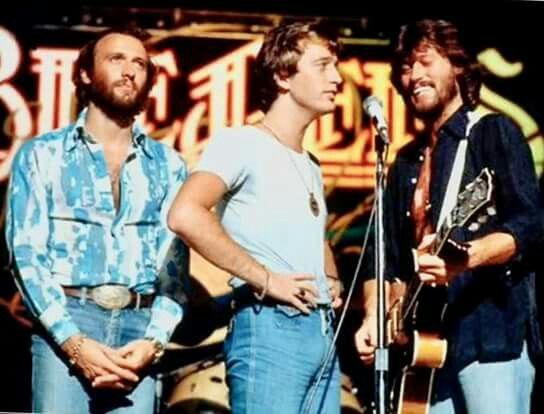
On the Bee Gees’ last studio album, Barry Gibb turned a quiet acoustic song into a small black-and-white cinema lit by Technicolor memory.
“Technicolor Dreams” appears on This Is Where I Came In, the Bee Gees album released in 2001 and later remembered as the group’s final studio album. Written and sung by Barry Gibb, the track sits apart from the louder associations many listeners bring to the brothers’ name. It is not the sweep of their late-sixties orchestral pop, not the glittering pressure of their disco-era dominance, and not the polished adult-pop confidence that carried them through later decades. Instead, it feels deliberately small: an acoustic, retro-styled reverie that looks backward toward the dream language of early Hollywood, especially the romantic fantasy of the 1930s movie screen.
That choice matters because This Is Where I Came In arrived at a reflective point in the Bee Gees’ story. By 2001, Barry, Robin, and Maurice Gibb had already lived through several public lives as a group. They had been teenage balladeers, baroque-pop craftsmen, soul and dance-floor architects, comeback survivors, and elder statesmen of melody. Their catalog was so large that any new album had to carry the weight of memory before a single note was heard. Yet “Technicolor Dreams” does not try to compete with the grandest chapters. Its charm comes from refusing to shout. It opens a side door.
Barry’s lead vocal here is not built around the dazzling high drama that once made Bee Gees records sound as if they were climbing toward the ceiling. He sings with a lighter, more conversational touch, letting the song’s period flavor do part of the storytelling. The acoustic setting gives the track a handmade quality, as though it were being performed in a room rather than projected from a stadium. There is a gentle theatricality in it, but not a heavy one. It feels like someone remembering old cinema not as an archive, but as a private escape: a place of painted backdrops, soft wit, impossible glamour, and emotions tidy enough to fit inside a reel.
The title itself carries a sly historical shimmer. Technicolor became one of the great words of movie fantasy, associated with Hollywood’s move from shadowy monochrome into saturated visual spectacle. By invoking that world, Barry Gibb reaches for a kind of nostalgia older than the Bee Gees themselves: the pre-war movie palace, the dream factory, the screen romance where style and longing were inseparable. But “Technicolor Dreams” is not merely costume music. Its retro manner is less about imitation than atmosphere. It suggests how the past can become a shelter, especially for artists whose own lives have become part of pop history.
That is why the song feels like a late-career gem. It is modest, but it is not slight. On an album that allowed the brothers’ individual voices and instincts to come forward, Barry Gibb uses this track to reveal one of his quieter gifts: the ability to make melody feel like memory before the listener has fully understood why. The tune has the relaxed curve of a song that knows it is not chasing the charts. It wanders with affection through an imagined older world, where cinema, romance, and make-believe can still soften the hard edges of time.
There is also a gentle irony in hearing the Bee Gees, a group so often tied to modern pop reinvention, turn toward a sound that gestures back to the 1930s. The brothers were never only one thing, despite how often popular memory tries to reduce them to a single era. Their best work often came from absorption: country melancholy, English pop, American soul, Broadway-like drama, R&B pulse, and folk-based harmony all passed through their music at different times. “Technicolor Dreams” belongs to that same restless musical imagination, but in miniature. It does not announce reinvention. It simply lets Barry step into another frame.
He sounds less like a pop star proving relevance than a songwriter enjoying the freedom to follow an odd, affectionate idea. That freedom gives the song its warmth. The acoustic texture leaves enough space for the listener to notice the craft: the phrasing, the old-fashioned melodic lift, the balance between playfulness and yearning. It is easy to imagine the song as a brief scene in a forgotten musical, yet it remains recognizably Bee Gees because the emotional center is so melodic. Even when the arrangement looks backward, the feeling is direct.
Heard today, “Technicolor Dreams” gains an added tenderness because of where it stands in the group’s timeline. It comes from the final full studio statement Barry, Robin, and Maurice made together, before Maurice’s death in 2003 changed the Bee Gees forever. The song does not need to be turned into a farewell to be moving. Its poignancy is quieter than that. It is the sound of a great pop craftsman, late in a long journey, taking a brief walk through an imagined cinema of the past and finding there not escape exactly, but gentleness. In a catalog filled with towering choruses and global memories, this small acoustic dream still glows because it asks for so little and leaves such a distinct trace.
