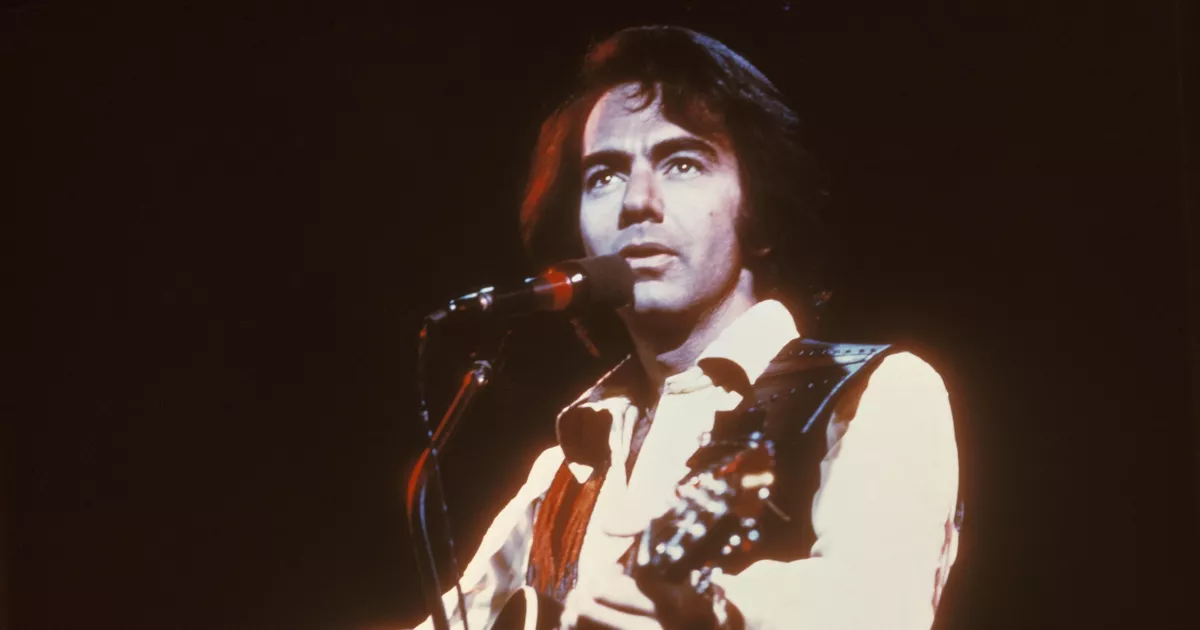
Neil Diamond’s 1977 reading of Joni Mitchell’s Free Man in Paris turns a sharp portrait of escape into something closer to a performer measuring the cost of being needed.
When Neil Diamond recorded Free Man in Paris for his 1977 album I’m Glad You’re Here with Me Tonight, he was not simply borrowing a well-written song from another major artist. He was stepping into one of Joni Mitchell’s most finely observed character studies, a song first released on her 1974 album Court and Spark and widely understood as being inspired by music executive David Geffen. Mitchell’s original had the brightness of a West Coast afternoon and the sting of an insider’s joke: a man powerful enough to decide other people’s futures could feel most alive only when he was far from the ringing phones, obligations, favors, and machinery of the business.
That is what makes Diamond’s 1977 cover so interesting. By the time he placed Free Man in Paris on I’m Glad You’re Here with Me Tonight, he was deep into a career where applause and pressure had become almost inseparable. He had already moved far beyond the Brill Building beginnings and the lean, hard pop craftsmanship of songs like Solitary Man and Cherry, Cherry. His concerts had grown larger, his records more polished, his public image more dramatic and self-contained. He was a star with a voice built for big rooms, yet many of his best performances carried the feeling of a man standing alone inside that scale.
Mitchell’s version of Free Man in Paris glides with a particular intelligence. It is quick, airy, conversational, almost smiling at its own precision. The arrangement on Court and Spark belongs to her early-seventies shift toward jazz-inflected pop, where rhythm, melody, and observation move with restless elegance. The song does not plead for freedom; it notices freedom, briefly, almost with surprise. It is a portrait drawn in motion, the kind of writing where one line can contain a social world.
Diamond changes the temperature. His cover does not erase Mitchell’s wit, but it places the lyric in a different body. In his hands, the song feels less like a nimble sketch of a famous executive and more like a confession that has wandered onto a stage. Diamond’s baritone naturally carries weight. Even when he sings with lift, there is a density in the sound, a sense that every phrase has been pressed through experience before it reaches the microphone. The line about being unfettered and alive lands differently from him because fame, in Diamond’s world, was not an abstract subject. It was the air around him.
The album context matters. I’m Glad You’re Here with Me Tonight, released in 1977 on Columbia Records, sits in a period when Diamond was shaping his late-seventies identity around adult pop grandeur, romantic intensity, and a carefully controlled theatrical presence. The album is often remembered for its original solo version of You Don’t Bring Me Flowers, a song that would later become closely associated with his duet recording with Barbra Streisand. Against that emotional landscape, Free Man in Paris brings a different kind of longing. It is not about a romance gone quiet. It is about public success becoming a room with too many voices in it.
That is why the cover can feel quietly revealing even without changing the song’s basic meaning. Mitchell wrote with the cool brilliance of someone watching power from close range and understanding its exhaustion. Diamond sings as if he understands the exhaustion from the inside. The famous refrain, with its dream of Paris as a place where nobody is asking for anything, becomes less a travel memory than a fantasy of temporary disappearance. For a singer whose name was built into marquees, records, television appearances, and packed halls, the idea of being free for a moment carries a human charge that does not need to be overstated.
There is also a subtle tension in hearing Diamond sing a Joni Mitchell song at all. Mitchell’s writing often depends on edges, turns, and shifting emotional angles. Diamond’s art is more direct, more sculpted around declaration and presence. A lesser interpretation might flatten her nuance into showmanship. But the attraction of this version lies in the meeting of those differences. The song gives Diamond a lyric with worldly irony and quick intelligence; Diamond gives the lyric a heavier shadow. The result is not a replacement for Mitchell’s original, and it does not try to be. It is a second angle on the same window.
In 1977, popular music was widening in several directions at once: singer-songwriters were still shaping adult radio, arena performers were building larger myths around themselves, and polished studio pop was becoming increasingly cinematic. Diamond stood at an unusual intersection of those worlds. He was both songwriter and interpreter, both craftsman and performer, both intimate and monumental. Covering Free Man in Paris allowed him to momentarily slip into a song that questioned the very machinery that makes a star possible.
What remains most compelling about this cover is not whether it surpasses the original. That is the wrong question. The better question is what happens when a song written as a wry portrait of another powerful figure is sung by a man whose own fame had become its own demanding country. In Diamond’s voice, Paris is less a city than a state of mind: no favors to answer, no future to decide, no audience to satisfy for the length of a chorus. Just a passing illusion of open air.
That fleeting sense of release is what keeps Neil Diamond’s Free Man in Paris worth returning to. It reminds us that a cover can do more than reproduce a melody. It can shift the light, alter the room, and let an already brilliant song reveal a different kind of truth. Mitchell’s original sees the trap with a poet’s eye. Diamond’s 1977 version steps inside it and sings toward the exit.
