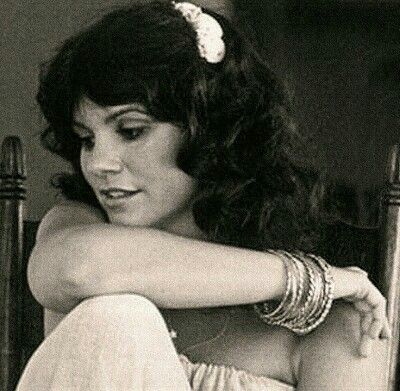
On her 1972 self-titled album, Linda Ronstadt turned Woody Guthrie’s wandering song into an early country-rock portrait of a voice still finding its horizon.
Linda Ronstadt recorded Ramblin’ ’Round for her 1972 self-titled third solo album, Linda Ronstadt, released by Capitol and produced by John Boylan. The song itself came from Woody Guthrie, one of the central figures in American folk music, whose writing carried the dust, humor, fatigue, movement, and stubborn dignity of people trying to survive a hard country. In Ronstadt’s hands, though, Ramblin’ ’Round did not simply become a museum-piece folk revival number. It became part of a young singer’s search for a language big enough to hold country, rock, folk, and the ache of the open road.
That matters because the 1972 album arrived before Ronstadt’s great commercial breakthrough with Heart Like a Wheel in 1974. This was still the forming period: after Hand Sown … Home Grown and Silk Purse, before the voice was widely understood as one of the most commanding instruments in American popular music. She was already admired, already unmistakable, but the full shape of her artistry was still being assembled in public. On Ramblin’ ’Round, you can hear that becoming. She is not trying to sound like Guthrie, and she is not smoothing the song into polite pop. She lets it breathe inside the country-rock atmosphere of early-1970s Southern California, where folk songs, honky-tonk accents, singer-songwriter confession, and electric-band looseness were all beginning to overlap.
Woody Guthrie’s songs often feel as if they were built for motion. They do not need elaborate architecture because they carry their landscape inside their plain speech. A Guthrie traveler is rarely romantic in the easy sense; the road is not just escape, it is hunger, work, weather, chance, and the uneasy freedom of having nowhere fixed to stand. Ronstadt’s interpretation respects that simplicity, but her phrasing gives the song a different emotional light. Her voice brings lift to the melody without removing the dust from it. She can sound bright without sounding carefree, strong without sounding untouched. That balance would become one of her great gifts.
The arrangement also places the song in a particular moment. The early country-rock sound was not yet a polished radio formula; it still had rough edges, porch-board rhythm, and the feeling of musicians listening closely to one another. On the Linda Ronstadt album, Ronstadt was surrounded by the creative Southern California world that would soon reshape mainstream American music. The same orbit included songwriters and players moving between folk clubs, rock stages, country influences, and studio sessions. In that setting, Ramblin’ ’Round becomes more than a cover. It becomes a bridge between Guthrie’s older American road song tradition and the new country-rock vocabulary that Ronstadt helped bring into sharper focus.
There is also something revealing in the way Ronstadt chose material during this phase of her career. She was never merely chasing one genre. Her ear moved across borders: folk, country, Mexican music, rock and roll, standards, soul-inflected ballads, and old songs that could be made newly alive by a fearless interpreter. By placing a Guthrie song on her 1972 album, she was acknowledging a lineage, but she was also quietly reshaping it. The male drifter voice of the American folk canon sounds different when carried by Ronstadt. She does not turn the song into a statement about gender; she does something subtler. She sings it as lived feeling, as restlessness that belongs to anyone who has ever had to keep moving.
That is why this early interpretation still rewards close listening. It does not announce itself as a grand career-defining moment, and perhaps that is part of its charm. It feels like a working road in the middle of the map, not the monument at the end of the journey. Ronstadt’s later recordings would bring more dramatic arrangements, bigger visibility, and wider acclaim. But here, on Ramblin’ ’Round, the emotional force is in the open space around the song. You hear a singer learning how many American voices she could carry without losing her own.
In hindsight, the performance feels almost like a snapshot taken just before everything widened. The voice is already there: clear, muscular, searching, unafraid of old songs, and unwilling to treat tradition as something frozen. Woody Guthrie gave American music a vocabulary for wandering; Linda Ronstadt gave this particular song a country-rock pulse and a young woman’s forward motion. The result is not a departure from Guthrie so much as a continuation of his restlessness in another era, another voice, another California room where the road still seemed to be calling from just beyond the speakers.
