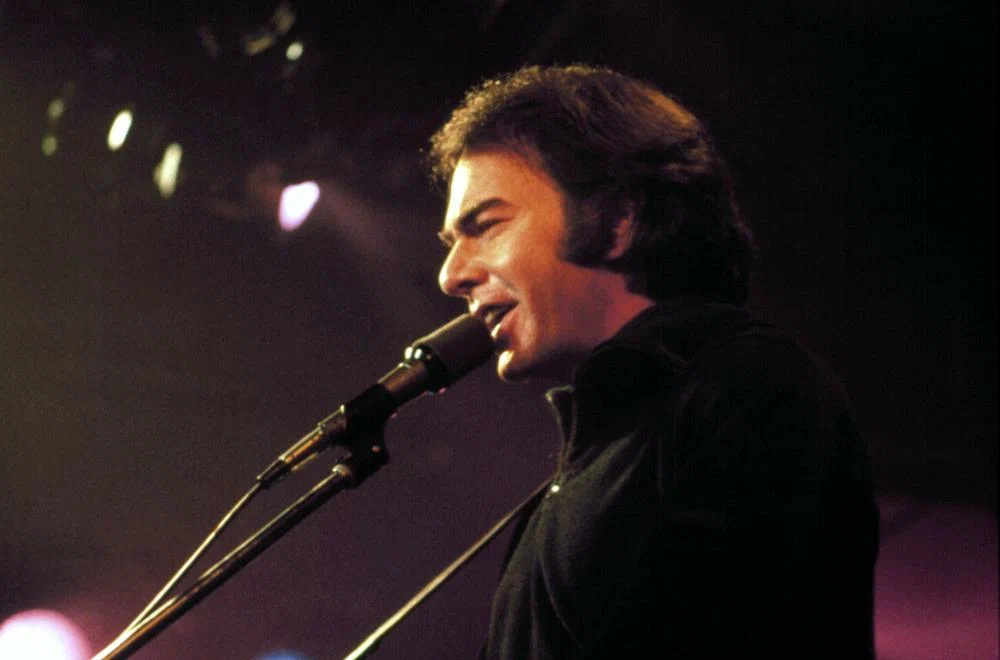
On Signs, Neil Diamond enters the textured world of Beautiful Noise, where Robbie Robertson frames a restless album track with unusual restraint.
Released in 1976 on Beautiful Noise, Signs belongs to one of the more fascinating recording chapters in Neil Diamond’s 1970s catalog: the album he made with producer Robbie Robertson, best known as guitarist and songwriter for The Band. That pairing still carries a quiet charge. Diamond had already become a commanding popular songwriter and performer, a figure whose voice could fill radio, theaters, and eventually arenas with a kind of direct emotional force. Robertson came from a different mythology: wood-grained American storytelling, ensemble feel, weathered characters, and songs that often seemed to arrive from some half-lit roadside room. On paper, the partnership might have looked unexpected. On record, it created an album where Diamond’s dramatic instincts were not erased, but placed in a more shadowed and cinematic frame.
Signs is not the best-known song from Beautiful Noise, and that is part of its appeal. The album is often remembered through the city pulse of its title track, the romantic ache of If You Know What I Mean, and the broader historical glow surrounding Diamond’s collaboration with Robertson. The same creative connection also produced Dry Your Eyes, co-written by Diamond and Robertson, which Diamond performed with The Band at The Last Waltz in 1976. Yet deep inside the album sequence, Signs offers something less ceremonial and more inward. It feels like a smaller doorway into the record’s atmosphere, a track that does not need to announce itself loudly in order to reveal the tension of the sessions.
The title alone suggests a world of messages: warnings, signals, marks left behind, indications that something is shifting beneath the surface. Diamond was always skilled at turning simple words into emotional architecture. In his hands, a plain phrase could open into memory, longing, pride, doubt, or motion. What makes Signs intriguing in the context of Beautiful Noise is the way the recording setting gives that instinct a different weight. Robertson’s production does not try to make Diamond sound like The Band, nor does it diminish the clean pop craft that had carried Diamond from his early songwriting days into major stardom. Instead, it gives the song room to lean into atmosphere. The edges feel less polished for display and more arranged for listening.
That matters because Diamond’s mid-1970s work existed at a crossroads. He was no longer simply the Brooklyn-born songwriter who had written compact, urgent hits in the 1960s. By the time of Beautiful Noise, he had become a performer of large gestures, capable of turning personal feeling into public ritual. With that kind of success comes a danger: every song can be expected to rise, declare, and conquer. But Signs resists that expectation. It belongs to the side of Diamond that watches as much as it proclaims. The performance feels less like a monument and more like a search pattern, as if the singer is reading the room, the street, the relationship, or the moment for clues.
Robertson’s presence is essential to hearing the track properly. His strongest production work on Beautiful Noise is not about novelty for its own sake. It is about context. He understood how a song could carry narrative pressure even when it was not spelling everything out. Coming from The Band, Robertson had helped shape records where the band itself seemed to breathe around the singer, where the arrangement could imply place, memory, and moral uncertainty. On Signs, that sensibility meets Diamond’s more declarative vocal personality. The result is not a disguise, but a conversation. Diamond remains unmistakably himself, yet the surrounding world feels more porous, more textured, less certain of easy resolution.
That is why the song has a particular kind of staying power for listeners who return to full albums rather than only the familiar singles. Album tracks can sometimes carry the most revealing evidence of an artist’s choices. They show what happens between the obvious landmarks. They reveal the color of a session, the trust between artist and producer, the risks that do not need to become slogans. Signs does exactly that. It shows Diamond inside a production environment that asked him to inhabit nuance without surrendering presence. His voice is still built for emotional reach, but here the reach feels measured against a background of movement and uncertainty.
In the larger shape of Beautiful Noise, Signs helps keep the album from becoming only a portrait of big-city sound or romantic memory. It adds a different kind of attention. It suggests that the noise around us is not only heard; it is interpreted. We look for signals in passing moments, in the way a song turns, in the space between a voice and the band carrying it. Nearly five decades later, the track remains interesting not because it demands to outrank Diamond’s more famous recordings, but because it asks to be heard as part of a creative meeting that briefly changed the room around him. In that room, with Robertson shaping the atmosphere, Diamond sounded less like a man delivering certainty and more like an artist noticing the messages flickering at the edge of the music.
