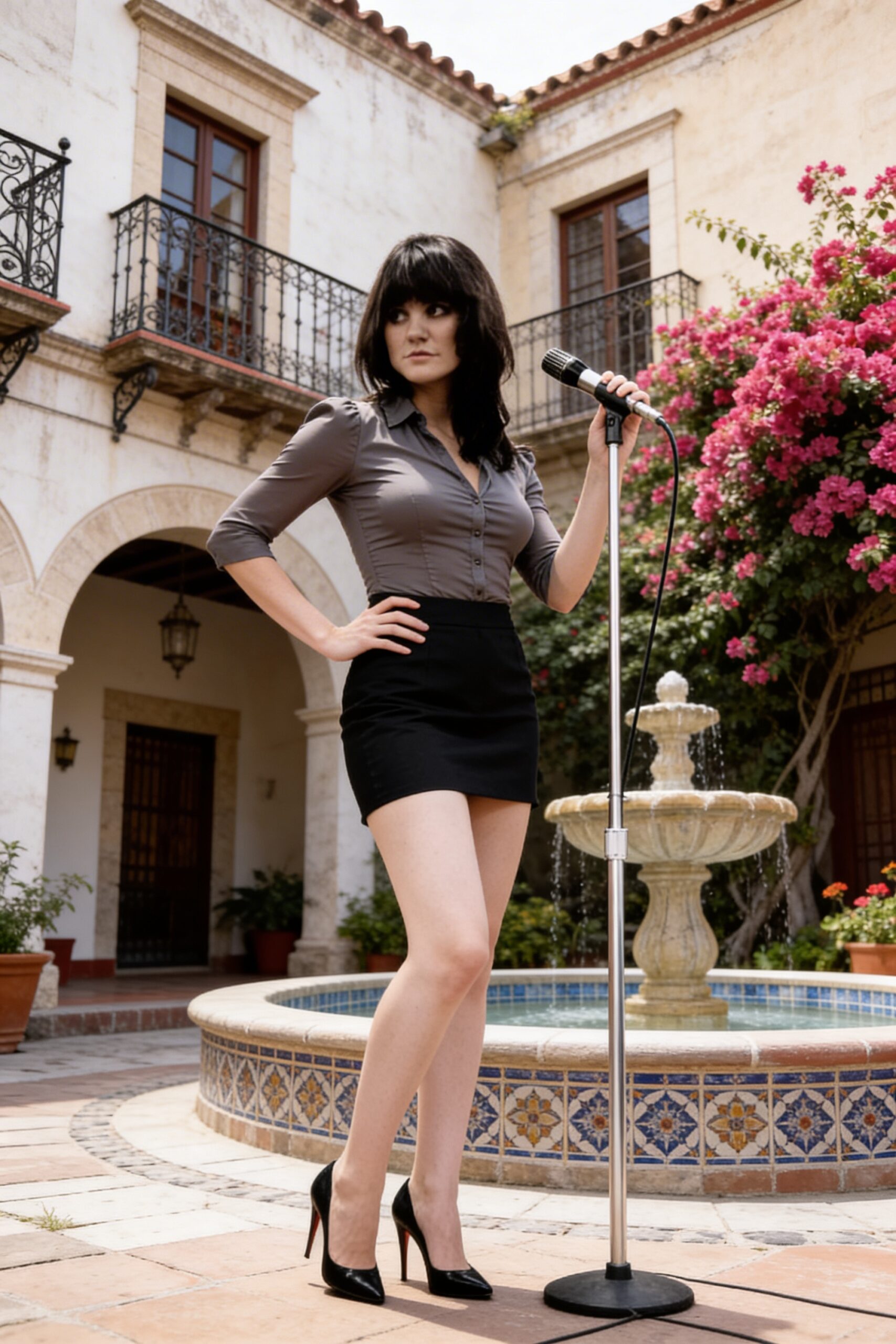
In the lush world of The Mambo Kings, Linda Ronstadt turned “Quiéreme Mucho” into more than a romantic standard — she made it feel like memory singing through a nightclub doorway.
Linda Ronstadt recorded “Quiéreme Mucho” for the 1992 soundtrack to The Mambo Kings, the film adaptation of Oscar Hijuelos’s Pulitzer Prize-winning novel The Mambo Kings Play Songs of Love. That specific setting matters. This was not simply another polished reading of a beloved Latin song; it arrived inside a movie steeped in Cuban music, immigrant ambition, brotherhood, glamour, longing, and the bittersweet promise of 1950s New York. In that cinematic frame, Ronstadt’s voice did what it so often did at its best: it honored a tradition while making the listener feel the private ache inside the melody.
“Quiéreme Mucho” is one of those songs that seems to carry romance as an old inheritance. Written by Cuban composer Gonzalo Roig, with Spanish lyrics associated with Agustín Rodríguez and Ramón Gollury, the song dates back to the early 20th century and later traveled widely through Latin America, Europe, and the United States. Many listeners also know its English-language life as “Yours”, a version that helped the melody cross into popular music beyond the Spanish-speaking world. But the Spanish title retains a directness that is difficult to soften: “love me deeply,” “love me very much,” a plea that sounds simple until a singer gives it breath.
Ronstadt came to the soundtrack with a rare kind of credibility. By 1992, she was not merely a pop and country-rock star trying on Latin repertoire for effect. She had already made a profound public return to the music of her Mexican family heritage with Canciones de Mi Padre in 1987, followed by Más Canciones in 1991. Around the same period as The Mambo Kings, she was also exploring classic Latin material on Frenesí, her 1992 Spanish-language album that included romantic and tropical repertoire connected to an earlier pan-Latin song tradition. Her presence on the film soundtrack therefore felt less like a guest appearance and more like a bridge — between Hollywood and Havana, between the American pop audience and the older emotional codes of Latin song.
The film itself, starring Armand Assante and Antonio Banderas as the Castillo brothers, follows Cuban musicians chasing recognition in New York during the mambo boom. Its soundtrack lives in that exciting borderland where dance music, show-business hunger, and homesickness press against one another. A song like “Quiéreme Mucho” does not need to shout within that world. Its power comes from contrast. Around it, one can imagine brass, rhythm, bodies in motion, crowded clubs, and the heat of performance. Then Ronstadt’s voice enters with a romantic steadiness that slows the room down.
What makes her recording so compelling is not excess, but control. Ronstadt had one of the great American voices of her generation, capable of soaring force, country tenderness, rock bite, and operatic clarity. On “Quiéreme Mucho”, she does not treat the song as a vocal exhibition. She leans into its formal beauty and lets the melody open gradually. The phrasing feels carefully shaped, but not stiff; affectionate, but not sugary. She understands that a romantic standard survives because it allows each generation to hear its own longing inside it.
There is also a particular emotional charge in hearing Ronstadt sing Spanish in this soundtrack context. Her career had already moved through so many rooms — the Troubadour-era Los Angeles scene, country-rock radio, Nelson Riddle orchestral standards, Broadway, mariachi, and Latin classics. By the time she entered the musical world of The Mambo Kings, her voice carried the weight of those travels. She could sound glamorous without sounding distant, technically assured without losing vulnerability. In “Quiéreme Mucho”, that balance gives the performance its quiet gravity.
The song’s place in the film’s musical atmosphere also deepens its meaning. The Mambo Kings is filled with the idea of performance as a kind of survival — men chasing a sound, a break, a memory of home, a place in a city that may applaud them one night and forget them the next. Against that restless backdrop, “Quiéreme Mucho” feels like an inner confession. It is the voice beneath the dance floor, the romantic ache beneath the bright arrangements, the stillness after the last note hangs in the air.
Ronstadt’s recording does not try to modernize the song in a way that erases its past. Instead, it allows the old-world elegance of the composition to sit comfortably inside a 1992 soundtrack shaped for a contemporary film audience. That is a delicate achievement. Too much nostalgia can turn a song into a museum piece; too much polish can strip away its human texture. Ronstadt finds a middle path, where the performance feels refined but alive, respectful but emotionally immediate.
For listeners who discovered “Quiéreme Mucho” through The Mambo Kings, the recording may always carry images of satin bandstands, crowded clubs, Cuban rhythms, and the ache of people trying to build a dream far from where they began. For those who already knew the song from older recordings or family memory, Ronstadt’s version offered another kind of recognition: proof that a classic can return without feeling diminished. It can step into a new film, a new arrangement, a new audience, and still keep its essential plea intact.
That is why this soundtrack recording continues to matter. It is not only a beautiful performance by a major singer; it is a meeting place. A Cuban romantic classic, an American film about Latin music and migration, and a vocalist with deep roots in both mainstream popular song and Spanish-language tradition all converge in one graceful reading. Linda Ronstadt does not simply sing “Quiéreme Mucho” as a love song. She lets it sound like something remembered, something inherited, and something still waiting to be answered.
