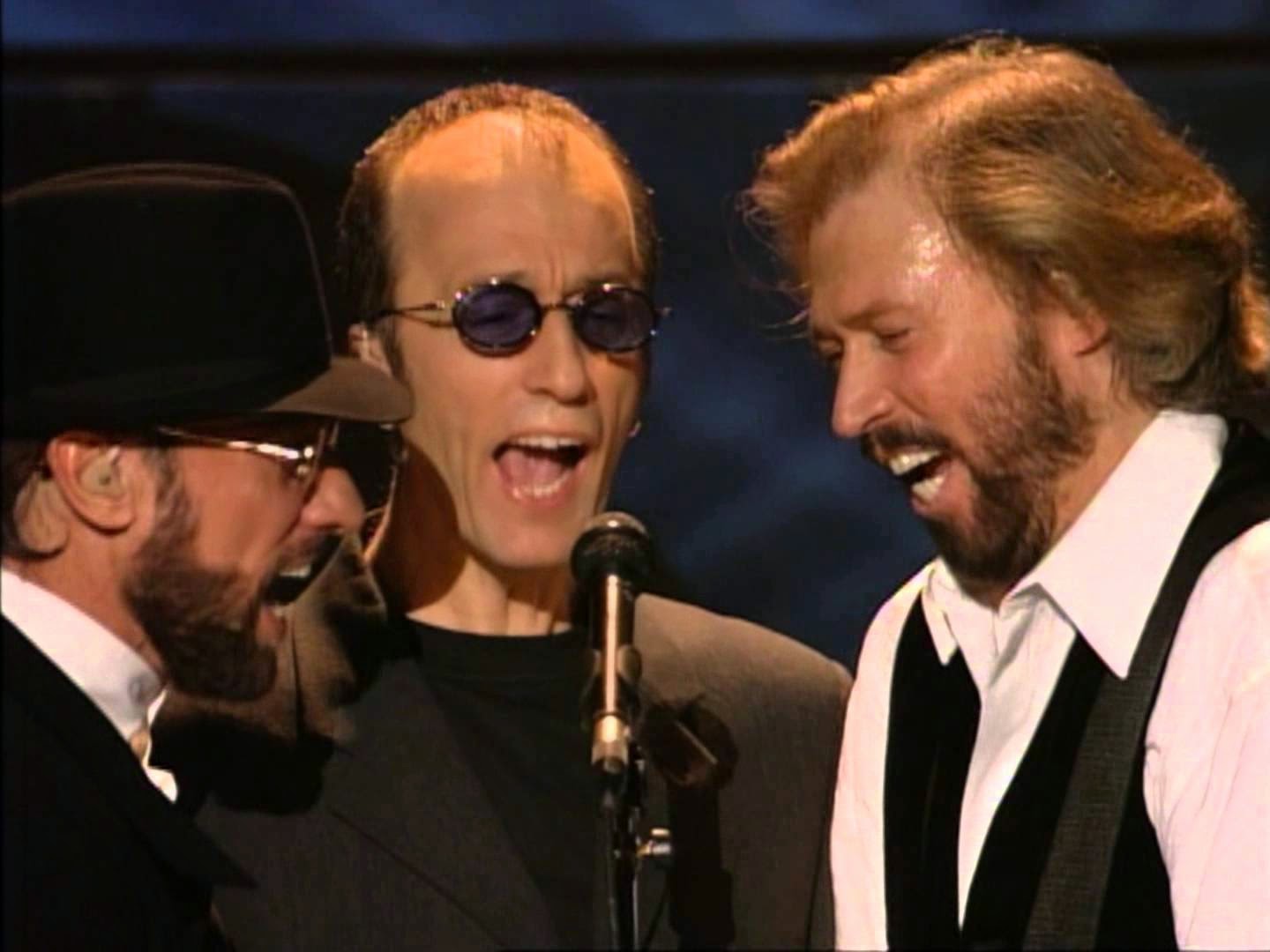
On a soundtrack famous for spectacle, the Bee Gees turned “Nowhere Man” into a close-harmony study in polished loneliness.
The Bee Gees recording of “Nowhere Man” belongs to a very specific and unusual corner of pop history: the 1978 Sgt. Pepper’s Lonely Hearts Club Band film soundtrack. That context matters. This is not simply a Beatles cover pulled from a studio session or a casual tribute. It is part of a lavish, late-1970s attempt to build a full musical fantasy around the songs of the Beatles, with the Bee Gees and Peter Frampton placed at the center of a project that was ambitious, colorful, and still debated decades later.
Because the film itself has long carried a complicated reputation, some of its individual musical moments can be too easily dismissed or buried under the weight of the production around them. Yet the Bee Gees’ take on “Nowhere Man” deserves to be heard with more patience. It reveals something that was always central to the group, even when the world was busy defining them by disco, white suits, and the enormous cultural shadow of Saturday Night Fever. Before and beyond the dance floor, Barry, Robin, and Maurice Gibb were architects of vocal blend. Their voices did not merely stack notes; they created shapes, tensions, and emotional weather.
The original Beatles version of “Nowhere Man”, released on Rubber Soul in 1965 and credited to Lennon-McCartney, is one of the group’s great early exercises in self-examination. Its bright guitars and crisp harmonies carry a lyric about emptiness, directionlessness, and a man somehow present and absent at once. The song has a sharpness beneath its melody. It looks at its subject almost from a distance, with sympathy and critique folded together so tightly that they cannot be separated.
The Bee Gees approach that same song from a different emotional angle. Their 1978 soundtrack version does not try to recreate the Beatles’ dry, chiming attack. Instead, it leans into the thing the Gibbs could do with rare precision: turn a familiar melody into a layered vocal structure. The arrangement gives the song a smoother surface, but that smoothness is not empty decoration. It creates a strange contrast with the lyric. The words describe a man with no point of view, sitting in his nowhere land; the voices around him are carefully organized, almost too beautiful, as if order has been built around confusion.
That contrast is what makes the performance interesting. In 1978, the Bee Gees were at one of the most visible moments of their career. Their falsetto-driven pop and dance records had become a defining sound of the era, and their association with Robert Stigwood’s entertainment world made their presence in the Sgt. Pepper’s Lonely Hearts Club Band film feel almost inevitable. But “Nowhere Man” points back to an older Bee Gees gift: the melancholy elegance of voices moving together, the family harmony that could make even a polished production feel inward.
There is also a curious historical symmetry in hearing the Bee Gees sing this particular Beatles song. Both groups understood the power of close harmony, though they used it differently. The Beatles often made harmony feel conversational, like separate personalities meeting inside the same line. The Bee Gees, especially in their most carefully arranged recordings, could make harmony feel architectural, as if a feeling were being built upward in glass and air. On “Nowhere Man”, that architecture gives the song a new kind of isolation. The title figure is not alone because the arrangement is sparse; he is alone inside a crowd of perfectly placed voices.
The soundtrack setting also changes how the recording lands. In a film filled with costumes, fantasy, and pop spectacle, this song becomes a moment where the surface brightness does not fully hide the unease beneath it. The Bee Gees’ vocal discipline keeps the performance from becoming melodramatic. They do not need to push the lyric too hard. The sadness is carried in the spacing of the harmonies, in the clean movement from phrase to phrase, in the sense that the singers understand restraint as much as shine.
For listeners who come to this version expecting only a glossy late-1970s reinterpretation, the surprise is how much of the song’s inner question remains intact. It is still “Nowhere Man”, still a portrait of disconnection, still a melody that seems to smile while looking at something unresolved. But through the Bee Gees, it becomes less like a sketch of one lost figure and more like a chorus of voices circling him, trying to define the emptiness without disturbing it.
That may be why this soundtrack performance continues to hold a quiet fascination. It sits between eras: the Beatles’ mid-1960s introspection filtered through the Bee Gees’ late-1970s studio polish, a classic song reframed by artists who knew how to make harmony feel both luxurious and lonely. Heard on its own terms, the Bee Gees’ “Nowhere Man” is not just a cover from a famous film soundtrack. It is a reminder that even the most familiar songs can change shape when another group’s voices find a different shadow inside them.
