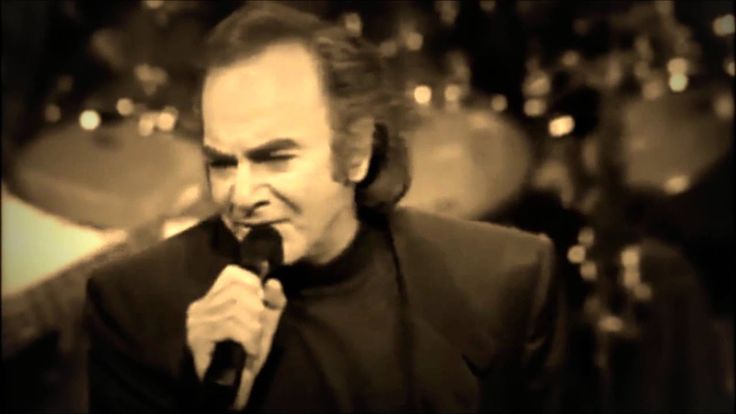
When Neil Diamond carried The Beach Boys’ God Only Knows into 1977, he did not chase its innocence; he turned it into an adult confession of gratitude and need.
Neil Diamond recorded God Only Knows for his 1977 album I’m Glad You’re Here with Me Tonight, placing one of the most delicate pop songs of the 1960s inside the broader, more burnished emotional world of his late-1970s Columbia period. The original Beach Boys recording, released in 1966 on Pet Sounds, was written by Brian Wilson and Tony Asher and sung with remarkable purity by Carl Wilson. By the time Diamond approached it more than a decade later, the song already carried the air of a modern standard: short, devotional, harmonically unusual, and almost impossibly tender.
That is what makes Diamond’s cover so interesting. He was not simply borrowing a famous melody. He was stepping into a song whose emotional identity had been shaped by another voice, another era, another kind of vulnerability. The Beach Boys’ version seems to float above the ground, with its chamber-pop arrangement, weightless harmonies, and a lead vocal that feels almost shy in its sincerity. Diamond, by contrast, brings the song down into a more physical space. His voice has grain, shadow, and authority. It does not sound like a young man marveling at love for the first time; it sounds like someone who understands the cost of needing another person.
On I’m Glad You’re Here with Me Tonight, that difference matters. The album belongs to a period when Diamond was working in a polished adult-pop language, one that could hold romance, theatricality, loneliness, and private reflection in the same frame. The record is often remembered in connection with You Don’t Bring Me Flowers, which first appeared there as a solo Diamond performance before the later duet with Barbra Streisand became widely known. In that setting, God Only Knows does not feel like an ornamental cover tucked between original material. It becomes part of the album’s atmosphere: intimate, grateful, slightly wounded, and aware of how much can remain unsaid between two people who share a life.
The greatness of God Only Knows has always rested on a quiet contradiction. The title sounds spiritual, but the lyric is human and immediate. The opening line is unusually candid for a love song: the singer admits that love may not last forever, and yet the confession that follows feels even stronger because of that uncertainty. It is not a fantasy of perfect devotion. It is devotion spoken from inside impermanence. That tension is one reason the song has outlived so many of the era’s more obvious declarations. It does not shout. It trembles.
Diamond’s interpretation leans into the weight of that trembling. Where Carl Wilson’s original vocal carries a kind of luminous restraint, Diamond gives the words a more seasoned contour. He was never a singer who disappeared into a song; he brought a recognizable presence, a dramatic center, and a carefully measured emotional force. In his hands, the phrase God only knows what I’d be without you feels less like a youthful vow and more like a late-night admission. The tenderness is still there, but it has been darkened by experience.
This is the delicate challenge of covering a song as revered as God Only Knows. Too much imitation and the performance becomes unnecessary. Too much reinvention and the song’s fragile architecture can collapse. Diamond’s version is valuable because it understands the song as a vessel rather than a monument. He does not need to reproduce the sunny strangeness of Pet Sounds. Instead, he lets the composition pass through his own artistic language: more earthbound, more direct, more rooted in the stage-lit intimacy that defined so much of his work.
There is also a larger cultural echo in the timing. By 1977, popular music had moved through psychedelia, singer-songwriter confession, soft rock, disco, and arena-sized spectacle. The 1966 Beach Boys original already belonged to a different landscape, but it had not aged into nostalgia alone. In Diamond’s hands, it became proof that certain songs could migrate across eras without losing their center. The melody still carried its unusual grace. The lyric still opened its small door onto a very large feeling. What changed was the angle of the light.
For listeners who know the Beach Boys recording by heart, Diamond’s cover can feel at first like a room rearranged. The familiar objects are there, but the shadows fall differently. The song is no longer only about innocence preserved in harmony; it is about gratitude spoken by a voice that knows gratitude is never simple. That is the quiet strength of Neil Diamond’s 1977 God Only Knows. It reminds us that a great song does not belong to one emotional age. It can be young in one version, mature in another, and still remain honest in both.
What lingers is not competition between two recordings, but conversation. The Beach Boys gave the song its first shimmering body; Neil Diamond gave it another room to breathe in. On I’m Glad You’re Here with Me Tonight, it becomes less of a California prayer and more of a close-held evening confession, the kind of song that seems to wait until the lights are low before saying the thing that matters most.
