
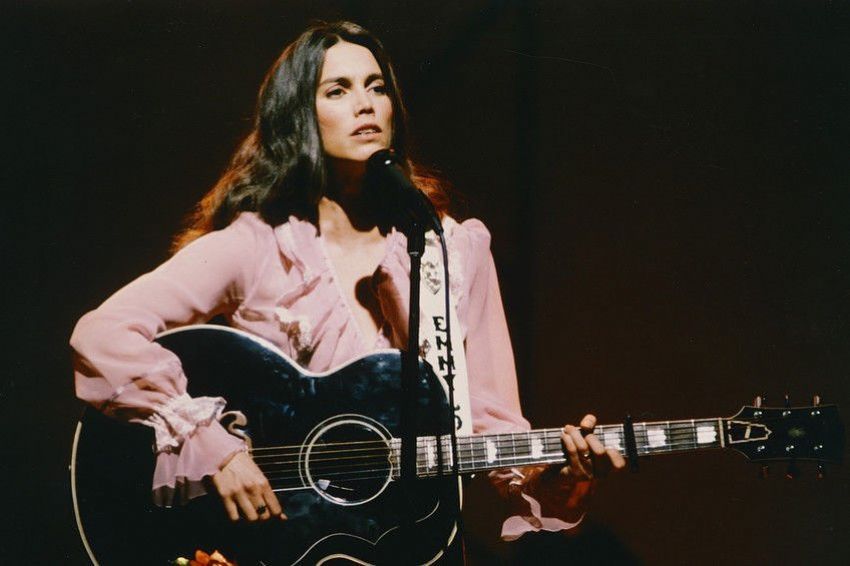
To understand why Emmylou Harris sounds so natural in Green Pastures, you have to go back to 1975, when Elite Hotel revealed how deeply the Louvin Brothers already lived inside her music.
One important fact belongs right at the beginning: Green Pastures was not part of Elite Hotel. Emmylou Harris recorded it later, on Roses in the Snow in 1980. But the emotional and musical thread that makes that performance so convincing was already present in her early Hot Band era, and especially in the breakthrough season surrounding Elite Hotel in late 1975. If we want to hear where her gospel-country feeling truly took root, that is the right place to begin.
By the time Elite Hotel arrived, Harris was no longer merely a promising new voice. She was becoming one of the defining interpreters in modern country music. The album reached No. 1 on Billboard’s country albums chart, a major milestone that confirmed she could honor tradition without sounding trapped by it. It also produced two No. 1 country hits, Together Again and Sweet Dreams, songs that showed how elegantly she could move between ache, restraint, and pure melodic grace. Yet beneath that polished success, there was something older and deeper at work: a reverence for the severe beauty of country harmony singing, especially the kind associated with the Louvin Brothers.
That connection had already been made explicit on Pieces of the Sky, her first solo album, when she recorded If I Could Only Win Your Love, a Louvin Brothers song that reached No. 4 on the Billboard country singles chart in 1975. That was no casual choice. Harris understood what the Louvins carried inside their music: not only sibling harmony of breathtaking precision, but also a spiritual seriousness that could sit beside romantic heartbreak without any contradiction. In their world, longing for human love and longing for peace of the soul were often separated by only a breath. Harris absorbed that lesson completely.
That is why the idea of Green Pastures belongs so naturally beside Elite Hotel, even if the recording itself came later. In the Louvin tradition, gospel is not treated as decoration. It is not a choir robe placed over country music for effect. It feels lived in, weathered, and humble. It sounds like a person who has walked through disappointment and still wants to believe in mercy. When Harris eventually sang Green Pastures, she did not approach it as a stylistic exercise. She sang it as someone who had already spent years learning how country music could hold both earthly sorrow and spiritual shelter in the same line.
The early Hot Band years were crucial to this. The group gave Harris lift, rhythm, and modern clarity, but they rarely disturbed the old foundations under her music. Even when the arrangements on Elite Hotel felt crisp and contemporary, the values were traditional: close attention to melody, emotional discipline, and a refusal to oversell the lyric. That restraint matters. It is the same discipline that makes gospel-country recordings endure. Harris never had to shout belief. She suggested it through tone, phrasing, and the almost prayerful calm with which she let songs unfold.
Listen closely to the spirit of Elite Hotel, and you can hear why the path to Green Pastures was already being laid. The album moves through love, loneliness, and fidelity with an almost old-world poise. Even when the songs are secular, there is a moral hush around them, as if Harris understands that country music is not only about broken hearts, but about how people carry themselves through hardship. That is a very Louvin Brothers idea. Their gospel-country thread was never just about religious language. It was about seriousness, humility, and the sense that a song could point beyond immediate trouble toward something steadier.
When Harris later turned more fully toward acoustic textures on Roses in the Snow, Green Pastures felt less like a new direction than a homecoming. By then, she had already made the grammar of that music her own. The distance between If I Could Only Win Your Love, the emotional atmosphere of Elite Hotel, and the still, searching beauty of Green Pastures is shorter than it may seem. One leads to the next. What changes is not the heart of the music, but how plainly that heart is revealed.
And perhaps that is the real beauty of Harris’s early work. She never treated tradition as museum glass. She treated it as something breathing. In her hands, the Louvin Brothers legacy was not preserved in a formal way; it was renewed through feeling, taste, and deep musical intelligence. Green Pastures may have arrived after Elite Hotel, but the faith-shaped quiet at its center was already there in 1975, waiting to be heard by anyone listening past the chart success and into the older country soul beneath it.
That is why this song still carries such unusual weight. It is not simply a beautiful performance from a later album. It is part of a longer story about how Emmylou Harris helped bring the sacred thread of classic country back into the light, not with grand gestures, but with grace, patience, and an ear tuned to the oldest truths in the music. In that sense, Green Pastures is not an isolated moment at all. It is one of the clearest windows into what her early Hot Band era was quietly building from the start.
