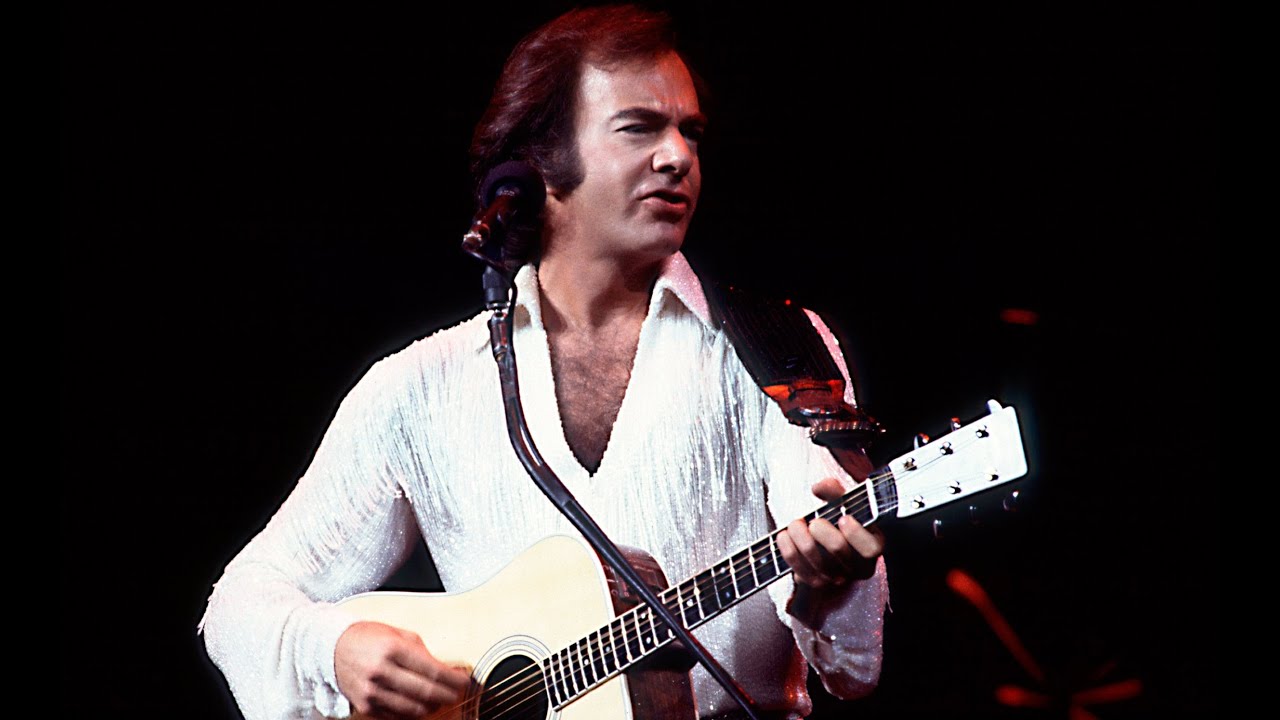
America began as a dramatic number in The Jazz Singer, but it did not stay there. What started on a soundtrack became one of Neil Diamond’s most powerful public songs, carrying memory, motion, and belief into the arena age.
There are songs that belong to a season, songs that belong to a hit record, and then there are songs that somehow outlive the very project that introduced them. Neil Diamond’s America belongs to that last category. First heard in the world of the 1980 film The Jazz Singer, it quickly proved it was larger than a soundtrack cue, larger than a movie scene, and even larger than the moment of its release. As a single, it rose to No. 8 on the Billboard Hot 100 in early 1981, giving Diamond another major pop hit. But the chart story, important as it is, only tells part of the truth. The real story is what happened afterward, when America kept expanding until it sounded less like a soundtrack number and more like a national gathering set to music.
That is part of what makes the song so fascinating. The Jazz Singer, a remake of the famous 1927 film, cast Diamond as Jess Robin, a performer caught between inherited tradition and the demands of modern stardom. That tension mattered. It gave America something deeper than applause-ready excitement. In the film, the song arrives with force and theatrical scale, but underneath the brass, drums, and rising vocal lines is a very old emotional subject: leaving one world behind and stepping into another with equal parts hope and ache. Even listeners who never saw the film could feel that. Perhaps that is why the song moved so quickly beyond its original setting.
Musically, America was built to travel. The arrangement does not creep into the room; it strides in. It has the pulse of movement, the architecture of a march, and the release of a sing-along chorus that practically invites thousands of voices to join in. Diamond understood arena dynamics as well as almost anyone of his generation. He knew how to write a line that could be lifted by a crowd, and America may be one of his clearest examples. The refrain feels communal from the first hearing. It does not ask for private reflection only. It asks for participation.
And yet the song would not have lasted if it were only big. Plenty of grand, patriotic-sounding records fade once the moment passes. America endured because it carries an emotional double meaning. On the surface, it is triumphant. Beneath that triumph is yearning. The song is about arrival, but it is also about departure. It celebrates the promise of a new life, while quietly acknowledging the cost of leaving home, language, family history, and familiar ground behind. That combination gives the record its unusual weight. It is not merely a salute. It is a journey.
That deeper meaning also fits Neil Diamond himself. Born to a Jewish family in Brooklyn, Diamond often wrote with a sense of heritage, longing, and self-invention close to the surface. In America, those feelings are transformed into something public and expansive. The personal becomes national without losing its human scale. That is a difficult balance to achieve. Many songs try to speak for everybody and end up sounding vague. America manages to sound broad because it begins with something specific and recognizable: the restless dream of people moving toward possibility.
Its afterlife is the clearest proof of its strength. Over time, the song became a fixture in live performance, civic celebration, and large public settings where music must do more than entertain. It has been heard in arenas, at major events, and in moments when a crowd wants not just a tune, but a shared feeling. By the mid-1980s, its association with national celebration had only grown stronger, and its reach widened far beyond the film that birthed it. That is when the transformation was complete. America was no longer simply a soundtrack hit from The Jazz Singer. It had become one of those rare songs that people borrow for their own memories.
There is also something distinctly era-defining about the way the song landed. The late 1970s and early 1980s were full of performers learning how to fill ever larger venues, how to turn the concert into a communal event rather than a recital. Neil Diamond was one of the masters of that world. He could be intimate and enormous in the same breath. America fit that skill perfectly. It had enough emotional sincerity for a close listener and enough scale for the back row. In another singer’s hands, it might have become overblown. In Diamond’s, it became a public declaration carried by conviction rather than mere volume.
What remains so striking today is how naturally the song still connects. Some hear patriotism in it. Some hear an immigrant story. Some hear the sound of aspiration itself. Others hear the ache behind the celebration. All of those readings are present, and that is why the record continues to resonate. It speaks to movement, reinvention, belonging, and the dream of a place large enough to contain many different arrivals. Those ideas do not age easily, and neither does a song that frames them with this much lift.
So when people remember America now, they are often remembering more than a scene from The Jazz Singer. They are remembering how a movie song escaped its original frame and found a wider life in the culture. They are remembering the unmistakable force of Neil Diamond at full reach. And they are remembering that sometimes a soundtrack number does not stay in the theater. Sometimes it walks out into the world, finds a crowd waiting for it, and becomes part of the sound of an era.
