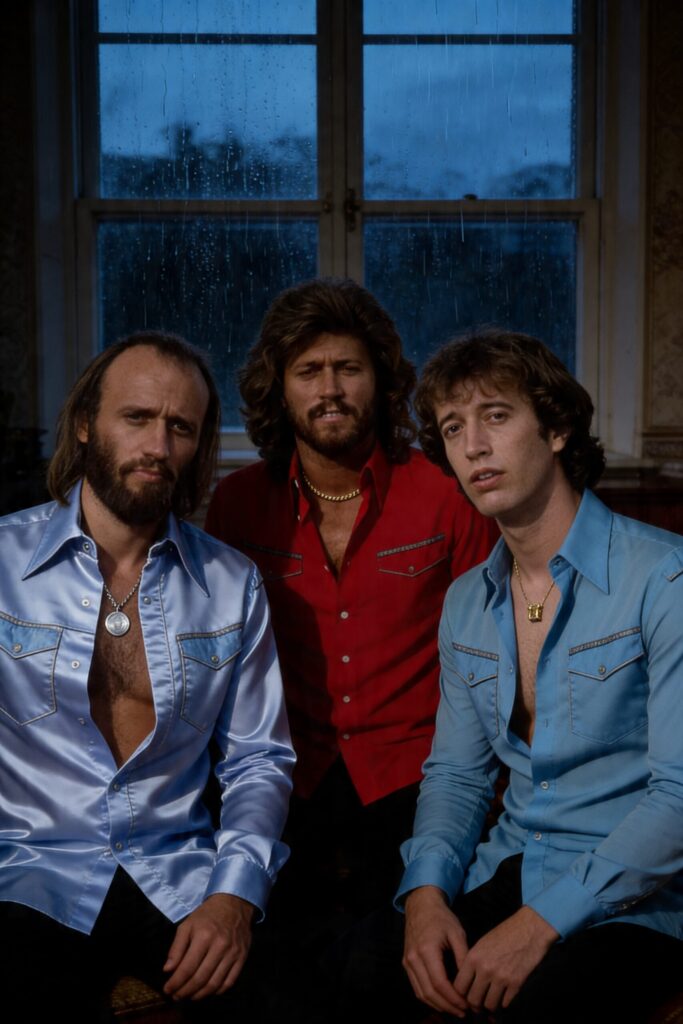
On I Surrender, the Bee Gees turned away from spectacle and sang about love as trust, humility, and emotional peace.
Among the quieter treasures on Still Waters, the 1997 comeback album by the Bee Gees, I Surrender stands as one of those songs that seems to grow more moving with time. It was not released as a major standalone single, so it did not build its own chart history the way Alone did. But the album that carried it made a strong international impression, reaching No. 2 in the UK and No. 11 on the Billboard 200 in the United States. That matters, because I Surrender belongs to a chapter when the Gibb brothers were no longer trying to prove they could write hits. They already had. What they were doing instead was something more difficult and, in many ways, more lasting: writing from maturity.
By the time Still Waters arrived, Barry Gibb, Robin Gibb, and Maurice Gibb had traveled through more eras than most groups ever survive. They had been beat poets of melancholy pop, architects of baroque studio beauty, global kings of the disco years, and then, for too long, victims of lazy misunderstanding by listeners who reduced their legacy to one sound. Yet songs like I Surrender remind us that the Bee Gees were always, at heart, writers of feeling. Their finest work was never really about fashion. It was about the ache of wanting, the fear of losing, and the fragile courage it takes to love someone without holding back.
That is the quiet strength of I Surrender. The title may suggest collapse or defeat, but the song carries a richer meaning than that. In the hands of the Bee Gees, surrender is not weakness. It is the moment when pride falls away and emotion finally speaks honestly. There is a softness in the song, but also conviction. It understands something many younger love songs miss: that the deepest kind of devotion is not dramatic possession, but willing openness. To surrender here is to trust, to stop resisting, to admit that another person has reached a place in the heart no argument can protect.
Musically, the recording fits beautifully into the elegant, polished atmosphere of Still Waters. The arrangement is smooth and restrained, allowing the melody and harmonies to carry the emotional weight. That choice was wise. The Bee Gees did not need to overwhelm the listener. Their voices had always been capable of delivering complexity through tone alone. On I Surrender, those familiar harmonies do not sound theatrical; they sound seasoned. There is grace in the phrasing, and a sense that the song is less interested in making a grand statement than in telling a personal truth. It is the kind of performance that invites the listener inward rather than reaching outward for applause.
The story behind the song is best understood through the place the brothers occupied in 1997. They were elder statesmen of popular music by then, still commercially viable, still creatively alive, but carrying the weight of history with them. Still Waters was embraced partly because it showed that the Bee Gees could still write for the present without abandoning the emotional intelligence that had defined them from the beginning. In that context, I Surrender feels almost like a private statement tucked inside a public return. If Alone was the album’s large doorway back into radio and popular attention, then I Surrender was one of the rooms deeper inside the house, where the real atmosphere of the record could be felt.
There is also something unmistakably adult in the song’s emotional language. Many classic love songs are built on pursuit, longing, jealousy, or heartbreak. I Surrender lives in a more reflective emotional space. It speaks to what happens after some of life’s noise has settled, when love is not a fantasy but a decision, not a chase but a yielding. That gives the song its quiet power. It does not beg. It does not boast. It simply opens. That kind of writing can be harder to appreciate in youth, when intensity is often mistaken for truth. But with time, the wisdom of a song like this becomes more and more evident.
Another reason the song lingers is that it carries the special emotional signature of the Gibb brothers themselves. So much of the Bee Gees catalog is marked by a curious blend of vulnerability and control. Their songs often sound polished on the surface, yet underneath there is always some tremor of need, regret, tenderness, or longing. I Surrender belongs firmly in that tradition. Even within its smooth late-1990s production, it feels personal. The performance suggests men who understood that the hardest truths in life are often spoken quietly.
For listeners who know the Bee Gees mainly through the giant singles, discovering I Surrender can feel like opening a letter that was slipped between the pages of a famous book. It may not have dominated radio or driven headlines, but it reveals the band’s emotional craftsmanship with remarkable clarity. It shows that their late-period work was not merely a continuation of an old legacy. It was a refinement of it. The brothers were still writing about the heart, but now with less urgency, more patience, and a deeper acceptance of love’s cost.
In the end, that may be why I Surrender stays with people. It does not demand attention. It earns it slowly. It is a song about letting go of defenses without losing dignity, about devotion without melodrama, about the kind of emotional honesty that only becomes more beautiful as the years pass. In a catalog filled with towering hits and cultural landmarks, this understated track from Still Waters reminds us of something essential: the Bee Gees were never great only when they were enormous. They were just as great when they were intimate.
