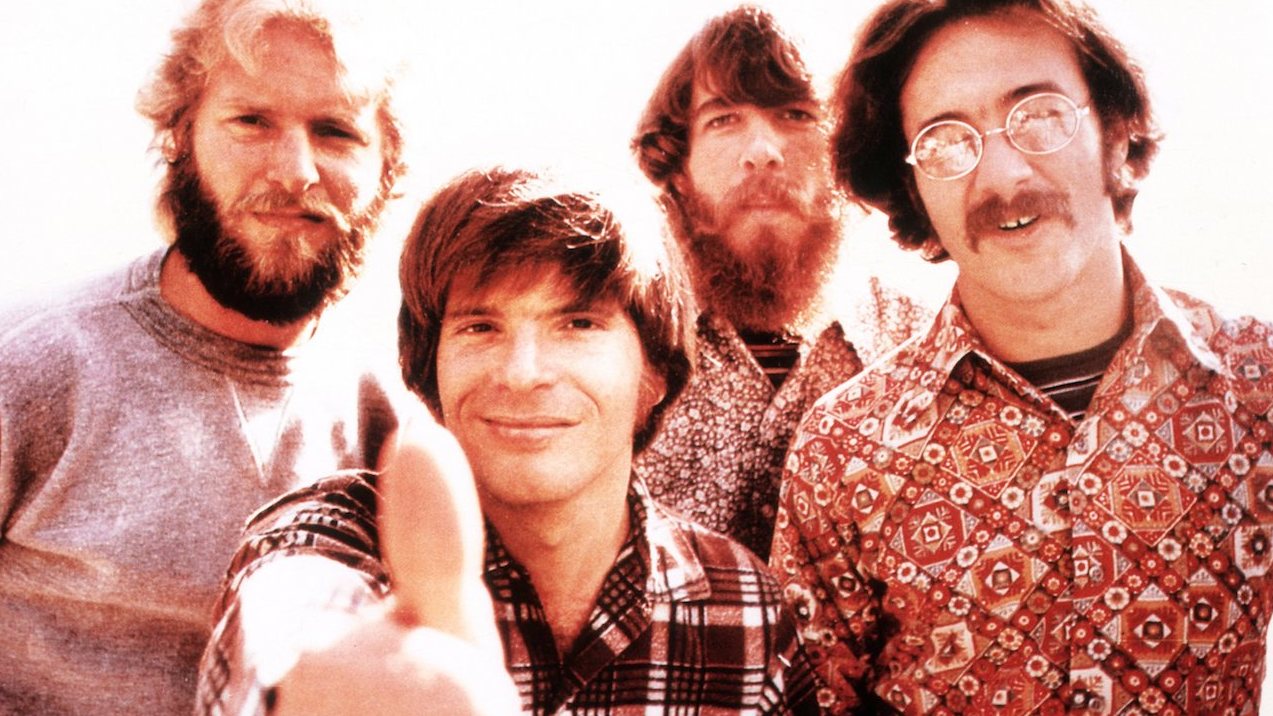
“Bonita” feels like one of those lost titles that should belong to Creedence Clearwater Revival—and that is exactly why it continues to fascinate listeners who swear they almost remember it.
Now and then, a song title appears in the world of old music collecting like a wisp of smoke: familiar, believable, and strangely hard to hold onto. That is the case with “Bonita” and Creedence Clearwater Revival. For many listeners, the title sounds as if it ought to be real, as if it could have lived somewhere between the lean force of “Green River”, the midnight mood of “Born on the Bayou”, and the plainspoken ache that John Fogerty could put into almost any melody. But the important fact comes first: there is no confirmed official CCR release titled “Bonita” in the band’s canonical discography, and no original chart position exists for it because it was not issued as an official single or album track.
That alone tells a story. In a catalog as carefully documented as that of Creedence Clearwater Revival, a genuine song does not usually vanish without leaving a trace. The band’s official studio albums—Creedence Clearwater Revival (1968), Bayou Country (1969), Green River (1969), Willy and the Poor Boys (1969), Cosmo’s Factory (1970), Pendulum (1970), and Mardi Gras (1972)—have been pored over for decades by fans, historians, collectors, and reissue producers. Yet “Bonita” does not appear among those official tracks, nor among the major singles that made the group one of the defining American bands of the late 1960s and early 1970s.
And what a run those real singles had. “Proud Mary” reached No. 2 on the Billboard Hot 100. “Bad Moon Rising” also climbed to No. 2 in the United States and became one of the band’s most enduring recordings worldwide. Those songs were not merely hits; they became part of the emotional furniture of their era. So when a title like “Bonita” begins circulating in fan searches, it immediately raises a wistful question: is this a forgotten deep cut, a mislabeled recording, an unreleased rumor, or simply a memory borrowing the voice of CCR because that voice still feels so vivid?
Most likely, the answer lies in the strange afterlife of old music in the digital era. For years, tracks have been uploaded, copied, renamed, traded, and misattributed across file-sharing sites, video platforms, and unofficial compilations. A song by another artist can easily be tagged as Creedence Clearwater Revival if it carries a swampy guitar sound, a roots-rock pulse, or a vocal texture that faintly suggests Fogerty. Once a mislabel spreads, it gains the momentum of repetition. Before long, the false title begins to feel familiar simply because so many people have seen it.
That is part of what makes “Bonita” such an intriguing subject. It reveals how deeply listeners trust the emotional world of CCR. The name itself sounds cinematic and warm, almost sun-faded. One can imagine it as a roadside song, a quick sketch of longing, maybe a face remembered from a passing town, maybe a romance kept simple and bittersweet. In that sense, the title feels right for the band even if the song itself is not part of their verified body of work. Creedence Clearwater Revival had a gift for making songs feel older than the moment and closer than memory. They sounded like a jukebox in the next room, a summer highway, a riverbank, a warning in the wind. A title like “Bonita” naturally slips into that atmosphere.
There is also a more human reason this mystery lingers: people never stop hoping there is one more real CCR song left to discover. That hope says something beautiful about the band’s legacy. Even now, decades later, listeners are still searching for another hidden doorway into the music. A title with no confirmed place in the discography becomes a vessel for that longing. It stands for the dream of a lost B-side, an abandoned acetate, a stray recording from a rehearsal room, some overlooked fragment from the years when Creedence Clearwater Revival seemed incapable of making an ordinary record.
So what does “Bonita” mean in the end? Perhaps not the meaning of a song, but the meaning of devotion. It reminds us that memory does not always preserve music with archival precision. Sometimes memory preserves feeling first. It remembers the grain of the voice, the push of the rhythm section, the weather inside the sound. Then it builds a title around that feeling and sends us searching.
If you came looking for the chart history of “Bonita”, the truthful answer is simple: there was no official release, so there was no original chart run on Billboard or elsewhere under the name Creedence Clearwater Revival. But if you came looking for why the title still pulls at people, the answer is richer than a discography entry. It is because CCR still lives in that rare place where rumor, recollection, and real music keep brushing against one another. And sometimes, even a song that was not there can tell us how much a band still matters.
