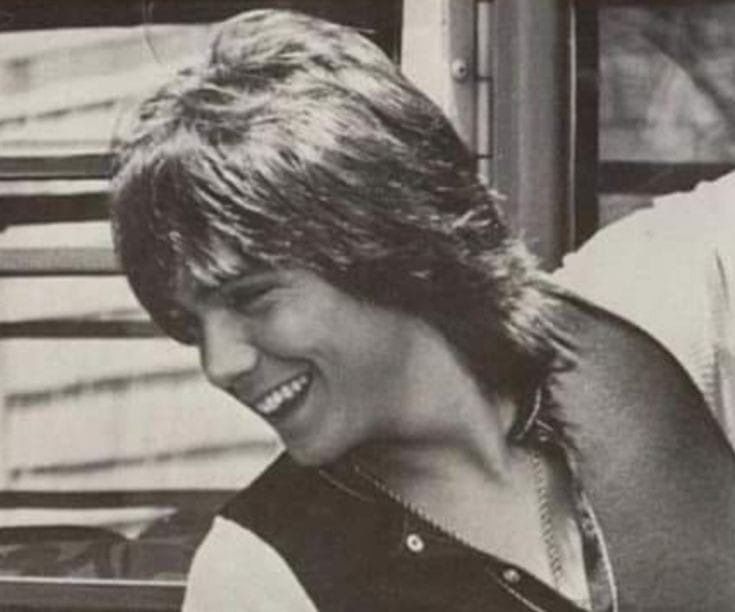
On the surface, Daydreamer is feather-light pop, but in David Cassidy‘s voice it became a quiet wish for somewhere gentler than fame.
Released in 1973, Daydreamer stands as one of the most telling singles of David Cassidy‘s solo career. In the United Kingdom, where Cassidy’s popularity had become a genuine cultural phenomenon, the single was issued as a double A-side with The Puppy Song and rose to No. 1 on the UK Singles Chart, staying there for three weeks. That success mattered for more than numbers. It proved again that the young star who had become famous through The Partridge Family could hold the public in a different way outside the television frame. With Daydreamer, he was not selling mischief or teen commotion. He was selling gentleness, romance, and the ache of wanting to drift beyond ordinary life.
What makes the record endure is how delicately it balances innocence and restlessness. The melody is polished, warm, and immediately accessible, exactly the kind of early-1970s pop that seemed to float instead of march. Yet underneath that softness there is a tug of longing. Daydreamer is built around the image of someone who lives a little apart from the hard edges of the world, someone drawn toward imagination, tenderness, and escape. That idea fit the mood of the era, but it also fit David Cassidy in a way that now feels almost painfully apt. Here was one of the most visible young men in pop culture singing a song about drifting somewhere quieter.
That is part of the hidden emotional power behind the record. By 1973, Cassidy was living inside a level of attention that few performers handle comfortably. The screaming crowds, the magazine covers, the endless projection of fantasy onto his face and voice had made him an international idol, especially in Britain and Australia. But fame of that kind can flatten a person into an image. Daydreamer quietly pushed back against that. Even though he did not write the song, he sang it with a tenderness that suggested interior life, not just public charm. The performance is light, yes, but it is never empty. There is a softness in his phrasing that gives the song its lasting appeal.
Musically, the single sits in that elegant space where teen pop meets soft rock. The arrangement does not force itself forward. Instead, it gives Cassidy room to sound intimate and melodic, almost as if he is leaning closer rather than performing at a distance. That mattered. A great many records made for teen idols were designed only for immediacy. Daydreamer has immediacy, but it also has atmosphere. It lingers. The sweetness is real, yet there is something wistful around the edges, as though the song understands that dreams are beautiful partly because they are fragile.
The backstory of David Cassidy‘s career makes the song resonate even more deeply. He spent years trying to be taken seriously as a musician and not simply as a television phenomenon. He had the voice, the instinct, and the charisma, but the machinery around him often preferred the simpler story of a pin-up idol. Songs like Daydreamer helped widen that picture. It showed how effectively he could inhabit a song that depended on mood rather than spectacle. For listeners at the time, it was easy to hear it as a beautiful pop single. Looking back, it feels like a clue to the emotional contradiction that ran through so much of his early success: the louder the world became around him, the more moving he sounded when he sang about softness.
The meaning of Daydreamer has always been larger than its simple title. It is about yearning, certainly, but not in a grand dramatic way. It is about wanting a life that feels kinder, slower, and somehow more private. That may be why the song has aged so gracefully. Its emotions were never tied to a passing trend. They belong to a very human instinct: the wish to step outside pressure for a moment and live in a gentler imagination. When Cassidy sang it, that instinct felt especially believable. Beneath the handsome image and polished production was a young artist carrying more strain than many listeners knew.
There is also a reason the song still stirs such strong memory in those who lived through that era. It arrived at the height of a phenomenon, yet it does not sound trapped by it. Many records associated with teen hysteria end up frozen inside their own moment. Daydreamer escaped that fate because it was never only about fashion or frenzy. It carried tenderness, and tenderness usually survives longer than hype. Long after the posters come down and the headlines fade, that gentle melody still suggests a private place inside the noise.
So when people revisit David Cassidy through Daydreamer, they are hearing more than a hit single from 1973. They are hearing one of the clearest expressions of what made him compelling in the first place: vulnerability wrapped in pop sheen, sweetness touched by distance, and the sense that behind the idol there was always a thoughtful young man looking for room to breathe. That is why the song remains more than a memory. It feels like a sigh from another time, still soft, still sincere, still carrying the ache of escape.
