
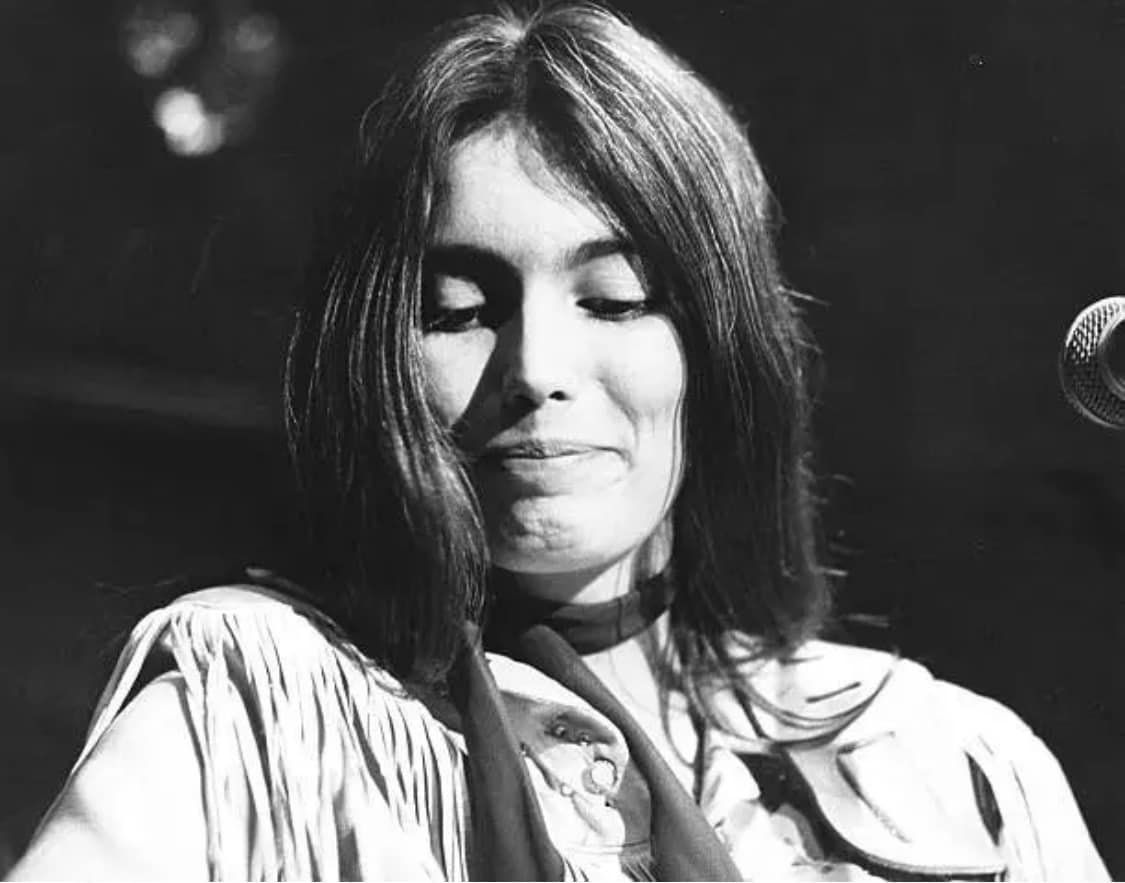
A title made for wanderers, “Even Cowgirls Get The Blues” turns freedom into something lonelier than it first appears, where pride still stands tall but the heart has already paid for the ride.
There are song titles that seem to open a whole landscape before the music even begins. “Even Cowgirls Get The Blues” is one of them. It sounds wide-open, windblown, full of dust and independence, the kind of title that promises movement, stubbornness, and a woman who knows how to keep going. But when Emmylou Harris sings it, that freedom does not feel weightless. It feels bittersweet. The road is still there, the self-possession is still there, yet something in the performance tells you that independence has its own ache, and that even the strongest spirit carries its bruises in silence.
Her version appeared on Blue Kentucky Girl, released in April 1979, an album that marked a graceful return to a more traditional country sound in her catalog. The record reached No. 6 on Billboard’s Top Country Albums chart, and within its beautifully judged mix of longing, steel guitar, and old-country poise, “Even Cowgirls Get The Blues” occupies a particularly intriguing place. It was written by Rodney Crowell, and Crowell himself later said he had written the song with Emmylou Harris and Susanna Clark in mind, which gives the performance an added intimacy. This was not just a clever title handed to a singer who knew how to wear it. It was a song already circling her spirit before she ever sang a line.
That may be why the song feels so naturally hers. On the surface, it carries the romance of the untamed woman, the drifter, the one who will not be fenced in by ordinary expectation. But the title also contains its own shadow. Even cowgirls get the blues. Even the ones who look born for the horizon. Even the ones who seem made for freedom. That one word changes everything. It lets the song admit that self-reliance does not cancel loneliness, and that the open road can sometimes deepen it. In Emmylou’s voice, that contradiction becomes the whole soul of the song.
There is a special tenderness in the way she handles it. She does not sing the title as a slogan. She sings it with the kind of calm understanding that keeps the song from becoming mere attitude. That is what makes it so moving. The independence in the song remains intact, but it no longer feels glamorous in any easy sense. It feels earned. It feels lived in. One hears not only motion and pride, but the cost of having to hold oneself together while moving on.
The setting around the song deepens that feeling beautifully. Blue Kentucky Girl was produced by Brian Ahern, and it is often remembered as one of Emmylou’s most purely country albums. The sound is spacious, elegant, and unforced, which gives a song like “Even Cowgirls Get The Blues” exactly the right emotional frame. Nothing is crowded. Nothing is pushed too hard. The song is allowed to keep its ambiguity — half celebration, half sigh. It also carries backing harmonies from Dolly Parton and Linda Ronstadt, born out of the earlier, not-yet-realized Trio sessions, and that detail adds a lovely sense of feminine kinship to the track without disturbing its solitude.
That balance is what makes the song linger. Plenty of songs about independence lean so hard on strength that they forget vulnerability, and plenty of sad songs forget the dignity of standing alone. “Even Cowgirls Get The Blues” holds both. It lets the listener feel the posture of a wanderer and the sorrow of being one. That combination suits Emmylou Harris perfectly. Few singers have ever been better at making sadness sound poised rather than broken, and few have understood so instinctively that grace can make heartbreak cut even deeper.
The “remastered” tag that listeners often see now belongs to later digital and reissue life, not to the emotional world of the song itself. What still matters is the performance — how naturally Emmylou inhabits this woman, how gently she lets the title bloom into something larger than a phrase, how the song stands at the meeting point of myth and human truth. The cowgirl remains proud, but the blues arrive anyway. And in that quiet concession lies the beauty of it.
So the title may be made for wanderers, but the song reaches far beyond the romance of wandering. In Emmylou Harris’ “Even Cowgirls Get The Blues,” independence is not stripped of its allure; it is simply shown whole. The freedom is real, the motion is real, the spirit is real — and so is the loneliness that travels beside them. That is why the performance still lingers. It understands that sometimes the strongest people are not the ones untouched by sorrow, but the ones who carry it with style, dignity, and their eyes still fixed on the horizon.
