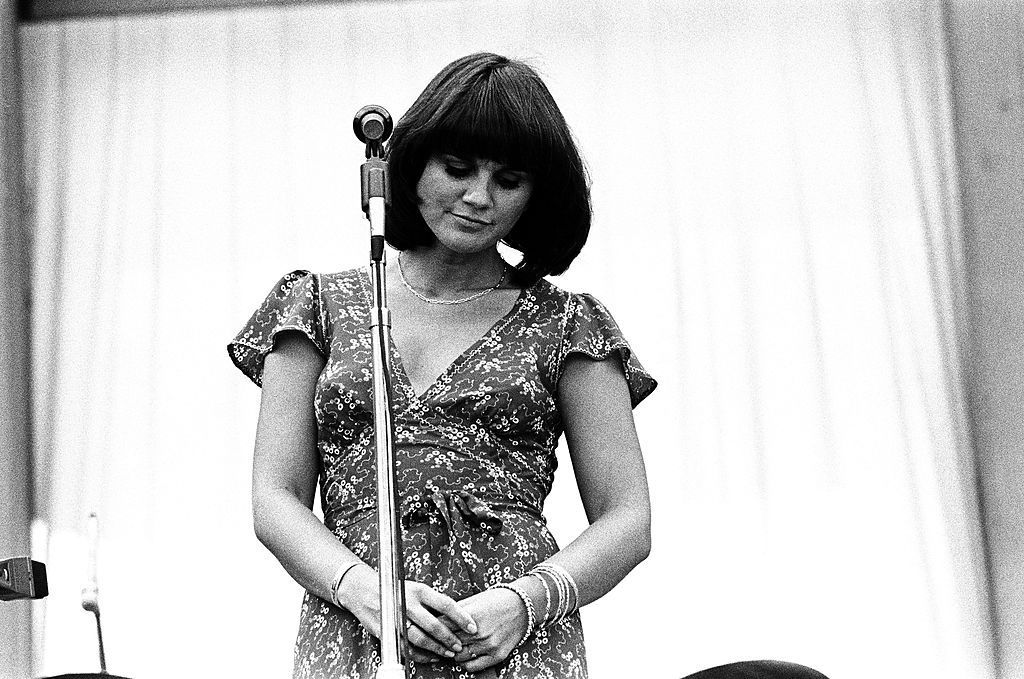
In Linda Ronstadt’s hands, “Miss Otis Regrets” becomes more than a standard—it feels like a velvet curtain drawn back on an older, darker elegance, where grace and ruin sit at the same table.
When Linda Ronstadt recorded “Miss Otis Regrets,” the surprise was not that she could sing it. By then, she had already spent decades proving that she could move between rock, country, pop, operetta, standards, and Mexican song with unusual authority. The surprise was the atmosphere she found inside it. Her version appeared on Hummin’ to Myself, released on November 9, 2004 by Verve, a late-career album devoted to classic standards and jazz material. The album reached No. 3 on Billboard’s Top Jazz Albums and No. 166 on the Billboard 200, while the song itself was not promoted as a separate chart single. That is important, because “Miss Otis Regrets” lives in her catalog not as a radio event, but as one of those performances that quietly reveal the range of an artist’s imagination.
The song itself came from a much older and far more intricate world. “Miss Otis Regrets” was written by Cole Porter in 1934, and from its first lines it carried that uniquely Porter combination of wit, sophistication, and cruelty. On the surface, the lyric sounds almost absurdly polite: a servant informing “madam” that Miss Otis regrets being unable to attend lunch. But the real story unfolds beneath that civility. Miss Otis has killed her unfaithful lover, been arrested, and then taken by a mob before she can keep her social appointment. That chilling contrast—high manners wrapped around violence and shame—is the song’s entire genius. Porter reportedly improvised its earliest form at a party, turning a kind of musical joke into one of the darkest miniatures in the American songbook.
That background helps explain why Linda Ronstadt sounds so unexpected here. Many listeners first learned her through the open-hearted sweep of “Blue Bayou,” “You’re No Good,” or the radiant ache of Heart Like a Wheel. Even those who followed her into the Nelson Riddle years may still think of her standards work as lush, romantic, and glowing. But “Miss Otis Regrets” is not glowing. It is poised, theatrical, and quietly merciless. Ronstadt did not place it in a large orchestral showcase. On Hummin’ to Myself, she returned to standards in a smaller-group jazz setting, with producers George Massenburg and John Boylan, and with players including Alan Broadbent, Christian McBride, Peter Erskine, and Roy Hargrove elsewhere on the album. The result is less grand than her 1980s albums with Riddle, but in some ways more intimate and more dangerous.
That may be why the performance feels so refined. Ronstadt does not overplay the song’s wickedness. She does not push it into camp, and she does not flatten it into mere period elegance. She trusts the material. The old-world diction remains, the poise remains, but beneath it one can feel the moral collapse the lyric never states outright until it is too late. In a song like this, understatement is everything. The horror becomes sharper because no one raises their voice. Ronstadt understood that instinctively. On an album built from songs she had long wanted to record—material linked to the classic jazz and standards world she had loved for years—“Miss Otis Regrets” stands out because it allows her to inhabit not only melody, but character.
There is also something deeply fitting about Ronstadt arriving at this song so late in her recording life. Hummin’ to Myself was her twenty-fourth studio album, and it would become her final solo studio album before retirement. By then she no longer needed to prove versatility; she could simply choose material that interested her. The album itself was described as a return to the classic standards territory she had explored earlier, though this time without the sweeping Nelson Riddle orchestra and with a more overtly jazz-centered approach. In that setting, “Miss Otis Regrets” feels like the work of an artist drawn not to display, but to nuance—to songs with hidden rooms inside them.
The meaning of the performance lies, finally, in that strange balance between beauty and brutality. Cole Porter wrote a song in which social grace becomes a mask for scandal, vengeance, and death. Linda Ronstadt sings it without tearing the mask away too soon. That restraint is what makes the performance feel so pure, so controlled, so unexpectedly elegant. It is “class” not in the shallow sense of polish alone, but in the deeper sense of discipline—knowing exactly how much feeling to reveal, and how much to leave trembling under the surface.
So yes, “Miss Otis Regrets” remains one of the most unexpected corners of Linda Ronstadt’s recorded legacy. Not because it is a novelty, and not because it sits awkwardly beside her better-known work. Quite the opposite. It fits because Ronstadt always had an interpreter’s instinct for songs that held more than they first seemed to say. Here she found one of the darkest jewels in the American songbook and treated it with perfect composure. The result is a performance of rare tact and lasting fascination—civilized on its face, tragic in its bones, and unmistakably worthy of a singer who knew that true elegance is never merely pretty.
