
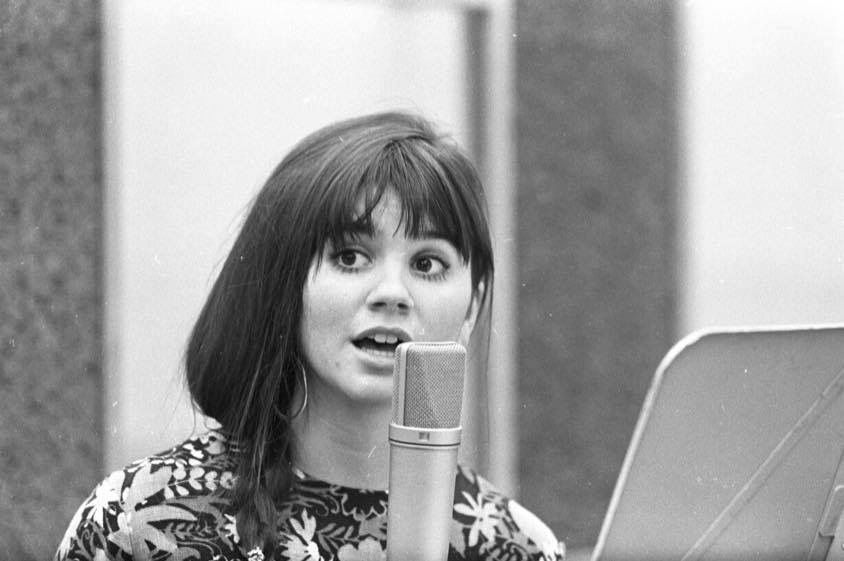
Linda Ronstadt’s “That’ll Be the Day” did not merely revive an old rock ’n’ roll favorite—it gave a familiar promise of heartbreak a new glow, as if memory itself had learned to sing in a different voice.
When Linda Ronstadt released her version of “That’ll Be the Day” in 1976, she was not reaching for nostalgia as a costume. She was already one of the defining voices of American popular music, and by then she had the rare gift of making a borrowed song sound uncannily personal. Her recording appeared on Hasten Down the Wind, released on August 9, 1976, produced by Peter Asher for Asylum Records. The song rose to No. 11 on the Billboard Hot 100, No. 27 on Billboard’s Country chart, and climbed as high as No. 2 in Canada, proof that this was no minor tribute tucked quietly into an album. It was a genuine hit, warmly received in its own time, and part of an album that later won Ronstadt the Grammy for Best Female Pop Vocal Performance.
That matters, because “That’ll Be the Day” already carried a sacred kind of history. Long before Ronstadt touched it, the song belonged to Buddy Holly and the Crickets, whose 1957 version became a turning point in early rock ’n’ roll. It was Holly’s first great breakthrough, a record that topped the American sales chart and also reached No. 1 in the UK, turning a young West Texas musician into an international figure. The title itself came from a line in John Ford’s The Searchers, where John Wayne repeatedly says, “that’ll be the day,” a phrase Holly and Jerry Allison took and transformed into something at once playful, wounded, and unforgettable.
But Linda Ronstadt did something very different with it.
Where Buddy Holly’s original had the bright confidence of youth, Ronstadt’s version carried the wisdom of someone who understood that defiance and vulnerability often live side by side. She did not try to imitate the wiry energy of the 1957 hit. She softened its edges without weakening its spirit. In her hands, the song became less like a rebellious wink and more like a clear-eyed memory—still rhythmic, still buoyant, but shaded with feeling. That was part of Ronstadt’s greatness as an interpreter: she could take a song people thought they already knew and reveal an emotional weather inside it that had gone unnoticed.
By 1976, that approach fit perfectly with where Ronstadt stood artistically. Hasten Down the Wind marked a moment when her recordings were becoming more expansive and emotionally textured. The album drew from contemporary songwriters and older material alike, and Ronstadt moved through those choices with remarkable assurance. Including “That’ll Be the Day” on that record was more than an affectionate nod to rock’s past. It placed Buddy Holly inside the broader map of American song that Ronstadt was building—one where country, rock, pop, heartbreak, and memory were never far apart.
The story behind the song gives Ronstadt’s version even more weight. Holly’s original had grown out of youthful bravado, but its lyric is really a line drawn against betrayal: you say you’re gonna leave—well, that’ll be the day. Beneath the catchy repetition is a fragile hope, almost superstitious in tone, as if saying the words aloud might keep the loss from happening. That emotional contradiction is one reason the song lasted. It sounds cheerful enough to dance to, yet its heart is bracing for disappointment. Ronstadt understood that tension instinctively. She did not overstate it. She simply sang it in a way that let the ache remain visible beneath the polish.
And perhaps that is why her recording still feels so alive. Revival records often arrive with a little dust on them, too aware of the past they are trying to honor. Ronstadt’s “That’ll Be the Day” never suffers from that problem. It feels lived in, not preserved. She sang with too much conviction, too much natural emotional command, for the performance to become an exercise in retro style. The record moves with real grace, and her phrasing gives the old lyric a fresh pulse, as though she had found the secret door between remembrance and the present moment.
There is also something quietly moving in the fact that Ronstadt, one of the great singers of the 1970s, chose to revisit a song from rock’s first flowering instead of trying to outmodern her own era. She knew that a strong song does not belong to one decade. It waits for another voice, another season of life, another way of hearing. When she recorded “That’ll Be the Day,” she was not simply looking backward. She was proving that the emotional truth inside a song can survive every change in fashion.
So yes, in one sense it was a kind of rock ’n’ roll revival. But that phrase hardly says enough. What Linda Ronstadt really did was more delicate, and more lasting. She took a song already fixed in American memory and made it feel newly human again. She let it breathe in a different light. And in doing so, she reminded listeners that some songs do not return as relics—they return as companions, carrying the old ache, the old melody, and somehow, against all odds, a brand-new heart.
