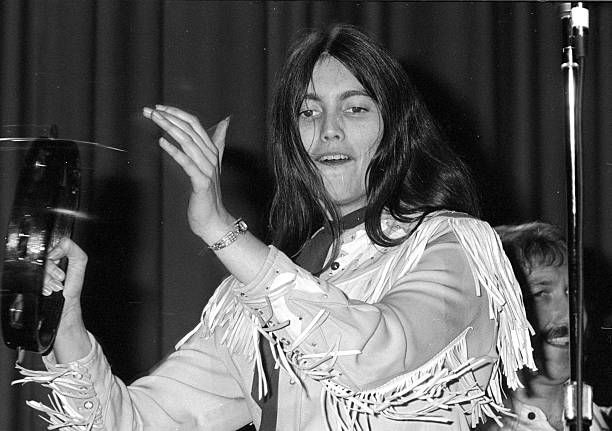

“Queen of the Silver Dollar” is Emmylou Harris at her most luminous and world-weary—a barroom portrait of feminine pride, loneliness, and survival, sung with such grace that even the smoke seems to glow around it.
One of the most important facts to place right at the beginning is that “Queen of the Silver Dollar” comes from Emmylou Harris’s breakthrough major-label album Pieces of the Sky, released on February 7, 1975. The song was written by Shel Silverstein, and Harris’s recording became the most successful charting version of the song to that point, reaching No. 18 on Billboard’s Hot Country Singles chart in 1975. The album that carried it was no minor footnote either: Pieces of the Sky rose to No. 7 on Billboard’s country albums chart and is widely regarded as the record that truly launched Harris as a major force in country music after her years with Gram Parsons. On the track itself, Linda Ronstadt sings harmony, a lovely detail that adds even more glow to one of Harris’s most memorable early performances.
As for the wording “2003 Remaster,” that label refers not to a newly recorded version, but to the later expanded/remastered reissue of Pieces of the Sky, issued in the early 2000s and commonly reflected in digital catalog listings. Discogs’ release data shows “Queen of the Silver Dollar (2003 Remaster)” as part of the expanded remastered edition of the album, even though the performance itself remains the original 1975 recording produced by Brian Ahern. In other words, the soul of the song belongs entirely to the mid-1970s; the remaster simply refreshed the sound for later listeners and reissue buyers.
The story behind the song begins, of course, with Shel Silverstein, one of those rare American writers who could move easily between wit, heartbreak, rowdy humor, and bruised tenderness. “Queen of the Silver Dollar” is one of his finest character songs, a vivid portrait of a woman who rules a cheap drinking place with charisma, style, and sadness. She is glamorous in a hard-lived way, regal but not protected, admired yet not truly sheltered from loneliness. That was exactly the kind of material that suited Emmylou Harris in her early prime. She had an uncanny gift for taking songs about worn places and wounded people and singing them with a purity that never erased their grit. Instead, she made the grit shimmer. The result is that Harris does not reduce this woman to a barroom cliché. She gives her stature. She lets her remain a queen, even in a kingdom made of cigarette smoke, jukebox light, and late-night disappointment.
That is the heart of the song’s meaning. “Queen of the Silver Dollar” is not merely about a woman in a tavern. It is about dignity in disreputable places. It is about the strange majesty some people carry even when life has not rewarded them with comfort, safety, or lasting love. The title itself is brilliant: a silver dollar is valuable enough to suggest worth, but humble enough to remain close to the everyday world. So this queen is no distant aristocrat. She belongs to ordinary night people, to the broken and the lonely, to the ones who live under neon rather than chandeliers. Harris understands this instinctively. She sings the song not with mockery, not with camp, and not even with pity, but with recognition. She knows this woman’s beauty is mixed with weariness, and that her authority is real precisely because it has been earned in a hard place.
Placed within Pieces of the Sky, the song becomes even more meaningful. That album already showed Harris’s astonishing breadth: she could move from The Beatles’ “For No One” to Dolly Parton’s “Coat of Many Colors,” from Merle Haggard to her own deeply personal “Boulder to Birmingham.” In that company, “Queen of the Silver Dollar” reveals another essential side of her artistry—her love for songs that drew memorable women, not as symbols, but as living souls with contradictions inside them. The album’s wide range also announced something crucial about Harris’s career from the start: she was never going to be a narrow Nashville stylist. She was a connoisseur of emotional truth, and she chose songs accordingly.
The 2003 remaster lets modern listeners hear that early brilliance with a little more clarity, but what endures has nothing to do with remastering technology. What endures is the atmosphere. The slow sway of the arrangement. The affectionate sadness in the lyric. The way Emmylou Harris seems to stand just beside the character rather than above her. Even the harmony from Linda Ronstadt feels like part of the song’s emotional architecture, as though another sympathetic witness has stepped into the room. The performance does not judge this queen of the bar. It crowns her. And that is why the song remains so moving. It understands that some people create their own little thrones because life has denied them larger ones.
So “Queen of the Silver Dollar – 2003 Remaster” should be heard as a later catalog presentation of one of Emmylou Harris’s essential early triumphs: a 1975 recording from Pieces of the Sky, written by Shel Silverstein, enhanced by Linda Ronstadt’s harmony, and carried to No. 18 on the country chart. But beyond those facts lies the deeper reason the song lasts. It gives us one of country music’s great nocturnal portraits—a woman standing proud in a world that has not been kind, still glittering under barroom light, still commanding the room, still holding herself like royalty long after midnight has begun to tell the truth.
