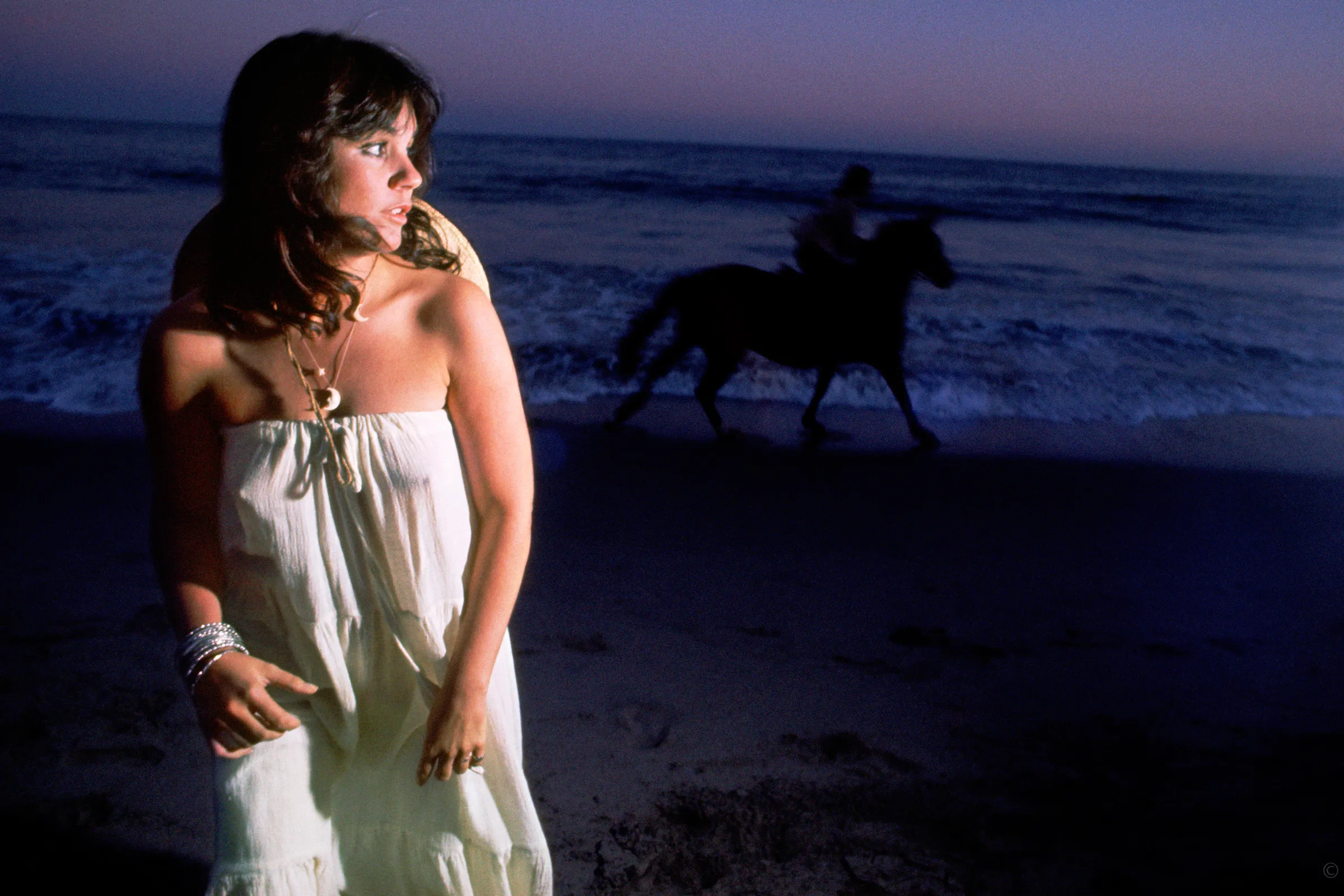
“I’m Leavin’ It All Up to You” is a love song that doesn’t argue—it surrenders, placing a trembling heart on the table and letting the other person decide whether it will be held… or left behind.
By the time Linda Ronstadt reunited her voice with Aaron Neville on Cry Like a Rainstorm, Howl Like the Wind—released October 2, 1989—she had already proven she could master almost any language of song: rock, country, pop standards, ranchera. Yet this album feels like something more intimate than versatility. It feels like a return to human closeness, a record built around the gentle electricity that happens when two voices trust each other enough to sing toward one another rather than simply “alongside.” Produced by Peter Asher and recorded at Skywalker Ranch between March and August 1989, the album became a major success, reaching No. 7 on the Billboard 200 and earning triple-platinum certification in the United States.
Inside that context, “I’m Leavin’ It All Up to You” doesn’t need to be a chart-topping single to matter. It works like a quiet scene in the middle of a film: the lights dim, the bravado steps out, and what’s left is the oldest emotional gamble of all—Here is my love. Do you want it, or are we through? That stark line is the song’s genius. It doesn’t decorate the moment with cleverness. It names the fear plainly: the fear that love can’t be negotiated, only offered.
The song’s history makes this tenderness feel even deeper. “I’m Leaving It Up to You” (often styled with slightly different punctuation/spelling across releases) was famously popularized in 1963 by Dale & Grace, whose version hit No. 1 on the Billboard Hot 100. The song’s legend carries a chilling footnote too: it was the No. 1 song on the Hot 100 when President John F. Kennedy was assassinated—a reminder of how pop music sometimes becomes entwined with national memory in ways no songwriter could foresee. So even before Ronstadt and Neville touch it, the song already carries a kind of American echo: romance living beside history, private longing happening while the world changes outside the window.
What makes Linda Ronstadt such a rare interpreter is her ability to make “old” songs feel newly vulnerable. In her hands, “I’m Leavin’ It All Up to You” becomes less doo-wop innocence and more adult reckoning. The lyric isn’t playful here; it’s bruised. There’s a particular kind of pain in choosing not to fight—because surrender can be either peace or defeat, and you don’t know which until the other person answers. That’s why the title line cuts so cleanly: it’s not romantic “fate,” it’s emotional risk management. It’s the moment you stop pretending you can control the outcome.
Pairing her with Aaron Neville (on an album built around their chemistry) sharpens that meaning. This project is explicitly framed as Linda Ronstadt featuring Aaron Neville, and it includes multiple duets that helped define her late-’80s renaissance. In that setting, a song about leaving the decision “up to you” becomes almost cinematic: two voices in dialogue, one offering, the other receiving—or hesitating. Even when the arrangement stays tasteful, you can feel the dramatic tension in the space between their phrases. That space is where the listener lives: remembering the times we tried to sound calm while our hearts were anything but.
There’s another quiet beauty here: Ronstadt’s choice to sing a song with such a long lineage is a kind of respect for continuity. The tune had already traveled from Don & Dewey (the original writers/performers in the 1950s) to Dale & Grace’s No. 1 pop moment, and later to other reinterpretations across decades. When Ronstadt draws it into her 1989 duet-era world, she isn’t museum-curating. She’s proving something truer: that heartbreak doesn’t modernize. It merely changes clothes.
In the end, “I’m Leavin’ It All Up to You” lands like a soft goodbye that hasn’t happened yet. It’s the sound of someone choosing dignity over drama—placing the heart down gently, not because it hurts less, but because pleading would only cheapen what was real. And that is why this song endures across generations: it understands that sometimes love’s final act is not to demand an answer, but to wait for one—quietly, bravely—under the same old melody that has carried the same old question for more than half a century.
