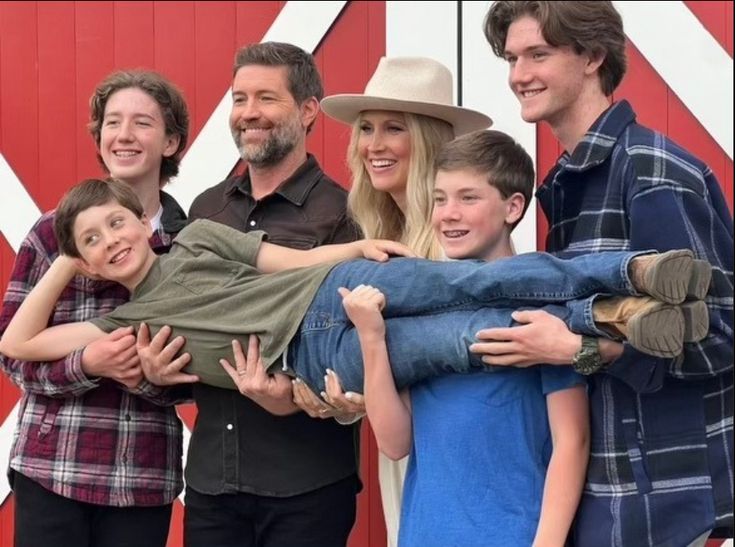
On the surface, Don’t Fence Me In is a Western standard about open land and restless skies, but in Josh Turner‘s hands it feels like something even deeper: a calm, dignified longing for freedom of spirit.
There are some songs that arrive like a memory before they even finish their first line, and Don’t Fence Me In is one of them. Long before Josh Turner lent it his rich, steady baritone, the song had already become part of the American songbook. Written by Cole Porter, with Robert Fletcher later receiving co-credit, it first rose to major popularity in the 1940s and became one of the era’s defining standards. The best-known early recording, by Bing Crosby and The Andrews Sisters, was a No. 1 hit in 1944, where it spent multiple weeks at the top. That chart success matters because it reminds us that this was never a minor period piece. It was a song that spoke to the national imagination.
Josh Turner‘s version, by contrast, was not built as a chart-chasing country-radio event, and it did not emerge as a major standalone Billboard country hit. That is part of its charm. He approaches the song not as a commercial vehicle, but as a piece of inherited American music, something to be respected, understood, and gently reintroduced. And that may be the most fitting way to sing it. A song like Don’t Fence Me In does not need to be forced into modern trends. It only needs the right voice, and Turner has the kind of voice that can make old songs feel as if they have been waiting for him.
What makes his performance so persuasive is the way he avoids overplaying the Western mythology. The song has all the familiar images: wide-open country, fresh air, space enough to wander, and the refusal to live hemmed in by walls or expectations. In lesser hands, that can turn into costume music, a nostalgic postcard with no pulse beneath it. But Josh Turner gives it gravity. His phrasing is patient, unhurried, and deeply grounded. He does not merely sing about freedom; he sounds like a man who understands why people cling to the idea of it.
The story behind Don’t Fence Me In has always been part of its fascination. Though it is forever associated with the American West, its principal songwriter was Cole Porter, a figure more often linked with urbane sophistication than prairie horizons. That contrast is one reason the song endured. It bridged worlds: Broadway polish on one side, Western longing on the other. The lyric’s emotional center is simple and timeless. It is not rebellion for the sake of noise. It is the desire for room to live honestly. To be left enough sky, enough wind, enough inward silence to know who you are.
That meaning lands beautifully in Josh Turner‘s interpretation. His voice has always carried a certain old-soul quality, and here that quality becomes the whole atmosphere of the recording. He does not rush toward the chorus as if trying to manufacture excitement. Instead, he lets the song stretch out. The effect is almost visual. You can hear distance in it. You can hear the horizon. More importantly, you can hear restraint, and restraint is often what gives a classic song its dignity.
There is also something especially moving about hearing a singer like Turner revisit material from an earlier age. He has always seemed at home with songs that value melody, craftsmanship, and emotional clarity over clutter. In that sense, Don’t Fence Me In fits him naturally. It lets him stand in continuity with earlier traditions of country and popular song without sounding imitative. He is not pretending to be a singer from 1944. He is reminding modern listeners that the emotional truths of 1944 have not disappeared. People still get weary of confinement. They still dream of open roads, private peace, and a life that feels larger than routine.
If the song continues to resonate, that is the reason. Its meaning is broader than cattle trails and Western imagery. At heart, Don’t Fence Me In is about the human need for breathing room. Sometimes that means literal landscape. Sometimes it means emotional space, spiritual independence, or simply the right to hold on to one’s own nature. That is why the song has survived so many generations of singers. And that is why Josh Turner‘s reading matters. He does not modernize the lyric by changing it. He modernizes it by singing it sincerely enough that we hear ourselves in it again.
In the end, his version feels less like a remake than a return. It carries the dust of old trails, the grace of classic songwriting, and the unmistakable warmth of a singer who knows how to let a song breathe. For listeners who love music with history in its bones, Josh Turner and Don’t Fence Me In make a natural pairing. The song still opens a window onto a larger world, and his voice makes that world feel close enough to touch.
