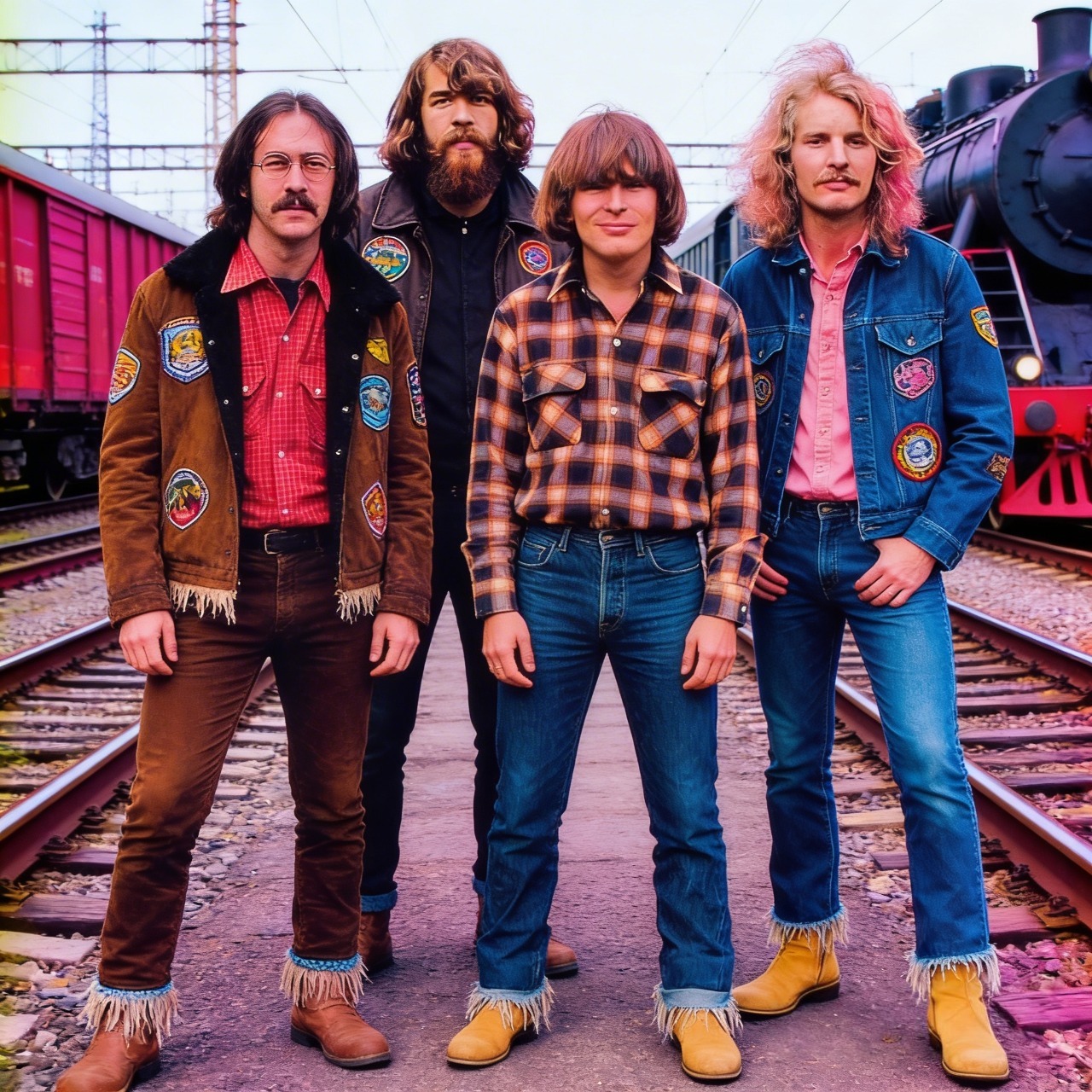
On 1969’s Bayou Country, Creedence Clearwater Revival let the blues slow down, darken, and stretch into an eight-minute train ride.
Released in January 1969 on Bayou Country, “Graveyard Train” sits in one of the most decisive moments of Creedence Clearwater Revival’s early rise. The album also carried “Proud Mary”, the song that brought the band to a much wider public, and “Born on the Bayou”, the opening statement of their swamp-rock identity. But “Graveyard Train”, written by John Fogerty, takes a different road. At more than eight minutes, with an extended harmonica passage at its center, it is not built for immediacy. It is built for atmosphere, weight, and the slow pull of repetition.
That matters because Bayou Country was the record on which the band’s soundworld became unmistakable. Creedence Clearwater Revival came from El Cerrito, California, not the bayou, but their music drew together blues, country, R&B, rock and roll, and Southern imagery into something lean and forceful. Fogerty’s writing did not offer travelogue realism so much as a concentrated American mood: rivers, heat, work, danger, motion, and fate. “Graveyard Train” belongs to the darker edge of that world, where movement does not promise escape. The train in the title feels less like transportation than a warning passing through the night.
The recording’s heaviness comes from restraint as much as volume. The groove does not hurry. Doug Clifford’s drumming holds the track close to the ground, while Stu Cook’s bass gives the performance a thick, repeating pulse. The guitars do not clutter the space; they help set a frame around the rhythm, leaving room for the vocal and harmonica to occupy the foreground. Instead of the bright, compact architecture of the band’s best-known singles, the track works like a long corridor. Each pass through the pattern makes the air feel denser.
Fogerty’s vocal is direct, but not flamboyant. He does not need to oversell the darkness because the arrangement is already doing so much work. His voice carries the blues language of warning and loss with a hard, nasal edge that cuts through the murk. Then the harmonica begins to stretch the song beyond conventional verse structure. The extended jam is not ornamental in the easy sense; it becomes the track’s emotional engine. Breath turns into rhythm. Phrases bend, repeat, answer themselves, and fray at the edges. The instrument gives the song a human scale, yet its placement inside the relentless groove makes it feel trapped inside the machinery of the train itself.
In the late 1960s, long rock tracks often announced themselves through virtuosity, psychedelic expansion, or collective improvisation. “Graveyard Train” is related to that era, but it does not sound like a band trying to float away from the song. It stays stubbornly earthbound. The length intensifies the smallness of the musical materials rather than disguising them. A riff, a pulse, a voice, a harmonica: the recording returns to these elements until they feel less like parts of an arrangement and more like weather.
This is also what makes the track important within Bayou Country. The album is often remembered through the clarity of “Proud Mary” and the thick mythic opening of “Born on the Bayou”, but its identity also depends on the willingness to linger. “Keep On Chooglin’”, another long track on the same album, turns endurance into drive; “Graveyard Train” turns endurance into dread. Together, they show a band discovering that repetition could be more than a beat. It could become a landscape. It could make the listener feel distance, heat, danger, and time without needing elaborate studio decoration.
The darkness of “Graveyard Train” should not be mistaken for theatrical gloom. Creedence Clearwater Revival were rarely ornate. Their power came from compression, discipline, and an almost physical belief in the groove. Even here, in one of their longer and heavier early recordings, the band remains severe. There is no grand orchestration, no elaborate narrative spoken over the music, no attempt to soften the edges. The track trusts the pressure of its own motion. That trust is part of its artistic courage: the courage to stay with a mood long enough for it to reveal its shape.
Heard beside the album’s more famous moments, “Graveyard Train” feels like a shadow cast by the same fire. It reminds us that Bayou Country was not only a breakthrough record of sharp hooks and unforgettable images, but also a study in atmosphere. The eight-minute harmonica jam is the place where the band lets darkness breathe, and where the imagined South of their music becomes less scenic and more elemental. The train keeps moving, but the song’s real force is in how long it makes us stand beside the tracks and listen.
