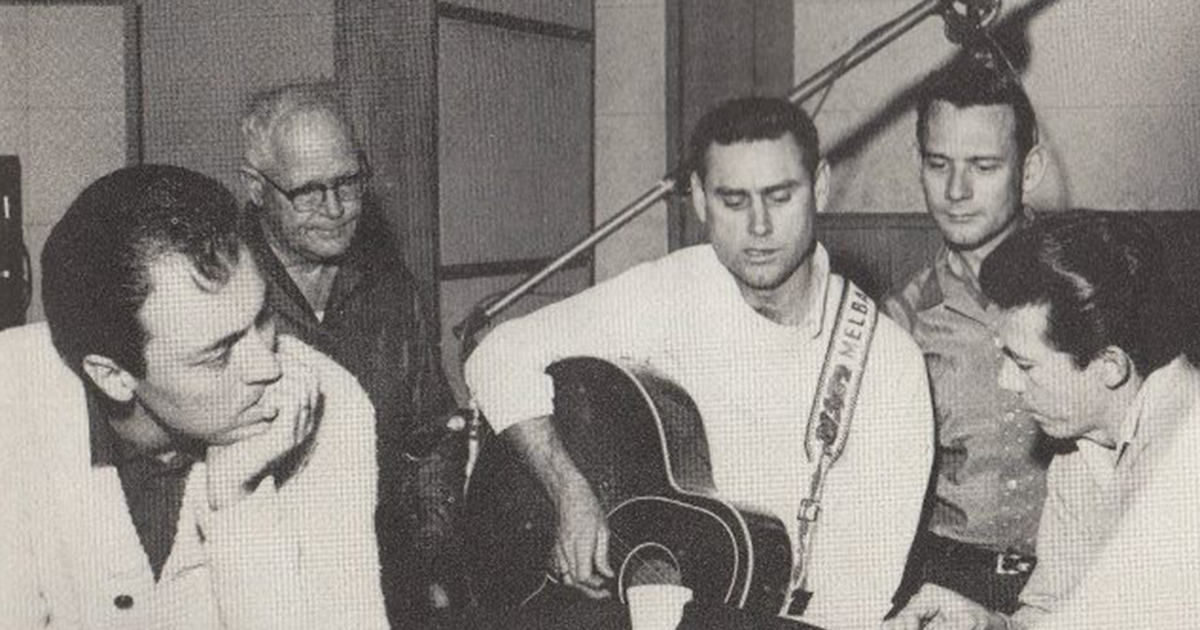
In George Jones’s 1974 The Grand Tour, heartbreak becomes architecture: room by room, a voice refuses to look away.
In 1974, George Jones released The Grand Tour, the title track of his album of the same name and one of the defining vocal performances of his career. Written by Norro Wilson, Carmol Taylor, and George Richey, and produced by Billy Sherrill, the song reached country radio as a formal ballad with a devastatingly simple premise: a narrator invites someone into a house that used to be a home, guiding them through its rooms until the loss at the center can no longer be avoided.
The brilliance of the recording lies in how little Jones needs to force. The lyric already has a theatrical frame, almost like a guided exhibit of domestic ruin. There is a front door, a chair, a bedroom, and finally the nursery. In another singer’s hands, that structure might have invited heavy gestures. Jones chooses a narrower path. He sings as if the narrator has rehearsed the tour many times, not because the pain has faded, but because repetition is the only way he can contain it.
Billy Sherrill’s production gives the performance a polished Nashville setting, with the kind of careful orchestration that could make heartbreak feel formal and immense. Yet the arrangement does not bury the singer. It frames him. The strings and background textures create space around the voice, while the tempo moves with the solemn patience of someone walking from one room to the next. The recording understands that the song is not about a sudden collapse. It is about endurance after collapse, about the strange composure that can appear when there is nothing left to protect.
That composure is where George Jones does his finest work. His voice in The Grand Tour has the familiar bend and ache associated with his greatest ballads, but the performance is not merely sad. It is exact. He lengthens certain vowels until they seem to carry the weight of memory, then pulls back before the emotion becomes ornamental. He can make a single word sound as though it is turning a corner. His phrasing gives the house dimension: each pause feels like a doorway, each rise in pitch like a room the narrator would rather not enter.
The song’s final revelation gives the record its deepest wound. The tour is not simply through a place abandoned by romance; it leads to the absence of a child as well as a partner. Jones does not treat that moment as a trick ending. He has been preparing the listener for it all along through restraint. When the lyric arrives at the nursery, the vocal does not need to explode. The pain has already been measured into the floorboards. The performance lands because it sounds less like discovery than admission.
By 1974, George Jones was already widely respected as one of country music’s most expressive singers. The Grand Tour did not create his reputation from nothing. What it did was gather many of his gifts into one concentrated form: the controlled break in the tone, the conversational intimacy, the ability to make melody feel almost spoken, and the instinct to let sorrow remain dignified. It became career-defining because it clarified what listeners had long heard in him. He could make a song dramatic without making himself theatrical.
The timing also mattered. Country music in the early 1970s held many competing energies: polished Nashville productions, honky-tonk memory, pop crossover ambitions, and a growing taste for more personal-seeming narratives. The Grand Tour sits at the meeting point of those worlds. It has the sweep of countrypolitan production, but its emotional logic belongs to older country storytelling: plain objects, plain speech, and a wound revealed through ordinary detail. The house is not symbolic in an abstract way. It is a chair, a bed, a nursery. The devastation comes from how recognizable those things are.
For that reason, the recording continues to feel intimate even when surrounded by orchestration. Jones never sounds as if he is performing heartbreak from a distance. He sounds as if he is keeping it in order, one phrase at a time. That is the quiet courage of the vocal: not the courage of overcoming pain, but the discipline of naming it without decoration. In The Grand Tour, he turns a lonely house into a map of loss, and then walks it with a steadiness that makes the loss more piercing.
A career-defining performance is not always the loudest or the most technically showy. Sometimes it is the one in which an artist’s gifts become inseparable from the song’s deepest need. George Jones found that meeting place in The Grand Tour. He did not simply sing about an empty home; he gave emptiness shape, pacing, and breath. The door opens, the rooms appear, and the voice remains, carrying what the house can no longer hold.
