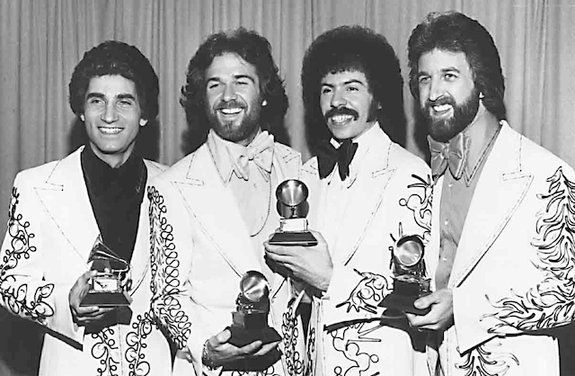
In “Elvira,” The Oak Ridge Boys turned a deep bass phrase into the joyful center of a country harmony moment.
In 1981, The Oak Ridge Boys released “Elvira” as a single from the album Fancy Free, bringing a song written by Dallas Frazier into a new and unusually buoyant life. Frazier had written and recorded the song in the 1960s, but the version that settled into American memory belonged to a quartet whose roots in gospel harmony gave them a different kind of authority. Their “Elvira” became a No. 1 country hit and crossed into the pop Top Five, but the statistics only describe its reach. They do not explain why the record feels so instantly communal.
The explanation begins with the group itself. By the early 1980s, The Oak Ridge Boys were not simply a country act with harmony on top; they were a harmony group moving through country music with gospel-trained precision. The lineup of Duane Allen, Joe Bonsall, William Lee Golden, and Richard Sterban gave the record its balance: lead, brightness, middle weight, and depth. On “Elvira”, those elements are not displayed like separate features. They interlock, creating a record that feels light on the surface because so much discipline is working underneath.
The song itself is built for motion. Its lyric is direct, affectionate, and cheerfully uncomplicated, but the performance does not depend on lyrical complexity. It depends on sound: the bounce of the rhythm, the open vowels of the title, the repeated phrases that invite memory before the song is even over. The arrangement keeps everything clear. Nothing crowds the voices. The instruments provide lift and forward movement, while the vocal blend supplies the personality. It is country music with an oldies smile, but it avoids becoming a costume because the quartet sings it with conviction rather than parody.
At the center of that identity is Richard Sterban’s bass vocal, especially the famous “oom papa mow mow” refrain. What makes the phrase work is not only its depth, but its timing. Sterban does not take over the entire record; he arrives like a perfectly placed grin at the bottom of the harmony. His bass gives the song a physical shape. It turns the chorus downward and outward, making the listener feel the floorboards of the record as much as its melody. In another setting, the syllables might have been a novelty. Here, they become architecture.
That is the quiet sophistication of The Oak Ridge Boys’ reading. The record knows exactly how close it can stand to humor without becoming disposable. The bass hook is playful, but it is framed by a group that understands restraint. Duane Allen’s lead vocal keeps the song grounded, never treating the lyric as a joke. The surrounding harmonies brighten the edges, while William Lee Golden and Joe Bonsall help create the blend that makes the chorus feel wide and open. The listener may remember Sterban first, but the moment works because the whole group makes room for him.
The timing also mattered. Country music in the early 1980s was moving through a period when selected records could travel far beyond their usual radio lanes. “Elvira” did that without sanding away the group’s identity. It did not chase pop fashion so much as reveal how flexible a country harmony record could be. The track carried traces of doo-wop playfulness, gospel-quartet grounding, and Nashville polish, yet it remained simple enough to feel immediate. That combination made it accessible without making it anonymous.
For a harmony group, personality can be a delicate matter. Too much individual display can weaken the blend; too little can make the voices faceless. “Elvira” finds the rare middle ground. It allows one voice, Sterban’s unmistakable bass, to become the signature detail while the quartet remains the real instrument. The record’s pleasure comes from that trust. Nobody has to push beyond the song’s needs. Nobody has to explain the joke. The arrangement smiles, the bass answers, and the group keeps moving.
This is why “Elvira” continues to feel larger than its novelty surface. It is not preserved only by nostalgia or by the memorability of one low vocal phrase. It lasts because it demonstrates a principle that harmony groups have always known: a sound becomes powerful when contrast is organized into unity. High and low, lead and response, polish and looseness, humor and craft all meet in a record that feels effortless only because the structure is so sure.
In the end, The Oak Ridge Boys made “Elvira” a celebration of group identity. Richard Sterban’s bass may be the doorway into the song, but the room belongs to all four voices. The record still carries the feeling of people singing with enough confidence to leave space for one another. That may be its most generous quality: it turns a deep note, a bright chorus, and a simple name into a reminder that joy can be carefully made and still feel completely free.
