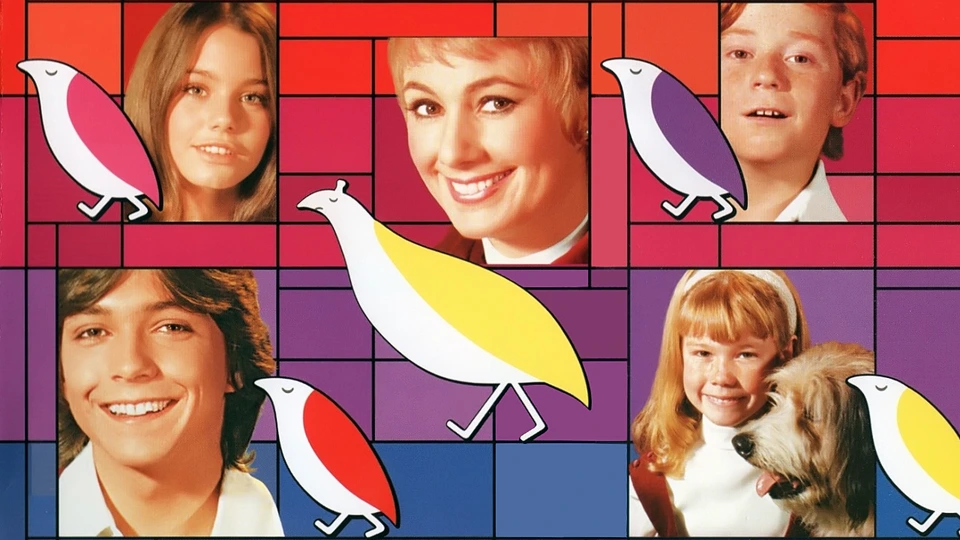
On Crossword Puzzle, a borrowed Bread rocker became a sharper test of David Cassidy’s pop authority—bright, restless, and more assertive than its television-band label suggests.
The Partridge Family placed its 1973 cover of Bread’s “Let Your Love Go” on Crossword Puzzle, an album released during the later stretch of the group’s run as both a hit television phenomenon and a real pop recording project. The song itself came from David Gates, who wrote it for Bread and brought it out in 1971, when the band was expanding its identity beyond the tender, carefully shaped ballads that would come to define much of its radio memory. In Bread’s hands, “Let Your Love Go” moved with a firmer pop-rock pulse; in The Partridge Family’s version, the same material becomes a showcase for David Cassidy at a moment when his voice could sound both polished and impatient to be taken seriously.
A cover song can expose more than a singer’s taste. It can reveal what a performer hears in himself when he steps into someone else’s melody. That is the quiet fascination of The Partridge Family’s “Let Your Love Go.” The group’s records were often placed under the bright umbrella of television pop, tied to the ABC sitcom that made the family-band image familiar in American living rooms. Yet the recordings were carefully constructed studio pop, with Cassidy’s lead vocals and Shirley Jones’s presence giving the fictional premise a real musical center. On Crossword Puzzle, that distinction matters. The name on the sleeve may have belonged to a scripted family, but the voice driving this track belongs to a singer working hard inside a commercial machine.
What makes this version interesting is not that it erases Bread’s original character. It does almost the opposite. It accepts the song’s forward motion, its crisp invitation, its slightly more muscular stance, and filters it through the clean, radio-ready architecture of The Partridge Family sound. Bread’s original recording stood apart from the group’s softer ballads because it had a more kinetic edge, a sense of movement rather than confession. The Partridge Family cover does not turn it into a novelty or a softened imitation. Instead, it brightens the corners and lets Cassidy step into the song as if he has already decided where it needs to go.
David Cassidy’s lead vocal is the engine of the performance. He does not sing “Let Your Love Go” as a pleading romantic figure or as a boyish ornament placed on top of a cheerful arrangement. His phrasing is direct, his tone noticeably assured, and his presence sits up front in the track. There is a confidence here that complicates the easy assumptions often made about Cassidy’s Partridge Family work. The teen-idol image could make everything seem prepackaged from a distance, but the vocal tells a more specific story: a young singer with control, timing, and enough force to make a borrowed song feel like part of his own argument.
That confidence carries extra weight in the context of 1973. By then, Cassidy was balancing the expectations of a massive television audience, the demands of a recording schedule, and the growing scrutiny that came with fame beyond the show itself. Crossword Puzzle arrived when The Partridge Family brand was still recognizable but no longer new, and that makes the album feel less like an introduction than a continuation under pressure. A cover such as “Let Your Love Go” becomes more than filler in that setting. It becomes a small but telling place where Cassidy could push against the boundaries of the image while still operating inside its sound.
The arrangement supports that push without making a spectacle of it. The track belongs to the bright pop-rock language The Partridge Family handled well: clean momentum, accessible hooks, and a surface that invites casual listening. But underneath the shine is a tension that comes from the source material meeting Cassidy’s delivery. Bread’s song had already proved that David Gates could write outside the hushed intimacy many listeners associate with him. The Partridge Family’s version, in turn, suggests that Cassidy could do more than float through sweet melodies. He could give a song lift, direction, and a certain controlled bravado.
This is why the cover rewards a second listen. It sits at the crossing point between two kinds of early-1970s pop credibility: Bread’s songwriter-led craft and The Partridge Family’s television-era accessibility. One came with the aura of a real band navigating the soft-rock landscape; the other came through a fictional family that nevertheless generated real records, real radio memories, and real emotional attachments. “Let Your Love Go” is not the grandest song in either catalog, but it becomes revealing because of that very scale. It is compact enough to show the mechanics clearly: the borrowed tune, the polished production, the lead vocal that refuses to sound anonymous.
Heard now, The Partridge Family’s 1973 take on “Let Your Love Go” feels less like a simple cover and more like a snapshot of Cassidy’s pop instincts in motion. The song keeps its easy appeal, but the performance has a firmer center than its cheerful exterior might suggest. It reminds us that some of the most interesting moments in television pop are not always the biggest hits or the most sentimental favorites. Sometimes they are the album cuts where a familiar voice leans forward, takes possession of another writer’s song, and quietly asks to be heard on its own terms.
