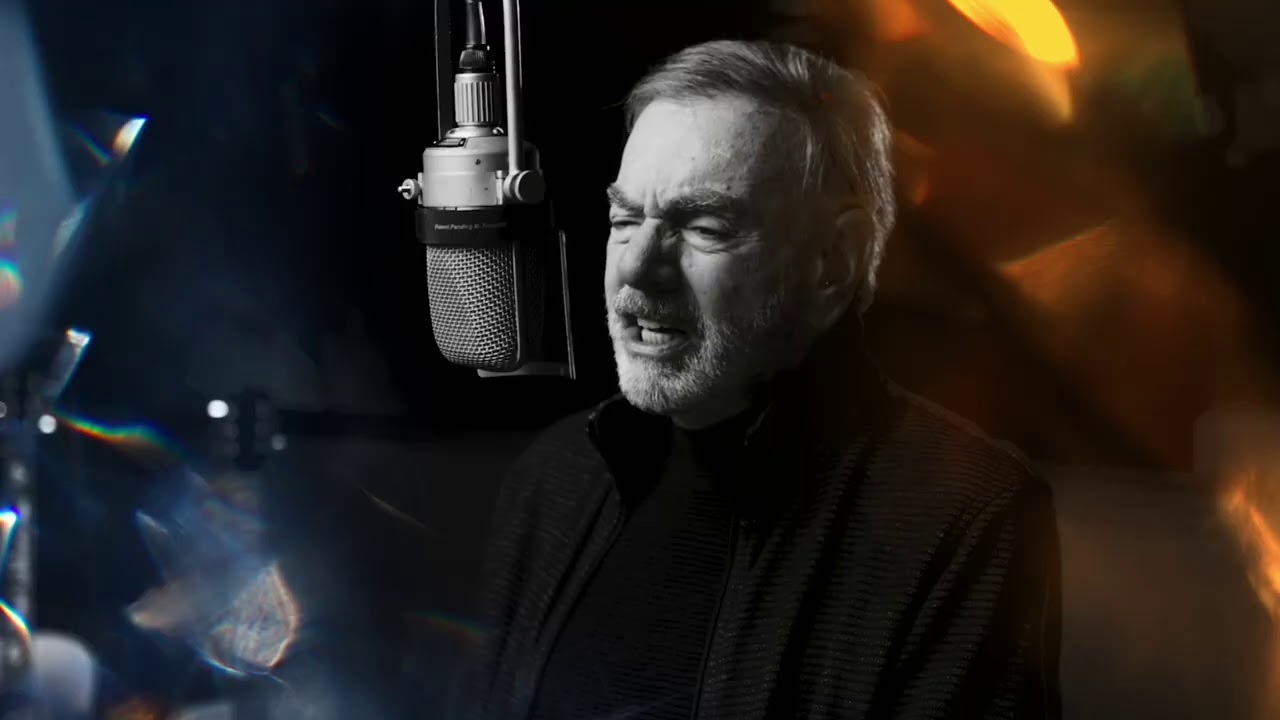
In Neil Diamond’s 1993 reading of Up on the Roof, a city escape first made famous by The Drifters becomes something more reflective: a songwriter returning to the pop craftsmanship that helped shape him.
When Neil Diamond recorded Up on the Roof for his 1993 album Up on the Roof: Songs from the Brill Building, he was not simply adding his name to a beloved standard. He was stepping into a room full of ghosts, many of them friendly, all of them influential. The album was conceived as a tribute to the New York songwriting culture that gave American pop some of its most graceful, durable melodies, and its title track carried the weight of that idea with unusual clarity. This was a Drifters cover, yes, but it was also a kind of homecoming.
The original The Drifters recording of Up on the Roof arrived in the early 1960s, written by Gerry Goffin and Carole King, two of the defining songwriters associated with the Brill Building era. With Rudy Lewis’s lead vocal giving the song its elegant lift, the record turned a simple urban image into a small act of survival. It was not a grand anthem. It did not need to be. Its power came from the modest dream of finding one place above the noise, one private corner where the pressure of the street could loosen its grip.
That is why Diamond’s 1993 version matters as more than a nostalgic exercise. By the time he made the album, he was long past the uncertainty of his early professional life. He had become a major recording artist with a voice instantly recognizable for its grain, reach, and dramatic conviction. But before the arena choruses, the worldwide tours, and songs such as Sweet Caroline and I Am…I Said, Diamond had been a young New York songwriter moving through the same broad ecosystem of publishers, demos, and disciplined pop craft that surrounded the Brill Building world. He knew what it meant to search for a song in a city that could make ambition feel both thrilling and unforgiving.
That background changes the emotional temperature of his cover. Diamond does not approach Up on the Roof as a singer trying to outshine The Drifters. He approaches it like someone who understands the architecture underneath the song. The melody is treated with care, the lyric with respect, and the feeling with the patience of a man who has lived long enough to know that escape is never quite as simple as going somewhere higher. In the Drifters’ hands, the rooftop feels young, immediate, almost weightless. In Diamond’s hands, it feels remembered.
The early 1990s setting also gives the recording its own character. Up on the Roof: Songs from the Brill Building arrived in a period when many veteran artists were revisiting earlier pop and rock-and-roll songbooks through the smoother surfaces of contemporary adult pop production. That could easily have turned the album into a museum piece. Yet Diamond’s best moments on the record work because he is not pretending to belong to 1962. He lets the listener hear the distance between the original era and his own. The cover carries the polish of 1993, but beneath that polish is an older kind of musical manners: clean melody, clear emotional purpose, and a belief that a well-built song can survive a change of voice.
There is a special tension in hearing Diamond sing a song so closely associated with Goffin, King, and The Drifters. He was not one of those voices that disappeared into a composition. Diamond always brought himself with him. His phrasing tends to lean forward; his tone can make even a gentle line feel carved rather than brushed. On Up on the Roof, that quality gives the song a sturdier emotional frame. The rooftop is still a place of relief, but it is no longer only the refuge of a young man fleeing the demands of the city. It becomes a place to look back over the skyline of a life in music.
That is the quiet beauty of this interpretation. The song’s central image remains beautifully ordinary: up above the crowded streets, away from the rush, the calls, the disappointments, the daily friction of city life. But in Diamond’s version, the climb upward suggests more than escape. It suggests memory. It suggests craft. It suggests the way songs themselves can become rooftops, places where listeners go when the world below feels too loud. A cover version succeeds when it finds a new emotional angle without damaging the original shape, and Diamond’s performance does exactly that. He does not strip the song down to confession, nor does he inflate it into spectacle. He simply lets his seasoned voice stand inside the old melody and notice what time has added.
The Brill Building was never only one address, though the famous building at 1619 Broadway became a powerful symbol. It represented a method and a culture: writers working quickly, teams shaping songs with precision, singers turning professional craft into living feeling. Up on the Roof is one of the great examples of that balance. Its construction is graceful, almost effortless on the surface, yet every part of it serves the emotional picture. Diamond’s tribute album understood that these songs were not fragile relics. They were working songs, built to travel from voice to voice.
Hearing Neil Diamond sing Up on the Roof in 1993, then, is like watching an artist pause at the edge of his own history. He honors The Drifters without trying to become them. He honors Gerry Goffin and Carole King without turning their song into an academic lesson. Most of all, he honors the idea that pop music can hold a complete human weather system inside a few minutes: frustration below, open air above, and somewhere between them a voice searching for room to breathe.
That is why this cover still earns attention. It reminds us that interpretation is not always reinvention. Sometimes it is recognition. Sometimes a singer returns to a familiar song not to change its meaning, but to reveal how meaning changes with age, memory, and distance. In The Drifters’ original, the rooftop is a dream of escape. In Neil Diamond’s 1993 version, it becomes a place of return.
