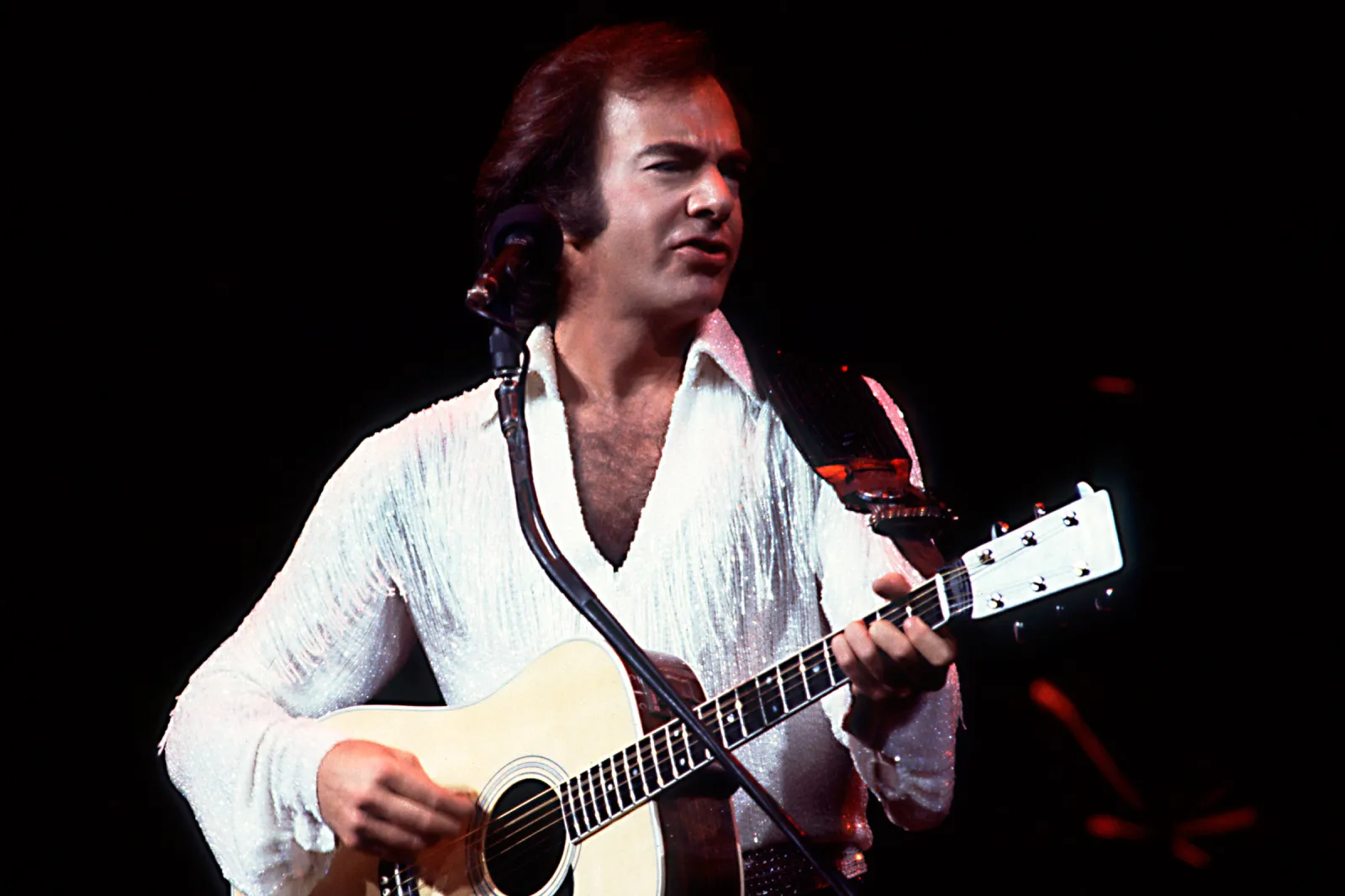
Some of the clearest evidence of change lives in the songs that were never pushed as hits, and Jungletime catches Neil Diamond in 1976, testing a tougher, more textured sound under Robbie Robertson‘s watch.
Released on the 1976 album Beautiful Noise, Jungletime is one of those Neil Diamond tracks that says more about an artist’s direction than its profile might suggest. It was written by Diamond and placed inside an album produced by Robbie Robertson of The Band, a collaboration that still stands out in Diamond’s catalog. The title song Beautiful Noise naturally carries much of the album’s public identity, but Jungletime is where the partnership can feel especially revealing. Not because it was turned into a giant signature moment, but because it lets you hear the working texture of the record: a singer-songwriter with a very recognizable voice stepping into a slightly rougher, more alert musical frame.
By the middle of the 1970s, Diamond had already built a career on melody, immediacy, and emotional command. He could write for the radio, for the stage, and for the listener sitting alone with a record. Robertson came from a different tradition. As a guitarist, songwriter, and one of the defining musical minds behind The Band, he understood how to make songs feel rooted in atmosphere and ensemble. His work often valued feel over polish, shape over excess, and a certain lived-in tension that kept a recording from becoming too tidy. Bringing him in to produce Beautiful Noise was not just a prestige move. It suggested that Diamond wanted a new environment around his songs, one that could sharpen edges without losing warmth.
That is why Jungletime matters. The title alone carries movement, pressure, and urban restlessness. It fits naturally within an album called Beautiful Noise, a record already interested in turning crowded modern sound into something musical and personal. In that context, Jungletime feels less like a stray deep cut and more like a piece of the album’s internal logic. The song belongs to a world of motion, show-business energy, and street-level unease. Rather than placing Diamond above that world as a polished narrator, the track lets him stand inside it. You hear a performer not retreating into familiar comfort, but allowing the atmosphere around him to shape the performance.
Robbie Robertson’s production presence is important here precisely because it does not announce itself with empty flash. What he brings is a sense of contour. The sound feels more grounded, more band-conscious, more interested in pulse and space than in smoothing every edge into easy grandeur. Diamond still sounds unmistakably like himself; the melodic instinct remains, and so does that direct line between singer and listener. But the setting is different. The song feels as though it is moving through air instead of decoration. That distinction matters. It gives Jungletime a kind of alertness that suits its title and strengthens its place on the album.
In broader career terms, Beautiful Noise arrived at an interesting moment. The 1970s were full of artists recalibrating their relationship to rock, pop, singer-songwriter intimacy, and the demands of a changing record business. Some leaned into lush polish. Others chased whatever seemed fashionable. Diamond’s work with Robertson feels more thoughtful than that. He did not suddenly become a different artist, and Robertson did not try to turn him into a copy of another scene. Instead, the album documents a meeting of sensibilities. On a track like Jungletime, you can hear how that meeting works: Diamond’s instinct for drama and memorable phrasing held in balance with a production style that prefers texture, momentum, and room for the song to breathe.
There is also something especially valuable about hearing that process in a non-single. Big songs often become detached from their original setting. Over time, they turn into public property, remembered for choruses, radio life, and concert applause. An album track can preserve more of the actual artistic conversation. Jungletime still feels connected to the room in which it was shaped. It helps explain that Beautiful Noise was not only an album built around a famous title track, but a full statement about sound and identity. For listeners who want to understand what Robertson actually contributed, this is the kind of song that offers an answer. He did not erase Diamond’s personality. He gave it a different landscape.
That may be why the song continues to reward attention. It shows Diamond as an artist still willing to test his own boundaries, still open to another strong musical mind changing the frame around his writing. Not every established star makes space for that kind of exchange. Jungletime survives as evidence that Diamond did. It captures a moment when confidence had not yet hardened into habit, when a familiar voice could still sound newly placed because the room, the production, and the atmosphere had shifted. In that sense, the track is more than an overlooked cut from 1976. It is a small but telling document of what Beautiful Noise really was: not just a title, but a method for turning tension, movement, and modern sound into something distinctly human.
