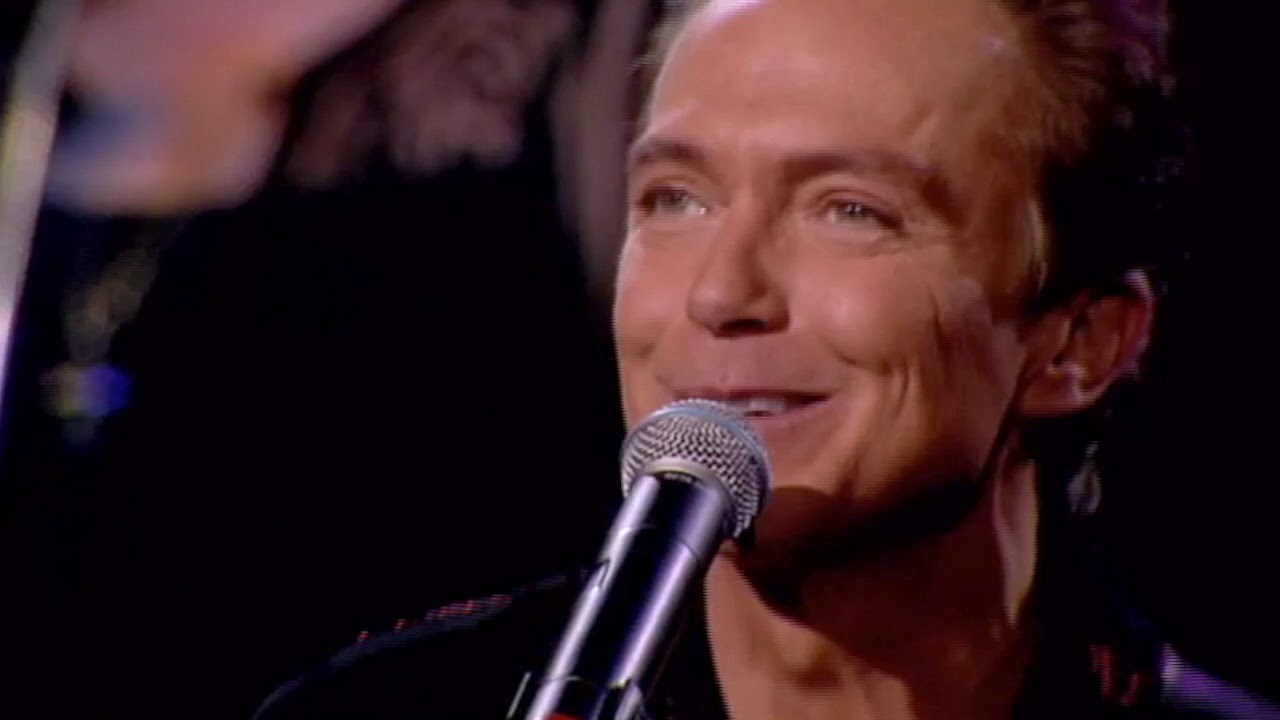
At the end of David Cassidy’s 1992 comeback album, One True Love sounds less like a grand finale than a private reckoning with what survives fame.
One True Love closes David Cassidy’s 1992 studio album Didn’t You Used to Be…, and that placement matters. This is not simply another romantic title in a pop catalog. It arrives as the final word on a record built around a complicated return: an adult artist stepping back into the studio while carrying the long, bright shadow of teenage fame, television memory, and the public’s habit of asking performers to remain exactly as they were. By 1992, Cassidy was not just singing new material. He was negotiating with a name that millions already thought they understood.
For many listeners, David Cassidy was permanently linked to The Partridge Family, to the early-1970s rush of I Think I Love You, to magazine covers, arenas filled with screaming fans, and the strange loneliness that can hide inside mass adoration. But the early 1990s found him in a different creative position. After renewed visibility around his 1990 return to recording, including the single Lyin’ to Myself, Didn’t You Used to Be… continued the attempt to let Cassidy be heard as an adult pop-rock singer rather than a preserved symbol of another decade. Even the album title feels sharp in that context. Didn’t You Used to Be… is not just a clever phrase; it sounds like the unfinished sentence many former teen idols are forced to hear for the rest of their lives.
That is why One True Love has a particular emotional charge as the closing track. It does not need to announce itself as the album’s biggest statement. Instead, it works because of where it sits. After an album concerned, directly or indirectly, with identity, return, romance, and public recognition, the final song narrows the frame. The lights pull in. The noise outside the room fades. What remains is not celebrity, not image, not the old question of who someone used to be, but the more human question of what he still believes in when all the labels have fallen away.
Album closers often reveal a musician’s instinct for farewell. A single has to compete; a closing track can linger. It can gather the record’s emotional residue and leave the listener with something quieter than applause. In Cassidy’s case, One True Love feels meaningful because it resists the obvious comeback gesture. A comeback album could have ended with defiance, with a loud reminder of vocal strength, with a polished bid for radio certainty. Placing a song called One True Love at the end suggests another kind of ending: not conquest, but belief; not proof, but tenderness.
The title itself is plain enough to be overlooked. In another context, One True Love might sound like a familiar pop phrase, the kind of promise that has passed through countless choruses across decades. But against the background of David Cassidy’s career, it carries more than romantic sentiment. Cassidy’s public life had been shaped by projection. People loved an image, a voice, a television character, a young man turned into a cultural object almost before he had time to define himself. To close a comeback-era album with a phrase so direct is to shift attention away from being loved by crowds and toward the idea of love as something singular, chosen, and personal.
That contrast gives the song its lasting value as an album cut. It may not be the track casual listeners name first, and it does not have to be. Some songs earn their place not by dominating a career narrative, but by quietly completing it for a moment. One True Love belongs to that category: the kind of track that deepens when heard in sequence, after the record has already asked listeners to reconsider who Cassidy was in the early 1990s. It is the sound of a performer closing the door gently rather than slamming it, leaving behind a feeling instead of a headline.
There is also something poignant about hearing Cassidy in this period because the distance between the young star and the adult singer is impossible to ignore. The voice belongs to the same person, but the atmosphere around it has changed. The screams have receded. The industry has moved on. Pop music has found new faces to elevate and discard. Yet Cassidy’s presence on Didn’t You Used to Be… suggests persistence, not in a dramatic sense, but in the everyday artistic sense of returning to the work and asking to be heard again. One True Love becomes part of that request. It is not asking the listener to forget the past. It is asking the listener to let the past make room for a more complicated present.
As a closing track, One True Love leaves the album with a softer kind of dignity. It reminds us that comeback records are rarely just about commercial return. They are about time, reputation, and the fragile hope that a familiar voice can still say something new. For David Cassidy, whose fame arrived with almost impossible force, that hope carried an added weight. The final impression of Didn’t You Used to Be… is not a man trying to outrun what people remembered, but an artist allowing a simple romantic idea to stand at the end of the argument. The song fades, and the unfinished question in the album title remains suspended. Didn’t you used to be? Maybe. But here, at the end, he is still singing.
