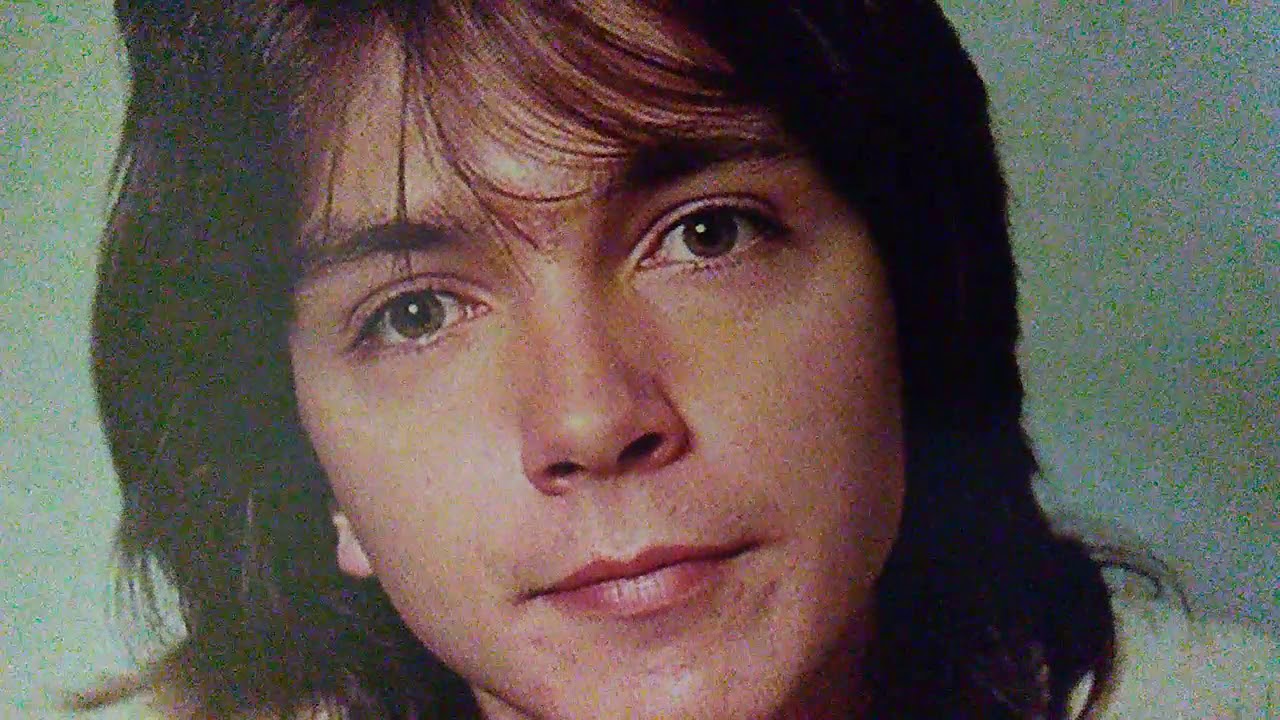
On a modest 1998 independent album, David Cassidy sounded less like a former teen idol chasing memory than a grown man measuring what memory had cost.
David Cassidy released Old Trick New Dog in 1998, long after the feverish first chapter of his fame had settled into something more complicated. Within that late-period independent release, (Whatever Happened To) Peace, Love & Happiness stands out because its title alone carries a lifetime of distance. It is not simply a nostalgic phrase borrowed from the language of the 1960s and early 1970s. In Cassidy’s hands, it becomes a question asked from the far side of celebrity, survival, disappointment, reinvention, and the strange burden of being remembered too clearly for one part of your life.
By the time this song appeared, Cassidy had already lived several public lives. To many, he was still tied to The Partridge Family, to the bright television image of Keith Partridge, to fan magazines, concert screams, and a kind of youth-culture intensity that could turn a young singer into an object before he had fully become an artist in the public mind. But Cassidy spent much of his adult career pushing against that frame. He made records, performed on stage, worked in theater, toured, and returned again and again to music not as a souvenir, but as a craft. Old Trick New Dog arrived in that spirit: not as a massive commercial machine, but as a smaller, more personal late-career statement.
The album title itself suggests the tension. An “old trick” implies experience, habit, show-business instinct, the muscle memory of a performer who knew how to stand beneath lights and give people what they came for. A “new dog” turns the phrase around, hinting at restlessness, irony, and refusal. Cassidy was not pretending to be the boy from the posters, but neither could he fully escape the expectations attached to that boy. That makes (Whatever Happened To) Peace, Love & Happiness feel especially revealing. The song’s question is broad enough to belong to a generation, but intimate enough to sound like an artist speaking from inside his own weathered history.
The phrase “peace, love and happiness” once carried the optimism of a cultural moment: the belief that youth, music, romance, and communal feeling might soften the edges of the world. Cassidy’s early fame unfolded in the afterglow of that language, but in a very different kind of marketplace. His image was polished for television and pop consumption, even while the rock era around him prized authenticity, rebellion, and self-definition. Decades later, singing a song that asks what happened to those ideals, Cassidy was not merely looking backward with affection. He was letting the question hang in the air, unresolved and slightly bruised.
That is where the late-period quality matters. Had a young star sung a title like (Whatever Happened To) Peace, Love & Happiness, it might have sounded like slogan or wish. From Cassidy in 1998, it carries more weight. It arrives after the cheers, after the backlash, after the long effort to be taken seriously, after the private and professional turns that inevitably shape any lasting career. The song becomes less about recapturing a vanished era than about noticing how ideals change once life has tested them. Peace is no longer an abstract dream. Love is no longer only pop melody. Happiness is no longer guaranteed by applause.
Musically, Cassidy’s late work often asked listeners to hear the grain in his voice rather than the shine around his name. That is an important distinction. The teenage fantasy built around him depended on brightness and immediacy; the adult singer could carry hesitation, reflection, and a faint edge of ruefulness. On Old Trick New Dog, that change in atmosphere is part of the appeal. The record does not need to erase the past. Instead, it lets the past sit in the room while the older artist speaks around it, through it, and sometimes against it.
What makes (Whatever Happened To) Peace, Love & Happiness compelling is not that it announces a grand revelation. Its power is quieter than that. It asks a familiar cultural question from a particular human position: a man who knew what mass affection felt like, but also knew that mass affection is not the same as peace; a performer who sang love songs to millions, yet understood that love as a lived reality is harder than love as a chorus; an entertainer associated with happiness, who had learned that public joy can exist alongside private struggle.
For that reason, the song belongs to a different David Cassidy than the one most casually remembered. It belongs to the Cassidy who kept working after the spotlight changed shape, who knew that the audience might arrive with memories he could not control, and who still tried to put something honest into the microphone. The independent nature of Old Trick New Dog deepens that feeling. Away from the machinery that once made him inescapable, the music can be heard as a smaller exchange between artist and listener. There is less spectacle, more weather. Less myth, more man.
In retrospect, (Whatever Happened To) Peace, Love & Happiness feels like one of those late-career recordings that asks to be approached without the old noise. It does not demand that listeners forget the early hits, the television fame, or the extraordinary pressure of Cassidy’s youth. Instead, it invites them to hear how a question can change over time. What once sounded like a flower-power promise becomes, decades later, an adult inventory of what survived and what did not.
That is the quiet ache of the song: not bitterness, not surrender, but recognition. David Cassidy spent a lifetime being remembered as a symbol of youthful escape. On Old Trick New Dog, and especially in (Whatever Happened To) Peace, Love & Happiness, he seems to be asking what remains after escape is no longer enough. The answer is not handed over neatly. It lingers in the title, in the late-career voice, in the space between the image people kept and the artist who kept moving. Sometimes the most revealing songs are not the ones that explain a life, but the ones that let a life ask its hardest question out loud.
