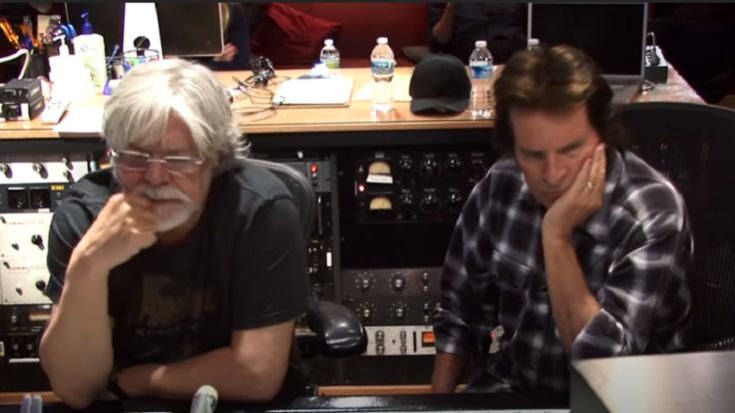
On Honey Do, John Fogerty turns a weekend chore list into a fast little getaway, proving that domestic life can still kick like rockabilly.
John Fogerty released Déjà Vu All Over Again in 2004, decades after his defining work with Creedence Clearwater Revival, and the album carried the marks of an artist still measuring American life through plainspoken images, roots rhythm, and sharp emotional instinct. Its title track drew attention for its uneasy political echo, but tucked inside the record is a smaller, lighter spark: Honey Do, a playful deep cut built around the familiar phrase “honey-do list” and the weekend pressure of household obligations. It is not a grand statement song. It does not arrive dressed for history. Instead, it kicks open the back door with a grin, chasing the sound of old rockabilly mischief while trying to escape a list of domestic chores.
That scale is part of its charm. Fogerty has always understood that American music does not need a large subject to feel alive. A car, a road, a porch, a bad job, a storm cloud, a Saturday morning — in his hands, simple things often start moving with mythic energy. Honey Do works in that modest but satisfying tradition. The joke is instantly recognizable: the weekend arrives, freedom seems close, and then the list appears. Fix this. Move that. Clean the other thing. The phrase itself carries a whole little household drama, affectionate and comic rather than bitter. Fogerty treats it not as a complaint but as a launchpad, turning ordinary domestic negotiation into a quick-footed rock and roll escape attempt.
The track’s Carl Perkins-style rockabilly flavor matters because it gives the song its character. Perkins, one of the key figures of Sun-era rock and roll and the writer of Blue Suede Shoes, brought country snap, blues bite, and nervous rhythmic propulsion into early rockabilly. Fogerty does not merely imitate that feel; he folds it into his own long-standing love of early American sounds. The result is lean, comic, and wiry. You can hear the imagined shoes tapping, the guitar wanting to jump the fence, the rhythm pushing forward as if the singer is already looking for the keys. The subject may be chores, but the sound is pure motion.
On Déjà Vu All Over Again, that motion creates useful contrast. The album arrived in a period when Fogerty was no longer the young swamp-rock firebrand of the late 1960s, but neither was he content to coast on memory. His solo work often revisited the musical soil that had fed him in the first place: country, blues, gospel shadows, early rock and roll, and the concise storytelling of radio-era songwriting. Honey Do feels like one of those moments when he reaches back not to sound old-fashioned, but to recover the directness of a form that never wasted a note. Rockabilly, at its best, can make a tiny predicament feel urgent. A pair of shoes, a fast car, a restless heart, or a chore list — all can become fuel.
There is also something quietly revealing about Fogerty choosing humor here. His catalog is often remembered through intensity: the dread in Bad Moon Rising, the working-class pressure of Fortunate Son, the river-lit atmosphere of Green River, the road-worn urgency of so many Creedence recordings. But he has always had room for wit, bite, and looseness. Honey Do lets that side surface without making a big announcement. It is a song about trying to dodge responsibility, but it never feels mean-spirited. The domestic world in the song is not a prison; it is the comic stage on which freedom and obligation do their weekend dance.
That is why the track holds interest as a solo deep cut. It shows Fogerty working in miniature, using a familiar phrase and a vintage rhythmic language to build a scene almost everyone can understand. The stakes are low, but the feel is precise. The singer is not fleeing heartbreak, war, or ruin. He is fleeing chores. Yet the music gives that little rebellion a beautiful urgency. In a catalog filled with larger storms, Honey Do is a quick flash of sunlight on a garage door, a song that remembers rock and roll can still begin with a joke, a beat, and the simple desire to get out before the weekend disappears.
Heard today, the pleasure of Honey Do is not that it reveals a hidden tragedy or changes the meaning of Fogerty’s career. Its appeal is warmer and more human than that. It catches a master craftsman relaxing inside a style he clearly understands, letting the old rockabilly engine idle, cough, and roar just enough to carry a small domestic comedy down the road. Sometimes a deep cut lasts because it shows an artist making room for play. Sometimes the list on the kitchen counter becomes a reason for the guitar to start running.
