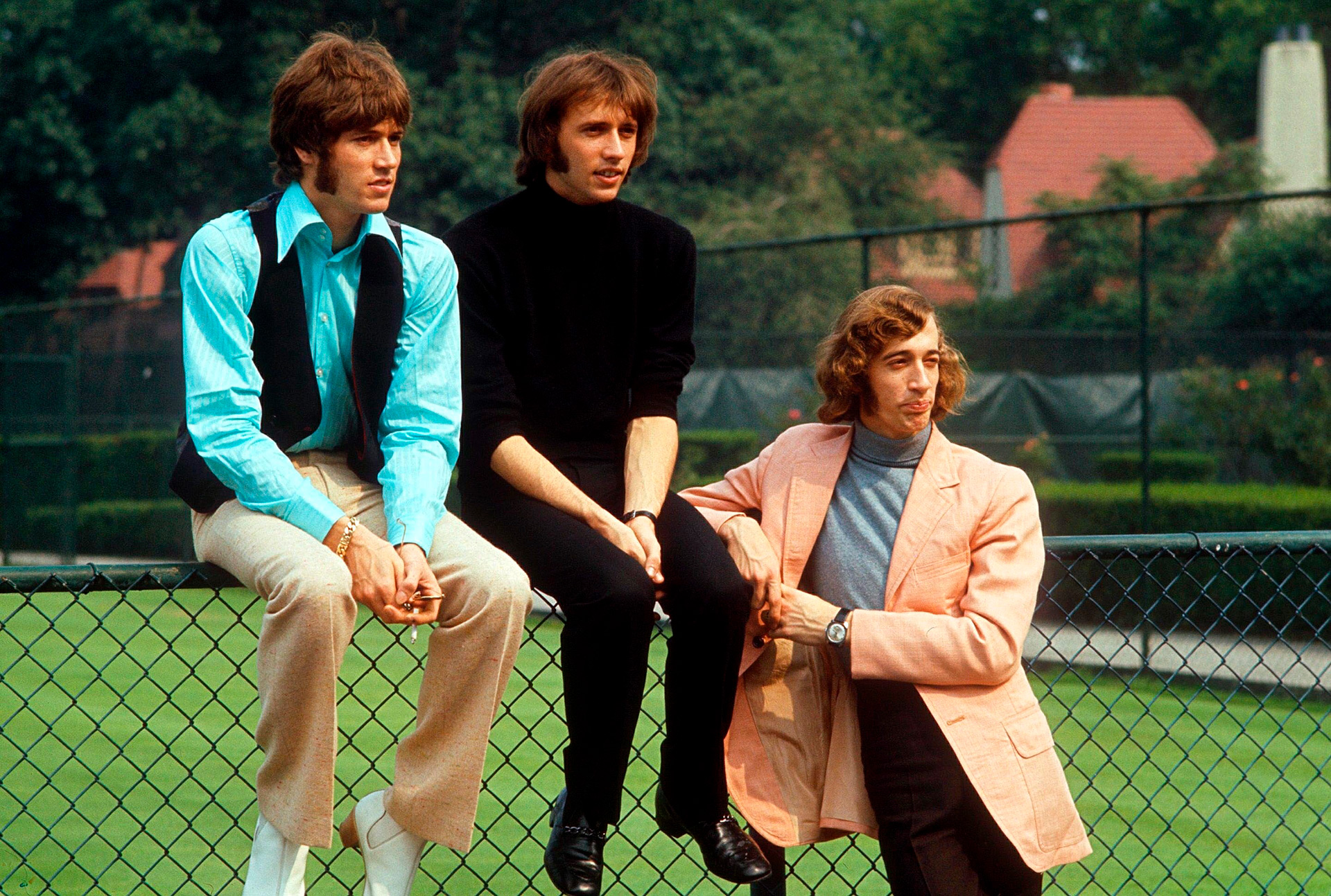
Before the Bee Gees became a story of reinvention, One Minute Woman caught Barry Gibb in a small, ornate room of doubt and melody.
One Minute Woman sits on Bee Gees’ 1st, the 1967 album that introduced Bee Gees to a much wider international audience after their early Australian years. Heard in the standard stereo mix, with Barry Gibb carrying the lead vocal, the song is not one of the record’s obvious calling cards. It does not arrive with the public drama of New York Mining Disaster 1941, the open-hearted reach of To Love Somebody, or the solemn glow of Holiday. Instead, it feels like a side-room discovery: brief, carefully dressed, and more revealing because it refuses to announce itself too loudly.
The title Bee Gees’ 1st can sound like a beginning, and in one important sense it was. It was the group’s first major international album, released in 1967 after Barry, Robin, and Maurice Gibb had returned from Australia to England and entered the orbit of Robert Stigwood. Yet the brothers were not arriving empty-handed. They had already learned how to write in close harmony, how to compress melodrama into a compact pop form, and how to make a song feel slightly strange without losing its sweetness. That early craft is all over One Minute Woman.
Produced by Robert Stigwood and Ossie Byrne, the album placed the Bee Gees inside the restless studio language of 1967: orchestral color, unusual song shapes, bright melancholy, and a fascination with pop music that could sound both intimate and theatrical. One Minute Woman belongs to that baroque pop world, but it works on a smaller scale than the album’s better-known pieces. Its power is not in spectacle. It is in proportion, in the way a brief idea is dressed with care and then allowed to pass before it overstays its welcome.
Barry’s lead vocal is the main reason the track lingers. Before later decades made his high register one of pop’s most recognizable sounds, Barry often sang with a controlled, almost conversational ache. On this track, he does not push the feeling to the front of the room. He lets it hover. The effect is youthful but not naive, tender but not fragile in a decorative way. He sounds like someone trying to keep a thought orderly while the melody quietly betrays how unsettled it is.
The standard stereo mix helps shape that impression. Early stereo records could sometimes feel boldly separated, but here the spacing gives the song a kind of private architecture. The vocal has room around it; the instrumental colors answer without crowding; the harmonies and arrangement details seem to move in and out like small changes in confidence. Nothing about the mix turns the song into a grand statement. Instead, it lets the listener notice how much feeling can sit inside a minor album track when the singer is not overprotected by density.
As a deep cut, One Minute Woman also corrects the easy version of Bee Gees history. The group is often remembered through big chapters: the eerie 1967 breakthrough, the lush ballads, the later dance-floor empire, the adult-contemporary afterlife. But a catalog is also built from smaller rooms, and this is one of them. Here the brothers’ gift is not merely harmony or hook writing; it is atmosphere. They were already interested in characters who seem to appear halfway through an emotional sentence, in women and men glimpsed through uncertainty, in melodies that make sadness sound well-mannered until it suddenly feels closer than expected.
That is why the standard stereo version of One Minute Woman remains rewarding for listeners who go past the famous tracks on Bee Gees’ 1st. It does not ask to represent the whole album. It does something quieter and, in its own way, more revealing: it lets Barry stand near the center of an ornate early Bee Gees sound without turning him into a monument. The recording captures a young band learning how to balance elegance with vulnerability, and a young lead voice discovering that restraint can carry drama as effectively as volume.
More than half a century later, One Minute Woman feels less like an overlooked footnote than a piece of early handwriting. The lines are delicate, the ink is still fresh, and the shape of the future is not yet fixed. That uncertainty is part of the beauty. It is the Bee Gees before the world had decided what to call them, and Barry Gibb before history had narrowed him to any single image, singing a small song that still opens a surprisingly large door.
