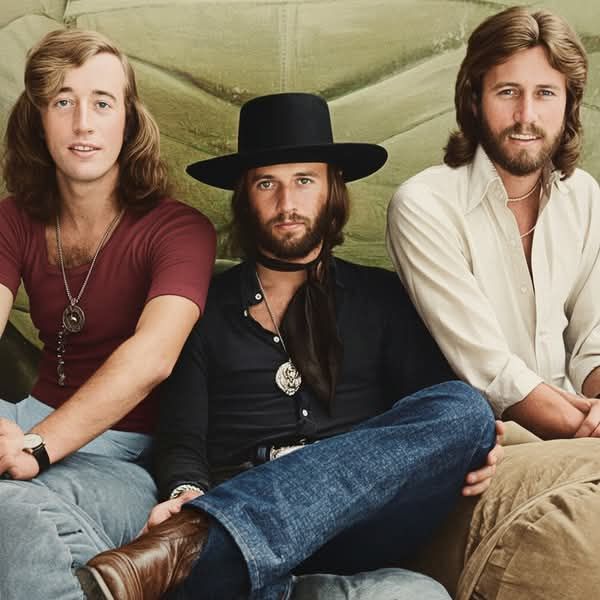
On Main Course, Bee Gees were stepping toward a new American groove, but All This Making Love arrived like a grin from the footlights.
Released in 1975 on RSO, Main Course is often remembered as the album where Bee Gees found the rhythm that would carry them into the second half of the decade. Recorded at Criteria Studios in Miami with producer Arif Mardin, it gave Barry, Robin, and Maurice Gibb a fresh setting: warmer air, sharper bass lines, funkier drums, and a sense that the old ballad craftsmen were suddenly hearing the street through the studio walls. Songs such as Jive Talkin’ and Nights on Broadway made the change impossible to miss. Yet tucked into that same record, opening the original LP’s second side, All This Making Love does something stranger and more mischievous. It refuses to march neatly with the reinvention.
That is exactly what makes the track so revealing. In the middle of an album often discussed as the brothers’ great mid-1970s R&B turn, All This Making Love sounds almost like a side door swinging open onto another stage. Its bounce has a theatrical tilt, its phrasing carries a wink, and its spirit brushes against music hall and vaudeville without becoming a full costume piece. It is playful, slightly absurd, and deliberately un-smooth. Where much of Main Course points toward a sleeker, more rhythm-conscious future, this song keeps one polished shoe planted in the Gibbs’ older instinct for character, drama, and pop eccentricity.
Before the world began to associate Bee Gees so strongly with the disco explosion, they had already lived several musical lives. They had written ornate ballads, melancholy chamber-pop miniatures, country-leaning songs, and tightly harmonized pop records that often felt more theatrical than fashionable. By 1975, however, they were in a precarious and exciting place. Their early fame had receded, the industry was changing around them, and American soul, funk, and dance music were reshaping the sound of radio. Main Course did not simply update the Bee Gees; it allowed them to discover a new language without fully erasing the accents they already had.
All This Making Love matters because it interrupts the album’s clean reinvention narrative. It reminds us that artistic change rarely happens in a straight line. The song is not the grand statement people usually reach for when explaining Main Course, and it was never meant to carry the historical weight of Jive Talkin’. But its oddity gives the record texture. The piano-driven bounce, the comic energy, and the near-vaudevillian shape make it feel like the brothers are testing how elastic their new sound can be. They are not only learning to groove; they are also proving they can still smirk, exaggerate, and turn a pop song into a little performance.
There is a special charm in hearing a band at the edge of transformation leave room for something this whimsical. In less confident hands, the track might have felt like a throwaway. On Main Course, it becomes part of the album’s personality: a reminder that reinvention does not require perfect seriousness. The Bee Gees’ harmonies had always contained a kind of dramatic awareness, as if the brothers knew that sadness, romance, and comedy often sit closer together than polite pop criticism admits. All This Making Love leans into that closeness. It treats desire with a raised eyebrow, letting the subject feel both human and faintly ridiculous.
Heard now, the song also complicates the familiar story of the Bee Gees’ rise toward their late-1970s peak. It shows that the road from early pop ballads to dance-floor dominance was not a clean replacement of one identity with another. It was a layering. The R&B pulse of Miami, the polish of Arif Mardin’s production, the brothers’ long history with theatrical songwriting, and their instinct for unusual melodic turns all coexist on Main Course. All This Making Love may not be the album’s most celebrated track, but it catches something precious: the sound of an old personality peeking through a new suit.
That is why this curious little detour continues to stand out. It does not weaken the album’s reinvention; it humanizes it. A record as important as Main Course could have presented the Bee Gees as fully reborn, polished into a single future-facing shape. Instead, it left space for a song that feels like a wink from backstage, a reminder that even at a turning point, the brothers could still be playful, strange, and unmistakably themselves. In that sense, All This Making Love is more than a novelty tucked among stronger-known songs. It is one of the album’s clearest signs that the Bee Gees’ transformation worked because it did not silence their eccentric heart.
