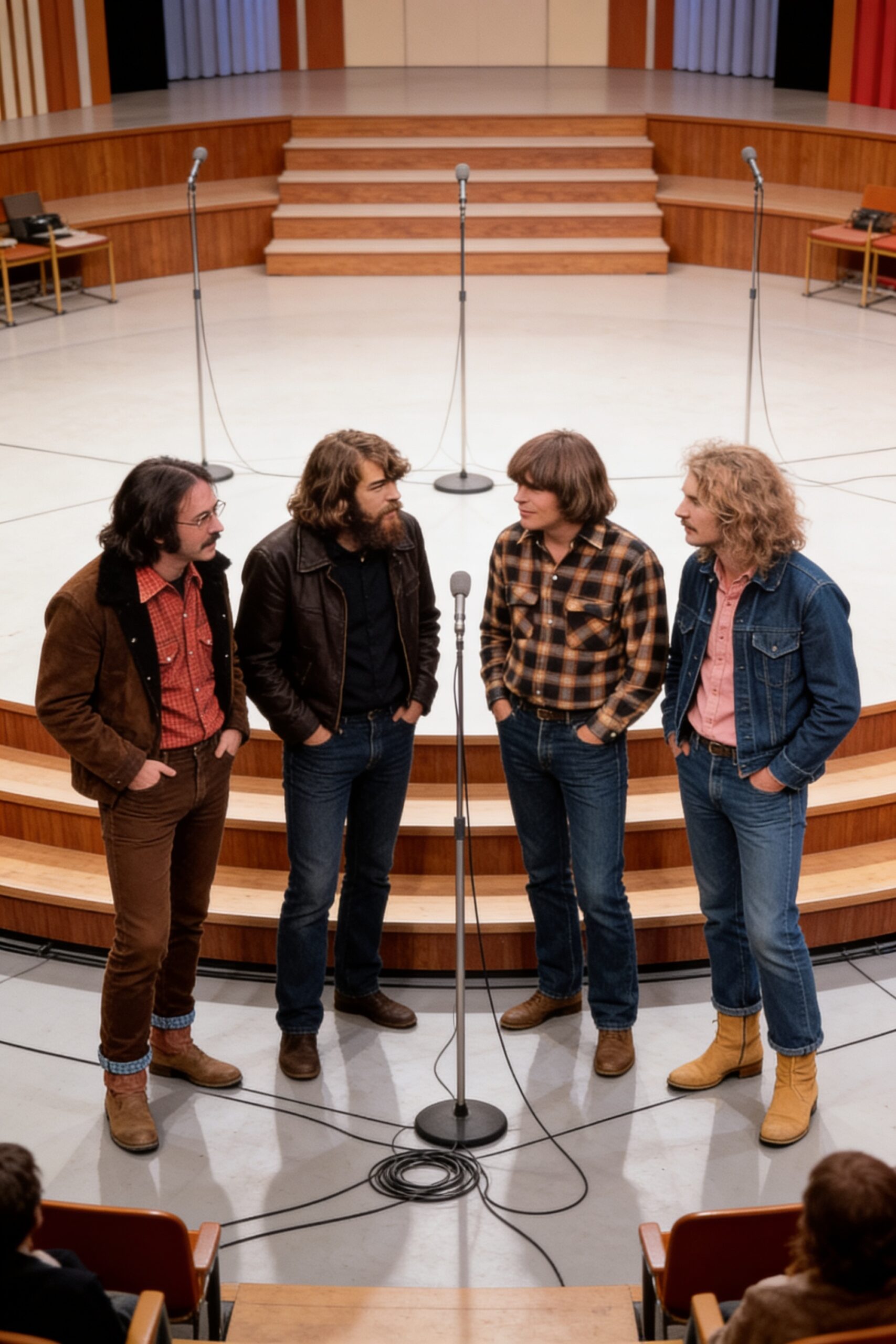
On Cosmo’s Factory, Creedence Clearwater Revival treated a Bo Diddley blues as more than a cover—it became a hard, plainspoken test of guilt, pride, and groove.
When Creedence Clearwater Revival included “Before You Accuse Me” on their 1970 album Cosmo’s Factory, they were not simply borrowing a familiar blues number to fill out a rock record. They were placing themselves inside a lineage. The song, written by Bo Diddley under his real name Ellas McDaniel, had first emerged in the late 1950s as “Before You Accuse Me (Take a Look at Yourself)”, a sharp, economical blues built around accusation, self-defense, and that old human habit of seeing another person’s faults before facing one’s own.
By 1970, Creedence were moving at a pace that almost seemed impossible. Cosmo’s Factory, released on Fantasy Records, arrived during the band’s most productive and commercially powerful period. The album gathered together some of their best-known original songs, including “Travelin’ Band,” “Who’ll Stop the Rain,” “Run Through the Jungle,” and “Lookin’ Out My Back Door.” But its cover songs mattered just as much to the album’s character. Alongside their take on “I Heard It Through the Grapevine” and roots-rock readings of earlier rock and rhythm-and-blues material, “Before You Accuse Me” showed exactly where the band’s engine had been built: not in psychedelic fantasy, but in blues clubs, jukebox records, R&B singles, and the rough grammar of American popular music.
The title Cosmo’s Factory itself carried a workmanlike meaning. Doug “Cosmo” Clifford, the band’s drummer, lent the nickname, while “factory” referred to the steady labor of rehearsing and recording. That idea fits the album perfectly. It does not feel like a polished monument so much as a room full of players who knew how to make old forms move with new urgency. On “Before You Accuse Me,” Creedence did not try to disguise the song’s origin or reinvent it beyond recognition. Instead, they tightened it, roughed it up, and gave it the unmistakable snap of a band that understood how blues could sit comfortably inside rock without losing its bite.
Bo Diddley’s original had its own authority: direct, rhythmic, sly, and deceptively simple. Diddley’s genius often lived in the way he made songs feel ancient and modern at once, building around repetition, pulse, and attitude. “Before You Accuse Me” is not a grand statement on the surface. It is a domestic argument compressed into a blues form. Yet that is exactly why it lasts. The lyric is built around a command that sounds defensive, maybe guilty, maybe justified: take a look at yourself before you point your finger at me. It is a line anyone can understand, because it lives in the space between love and blame, between wanting forgiveness and refusing to surrender.
In Creedence’s hands, that line becomes especially interesting. John Fogerty had a voice that could sound weathered even when singing from the center of a hit-making band. He rarely sounded distant from the material. He sang as if each lyric had dirt on its boots, and on this cover that quality matters. His vocal does not soften the narrator. It gives him urgency. The performance feels less like a polite tribute to a blues elder and more like a working band pushing an old argument through amplifiers, bass, drums, and clipped guitar phrases until the accusation becomes physical.
Part of the power of Creedence’s version is its restraint. The band does not overdecorate the song. They leave space for the rhythm to do its job. Stu Cook and Doug Clifford keep the foundation steady, while the guitar work carries the kind of lean pressure that defined much of Creedence’s best music. The arrangement has a bar-band honesty to it, but that phrase should not be mistaken for looseness. Creedence’s gift was making disciplined playing feel like it had just rolled in from the street. Their version of “Before You Accuse Me” has that same quality: familiar, grounded, and unpretentious, yet charged with the confidence of a group at its peak.
Placed on Cosmo’s Factory, the song also helps explain the album’s breadth. Creedence were often described through the language of swamp rock, although they came from California rather than the bayou country their sound sometimes evoked. What made that image convincing was not geography alone; it was their instinct for older American sounds. They could move from country-tinged reflection to R&B propulsion, from ominous war-era unease to rock-and-roll revival, without sounding like tourists. “Before You Accuse Me” sits inside that larger map. It reminds listeners that Creedence did not treat roots music as museum material. They treated it as living language.
There is also a quiet tension in hearing a band so identified with its own original hits devote album space to a Bo Diddley composition. In 1970, Creedence did not need a cover to prove they could write. Fogerty’s songs were already filling radio and shaping the sound of the era. But the cover choices on Cosmo’s Factory suggest something deeper than necessity. They reveal a band openly acknowledging the music that fed them. Their version of “Before You Accuse Me” feels like an argument across generations, not in opposition but in continuation: Bo Diddley’s blues voice speaking through Creedence’s rock machinery, the old warning still sharp enough to cut.
That is why the track remains more than a footnote on a famous album. It does not overshadow the original, and it does not need to. Instead, it shows how a great cover can expose a band’s instincts. Creedence were at their best when they sounded direct, unsentimental, and rhythmically sure. “Before You Accuse Me” gave them a perfect vessel for those strengths. The lyric’s moral demand—look inward before blaming outward—fit the band’s plainspoken style, while the blues structure gave them room to flex without grandstanding.
More than fifty years later, the Cosmo’s Factory version still has the feeling of a record made by musicians who knew exactly what they owed and exactly who they were. It carries Bo Diddley’s fingerprint, but it also bears Creedence’s sweat. The result is not a museum piece, not a casual jam, and not a decorative nod to the past. It is a working song, alive in the hands of a working band, asking the same uncomfortable question it asked from the beginning: before the blame starts flying, who is brave enough to look in the mirror?
