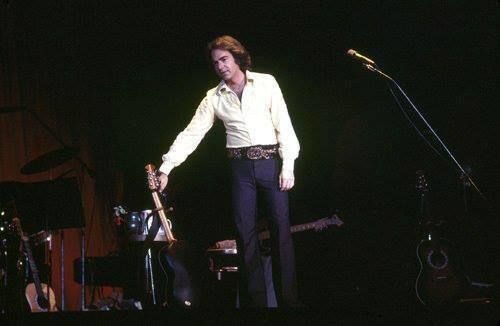
On All I Really Need Is You, Neil Diamond turned the polished sound of the early ’90s into something smaller, steadier, and deeply personal.
Neil Diamond recorded All I Really Need Is You for his 1991 album Lovescape, a Columbia-era release produced by Peter Asher and shaped by the adult-pop language of its time. That context matters. The song belongs to a moment when Diamond was no longer the restless young writer of Solitary Man, the dramatic hitmaker of Cracklin’ Rosie, or the arena-scaled showman who could make a chorus feel like a national address. By 1991, he was working inside a softer, glossier decade, one where keyboards, careful backing vocals, and broad romantic arrangements framed many veteran singers in a new emotional light.
Yet All I Really Need Is You does not feel like a man simply adapting to a trend. It feels more like Diamond doing what he had always done best: taking a direct declaration and making it sound larger than its wording, not through excess, but through conviction. The title itself is almost disarmingly plain. There is no puzzle in it, no elaborate metaphor, no cinematic twist. It says what it means. But in Diamond’s hands, plain speech can carry weight. He had built much of his career on that gift — making simple phrases feel like vows, arguments, prayers, or admissions spoken at the edge of a room after everyone else has gone quiet.
Lovescape arrived in a period when many established artists from the 1960s and 1970s were being heard through the textures of a new radio environment. The arrangements were cleaner, the drums smoother, the studio surfaces more polished. For some singers, that kind of production could blur the personality. For Diamond, whose voice has always carried a grain of theater and confession, the polish creates an interesting contrast. Around him, the track can feel carefully arranged, almost luminous in its restraint. But at the center is that unmistakable baritone — not youthful, not trying to be, but still alert to the pressure of a romantic line.
What gives All I Really Need Is You its particular 1991 character is the balance between grand romantic language and adult emotional weariness. This is not the sound of first love rushing toward the future. It is closer to the sound of someone who has already measured the noise of the world and decided what remains essential. The phrase “all I really need” suggests a stripping away. It is not the boast of someone who has everything. It is the statement of someone who has learned that plenty of things can fill a life without necessarily anchoring it.
Diamond had long understood the drama of need. In his early songs, need often came with motion: leaving, searching, yearning, chasing some promise beyond the next town or the next radio chorus. By the time of Lovescape, that yearning sounds less restless and more reflective. The desire is still there, but it has changed shape. It is no longer only about reaching outward. It is about recognizing what, or who, remains when the old momentum slows down. That is why this album track can feel more intimate than its smooth production might first suggest.
The early ’90s were an unusual place for a singer like Diamond. Popular music was moving in several directions at once: adult contemporary balladry, new jack swing, country-pop crossovers, the rise of alternative rock, and the last glow of big studio pop all shared space on the cultural dial. Neil Diamond did not belong neatly to any one of those lanes. He occupied a more durable territory — the songwriter-performer whose audience followed not because he sounded newly fashionable, but because his voice seemed connected to a long private history. All I Really Need Is You gains some of its power from that position. It is not trying to announce a revolution. It is trying to hold a feeling still long enough for someone to believe it.
Listening to it as a Lovescape album track, rather than only as an isolated romantic song, helps reveal its place in Diamond’s catalog. The album title itself points toward romance as a landscape — not a single moment, but a terrain of memory, devotion, longing, and disappointment. Within that setting, All I Really Need Is You works like a clearing. It is direct, open-hearted, and carefully measured. The song does not need to shout because its emotional argument is already complete: after all the songs about wandering, winning, losing, and beginning again, there is still room for a line that simply says what matters.
That directness has always been part of Diamond’s appeal, though it is sometimes misunderstood. His most effective performances are not merely big; they are exposed. Even when surrounded by strings, backing singers, or a full band, he often sings as if the decisive moment is happening between two people. On All I Really Need Is You, the scale narrows. The drama is not in spectacle, but in the steadiness of the admission. The performance trusts the listener to understand that a simple promise can be more revealing than a complicated confession.
Heard today, the song carries the atmosphere of its decade without being trapped by it. The production places it clearly in the early 1990s, but the emotional architecture is older and more durable: a voice, a melody, and a declaration of devotion shaped by experience. For fans who know Diamond mainly through his biggest singalong moments, All I Really Need Is You offers another kind of reward. It shows him in a reflective mode, not retreating from feeling, but refining it. The song asks for no grand mythology. It simply stands there, polished by the studio, warmed by the voice, and held together by the belief that love, named plainly enough, can still sound profound.
That may be why this track deserves more attention inside the Lovescape era. It captures a singer meeting a new decade without surrendering the emotional grammar that made him recognizable in the first place. Beneath the smooth surfaces of 1991, Diamond’s old urgency is still present, only quieter now, shaped less like a cry from the road and more like a promise made after the lights have lowered.
