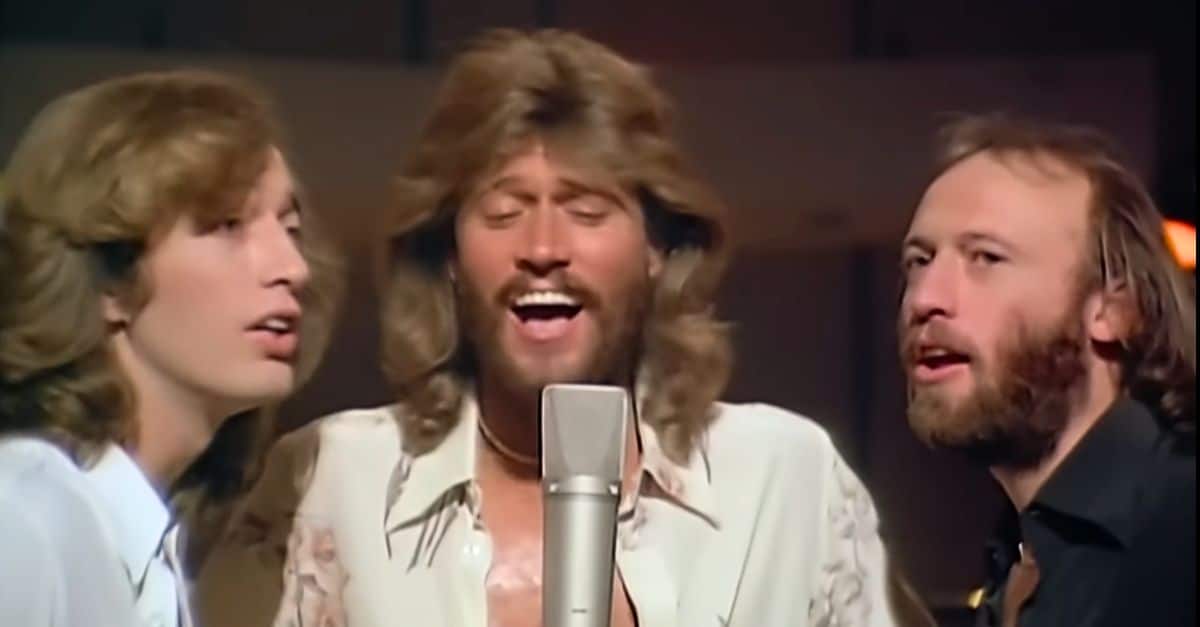
For eight weeks in 1978, Bee Gees’ Night Fever did more than top a chart; it made the Saturday Night Fever sound feel like the center of American pop life.
In 1978, Bee Gees took Night Fever to No. 1 on the Billboard Hot 100, where it spent eight weeks at the top. That chart run was not just another hit single enjoying its moment. It was one of the clearest signals that the Saturday Night Fever soundtrack had moved beyond movie success and become a cultural force, a record heard in cars, apartments, clubs, department stores, and radios that seemed unable to escape its pulse.
Written by Barry Gibb, Robin Gibb, and Maurice Gibb, and produced in the sleek late-1970s Bee Gees style associated with Albhy Galuten and Karl Richardson, Night Fever arrived as part of a soundtrack that helped define the public image of disco for a generation. The film Saturday Night Fever, released in 1977, gave dance culture a dramatic frame: not simply glamour under colored lights, but restlessness, escape, style, ambition, and the hunger to become someone else for a few hours. The song caught that energy in a form radio could repeat endlessly without wearing out its shine.
What makes Night Fever so powerful as a chart milestone is that it sounds both precise and effortless. The record does not crash through the door. It glides in. The strings lift with a kind of urban elegance, the rhythm section stays tight and aerodynamic, and Barry Gibb’s falsetto lead vocal rides above the groove like a signal from a brighter room. Robin and Maurice’s presence in the harmony gives the track its unmistakable Bee Gees identity: voices stacked so cleanly that they feel less like separate parts than one polished surface catching light.
By the time Night Fever reached No. 1, the Saturday Night Fever soundtrack was already shaping the sound of mainstream pop. The Bee Gees were not newcomers to success; they had already lived through earlier chapters as songwriters and performers, from the baroque-pop melancholy of the 1960s to the reinvention that brought them into the dance-driven world of the 1970s. But the soundtrack made their transformation feel complete. It placed them at the center of a mass-cultural moment where film, fashion, radio, and the dance floor all seemed to be speaking the same language.
The eight-week reign of Night Fever matters because it shows how thoroughly that language had entered everyday life. A single week at No. 1 can mark a hit. Eight weeks suggests something wider: repetition without resistance, a sound people kept choosing, requesting, buying, and carrying with them. It also reflected the unusual strength of the soundtrack itself, which included multiple Bee Gees recordings and related songs that dominated popular memory of the film. In that context, Night Fever was not just a song from a soundtrack; it was one of the engines that kept the whole phenomenon moving.
The title alone seemed to understand the era’s electricity. Night Fever is not a confession or a detailed story. It is a condition, a mood, almost a temperature. The phrase suggests a city after work, a body pulled toward movement, a private life temporarily rewritten by music. That is part of why the record connected so widely. Its lyrics are simple, but the arrangement does the deeper talking. The strings, the guitar accents, the bass, the clipped percussion, and the layered voices create the sensation of momentum. Nothing feels heavy, yet everything is in motion.
Heard today, the song can be separated from the glare and parody that later attached itself to disco. Beneath the familiar shimmer is a remarkably disciplined pop record. It knows exactly how long to linger, when to rise, when to leave space, and how to turn repetition into invitation. The Bee Gees understood that dance music could be emotional without being solemn, elegant without being distant, and commercial without losing craft. Night Fever proved that a song built for movement could also carry an entire cultural image on its back.
Its eight weeks at No. 1 also reveal something about the relationship between music and moment. Some records become hits because they fit the season. Others help create the season people remember. Night Fever belongs to the second group. It helped make the Saturday Night Fever soundtrack feel unavoidable, and it gave disco one of its most recognizable public faces. The song did not need to explain the dance floor; it made the listener feel already halfway there.
That is why the chart statistic still has emotional weight. Eight weeks at the top of the Billboard Hot 100 is a number, but behind it is a sound moving through a country with unusual force. Bee Gees captured a moment when pop music, cinema, nightlife, and aspiration briefly fused into one bright, synchronized rush. Night Fever remains the proof: not merely a hit from 1978, but the pulse of a soundtrack that turned a film into a phenomenon and a groove into public memory.
