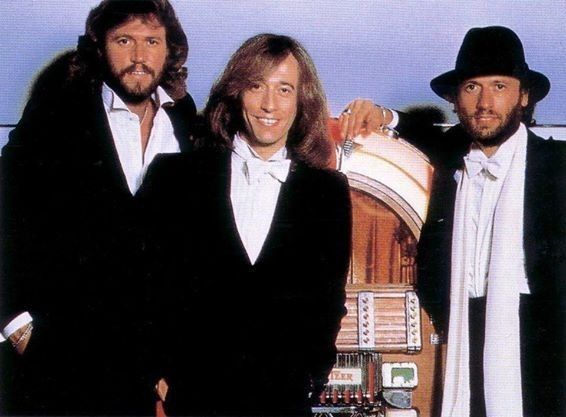
When the Bee Gees sang “Grease” at One Night Only, a hit made famous by another voice briefly returned to the family that built it.
Recorded at the MGM Grand in Las Vegas and released in 1998, Bee Gees One Night Only was more than a polished concert souvenir. It was a living map of the Gibb brothers’ reach, moving through the songs they performed themselves and the songs that had traveled into the world through other singers. In that setting, their live version of “Grease” carried a special kind of charge. Barry Gibb wrote the song for Frankie Valli as the title track for the 1978 film Grease, but the original hit single belonged to Valli’s unmistakable voice. Two decades later, Barry, Robin and Maurice Gibb brought it onto their own stage, letting the song step back inside the sound world that first imagined it.
The original Frankie Valli recording of “Grease” became a major pop success, reaching No. 1 on the Billboard Hot 100 in 1978 and helping frame one of the most widely remembered movie musicals of its era. It was a curious and effective marriage: Valli, already known for the soaring precision of the Four Seasons and his own solo career, singing a Barry Gibb composition at the height of the Gibb brothers’ late-1970s cultural presence. The film itself looked back toward a stylized 1950s America, but the title song carried the sleek pulse, falsetto tension, and modern studio sheen of the disco period. It did not simply introduce the movie; it pulled the past through the sound of 1978.
That is why the Bee Gees performance at One Night Only feels different from a standard live cover. The brothers were not borrowing someone else’s hit for variety. They were returning to a composition that had always carried their fingerprints, even when the public first heard it through another singer. Barry’s melodic architecture is there in the glide of the lines, in the way the chorus opens upward, in the polished tension between dance-floor confidence and something more elusive beneath the surface. When the Bee Gees performed it themselves, the song’s identity shifted just enough to make listeners hear the authorship more clearly.
The MGM Grand setting also matters. One Night Only arrived after decades of changing fashion, after the brothers had survived the strange burden of being both celebrated and simplified by the disco era. The concert gathered their catalog with the calm authority of artists who no longer needed to argue for their range. Instead of treating their history as a narrow lane, they opened it wide: early ballads, international pop landmarks, late-career songs, and compositions associated with other voices all had a place. In that context, “Grease” was not a novelty. It was evidence of how far the Gibb language had traveled.
Hearing the brothers sing it live also softens the boundary between performer and writer. Frankie Valli gave the 1978 single its public face, and his version remains inseparable from the film’s opening rush. But on the One Night Only stage, the song becomes less about cinematic branding and more about family sound. Barry’s presence draws attention to the composition’s shape; Robin and Maurice’s harmonies place it among the textures that made the Bee Gees instantly recognizable across generations. The performance does not erase Valli’s recording. It places another frame around it, one that says a song can have more than one home.
There is a quiet pleasure in watching the brothers reclaim “Grease” without turning the moment into a declaration. They do not need to explain the connection. The melody does the work. The audience hears a song everyone recognizes, then gradually senses the deeper thread running back to the Gibb family’s writing desk. It is a reminder that pop history is full of songs whose ownership is emotional as much as commercial: a singer may make a record famous, while a writer leaves a hidden pulse inside it that waits to be heard again.
By 1998, “Grease” had long since become part of a larger cultural memory, attached to movie screens, radio play, summer reruns, and the bright mythology of the film itself. But the Bee Gees performance at the MGM Grand gives the song a more personal afterlife. It lets the listener step behind the familiar surface and hear the Gibb brothers not as distant architects of a hit, but as musicians standing inside their own creation. The moment is not loud with revelation; it is satisfying because it feels earned. A song once sent out into the world came back under the lights, and for a few minutes, Barry Gibb and his brothers made “Grease” sound like it had been waiting for them all along.
