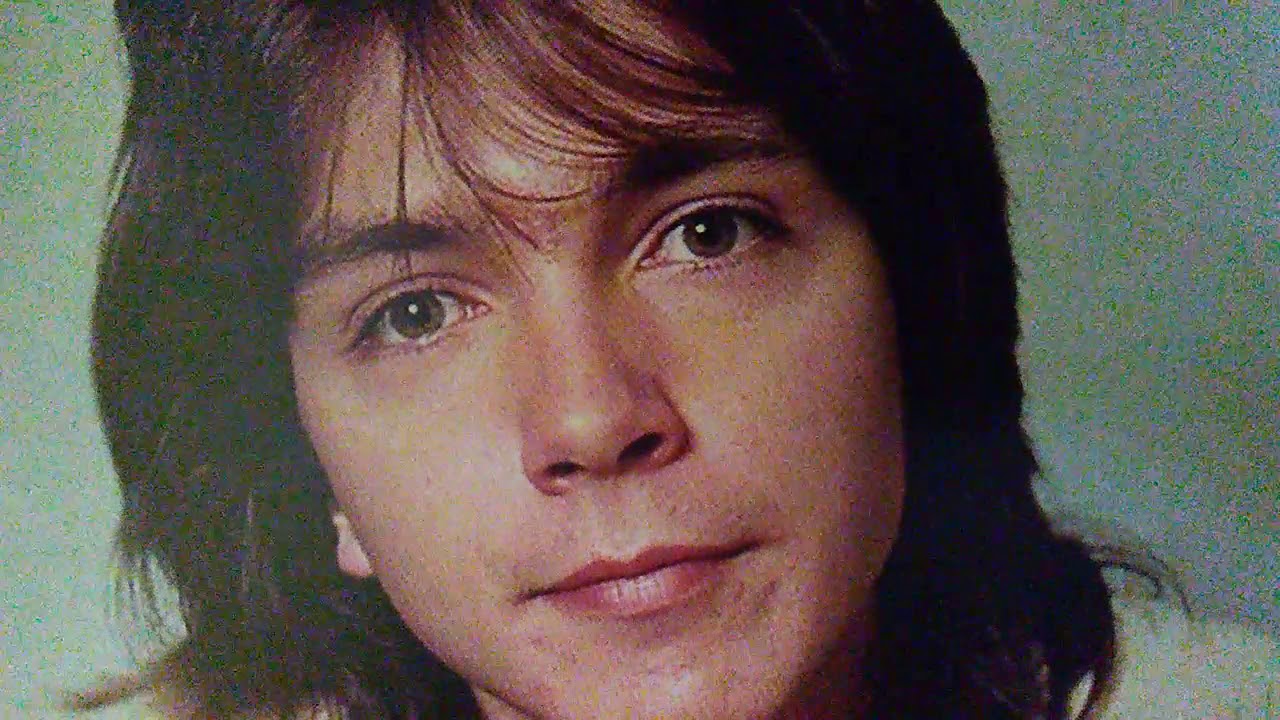
On The Higher They Climb, David Cassidy reached back to rockabilly and found a sharper way to be heard.
David Cassidy’s cover of “Be Bop A Lula” appears on his 1975 solo album The Higher They Climb, a record that arrived at a complicated point in his career. By then, Cassidy was no longer only the bright center of The Partridge Family phenomenon or the face on bedroom walls and magazine covers. He was trying to be understood as a working musician with taste, range, and a hunger to move beyond the clean outlines that fame had drawn around him. In that setting, choosing a 1950s rockabilly number associated with Gene Vincent was not just a nostalgic detour. It was a small act of repositioning.
The original “Be-Bop-A-Lula”, first recorded by Gene Vincent and His Blue Caps in 1956, belonged to the charged early vocabulary of rock and roll. Written by Vincent with Tex Davis, it carried the snap, swagger, and lean physicality of a new sound still close enough to the ground to feel dangerous. The song did not need elaborate storytelling. Its power came from rhythm, attitude, and repetition, from the way a phrase could become a pulse and a pulse could become a declaration. For Cassidy, covering it in 1975 meant stepping into a tradition that was far rougher than the polished pop image many listeners still attached to him.
That contrast is what makes his version so interesting. On The Higher They Climb, Cassidy was working in a moment when the expectations around him were unusually heavy. The early 1970s had given him enormous visibility, but visibility can become a kind of trap. A singer known for charm has to work harder when he wants to sound restless. A performer associated with television sweetness has to fight to be heard inside the music itself. “Be Bop A Lula” gave him a way to borrow some of rock and roll’s older nerve without pretending to be someone else entirely.
His reading of the song feels less like a museum piece than a deliberate jolt inside the album’s emotional landscape. The number does not ask Cassidy to confess or explain; it asks him to move, to bite into the rhythm, to trust the compact force of a classic rock phrase. That matters because The Higher They Climb is often remembered as one of his more ambitious post-Partridge Family statements, a record tied to his effort to take himself seriously as an artist at a time when the public still tended to treat him as an image first and a musician second. Placing “Be Bop A Lula” there gives the album a line back to the roots of rock performance: direct, physical, unadorned, and a little defiant.
The surprise is not that Cassidy knew the song. Many artists of his generation carried early rock and roll in their musical bloodstream. The surprise is how the cover changes the frame around him. Instead of the delicate ballad singer or the television-era pop idol, he becomes a performer testing the edge of a sound that predates his fame. The song’s simplicity becomes useful. There is no elaborate production concept to hide behind, no lyric that invites dramatic interpretation. There is only a groove, a title phrase, and the question of whether the singer can make the old electricity feel present.
He does not erase Gene Vincent’s shadow, and he does not need to. A good cover does not always win by replacing the original. Sometimes it matters because of where it is placed, who is singing it, and what pressure surrounds the performance. Cassidy’s “Be Bop A Lula” lands differently because it comes from an artist trying to loosen the grip of an identity the marketplace had built for him. The cover becomes a kind of conversation between past and present: 1950s rockabilly energy passing through a 1970s singer who wanted more room than his reputation allowed.
Heard now, the track has a curious brightness. It is fun on the surface, but underneath that fun is a sharper biographical tension. Cassidy sounds drawn toward the freedom of early rock and roll, toward music that existed before the machinery of teen-idol celebrity had fully learned how to package youth, faces, and feeling. In that sense, “Be Bop A Lula” on The Higher They Climb is more than an unexpected album cut. It is a reminder that even familiar performers can carry private musical ambitions that do not fit the easiest story told about them.
The charm of Cassidy’s version lies in that friction. It lets a famous voice step outside the soft glow that surrounded it and reach for something leaner, older, and more physical. The song remains playful, but the choice behind it feels purposeful. In the middle of a career transition, David Cassidy did not simply look backward for comfort. He reached back to rock and roll’s first sparks and used them to cut a different outline around himself.
